 VIPSolutions
Give step-by-step solution with explanation and final answer:Problem 3: [CLO-5] Saturn rotates around its axis in 10.7 hours. Using Kepler's third revised law, calculate the height of a satellite on a synchronous orbit around Saturn. Mention the approximation you consider. Given: Saturn Mass = 5.685 x 10% kg, Saturn Radius = 58,232km G=6.67408 x 10°" SI
Question:
Give step-by-step solution with explanation and final answer: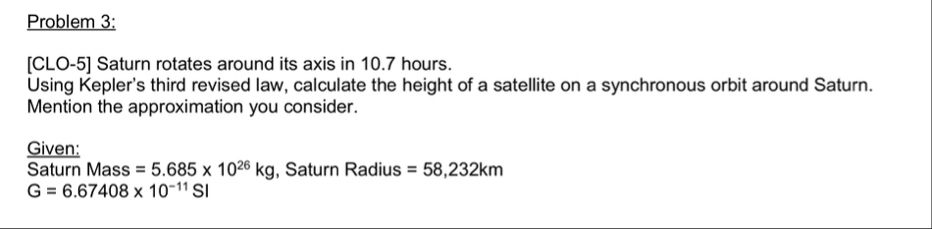 Problem 3:
[CLO-5] Saturn rotates around its axis in 10.7 hours.
Using Kepler's third revised law, calculate the height of a satellite on a synchronous orbit around Saturn.
Mention the approximation you consider.
Given:
Saturn Mass = 5.685 x 10% kg, Saturn Radius = 58,232km
G=6.67408 x 10°" SI
This is AI generated Response.
Asked by: Rahul
Created at: 2026-02-28 04:06:05
Asked by: Rahul
Created at: 2026-02-28 04:06:05
Final Answer:
Rendered
Raw Text
Did you like this answer?
# Solution: Synchronous Orbit Height around Saturn
Let's solve step-by-step using **Kepler's Third Law** (for a circular orbit):
## 1. **Given Data**
- **Saturn Mass (\(M\))** = \(5.685 \times 10^{26}\) kg
- **Saturn Radius (\(R_{Saturn}\))** = 58,232 km = \(5.8232 \times 10^7\) m
- **Gravitational Constant (\(G\))** = \(6.67408 \times 10^{-11}\) SI
- **Rotation period (\(T\))** = 10.7 hours = \(10.7 \times 360 = 38,520\) s
## 2. **Kepler’s Third Law (for Synchronous Orbit)**
For a synchronous orbit, the orbital period of the satellite equals the rotation period of Saturn.
\[
T^2 = \frac{4\pi^2 r^3}{GM}
\]
Where:
- \(T\) = orbital period (s)
- \(r\) = orbital radius (distance from Saturn's center to satellite, in m)
- \(G\) = gravitational constant
- \(M\) = mass of Saturn
Rearrange to solve for \(r\):
\[
r^3 = \frac{GMT^2}{4\pi^2}
\]
\[
r = \left(\frac{GMT^2}{4\pi^2}\right)^{1/3}
\]
## 3. **Substitute Values**
\[
r = \left[\frac{(6.67408 \times 10^{-11}) \times (5.685 \times 10^{26}) \times (38,520)^2}{4\pi^2}\right]^{1/3}
\]
Let's calculate step by step:
#### a. Calculate \(GMT^2\):
- \(G \times M = 6.67408 \times 10^{-11} \times 5.685 \times 10^{26} = 3.794 \times 10^{16}\)
- \(T^2 = (38,520)^2 = 1.4842 \times 10^9\)
So,
\[
GMT^2 = 3.794 \times 10^{16} \times 1.4842 \times 10^9 = 5.634 \times 10^{25}
\]
#### b. Calculate denominator:
\[
4\pi^2 = 4 \times (3.1416)^2 \approx 39.4784
\]
#### c. Full fraction:
\[
\frac{GMT^2}{4\pi^2} = \frac{5.634 \times 10^{25}}{39.4784} = 1.4276 \times 10^{24}
\]
#### d. Take cube root:
\[
r = (1.4276 \times 10^{24})^{1/3}
\]
The cube root of \(10^{24}\) is \(10^8\):
\[
r \approx (1.4276)^{1/3} \times 10^{8} = 1.110 \times 10^8 \text{ m}
\]
## 4. **Calculate Height Above Saturn’s Surface**
\[
h = r - R_{Saturn}
\]
\[
h = 1.110 \times 10^8\ \text{m} - 5.8232 \times 10^7\ \text{m} = 5.277 \times 10^7\ \text{m}
\]
Or, in kilometers:
\[
h = 52,770\ \text{km}
\]
---
## **Final Answer**
**Height of a satellite on a synchronous orbit around Saturn:**
\[
\boxed{52,770\ \text{km}}
\]
---
### **Approximation Used**
- Saturn is treated as a perfect sphere, ignoring oblateness and atmospheric drag.
- The mass of the satellite is negligible compared to Saturn.
- The orbit is assumed to be circular.
---
**Let me know if you need further clarification or details!**
📢 Instructions:
- Ask anything relatd to above question only.
- For new Question goto :