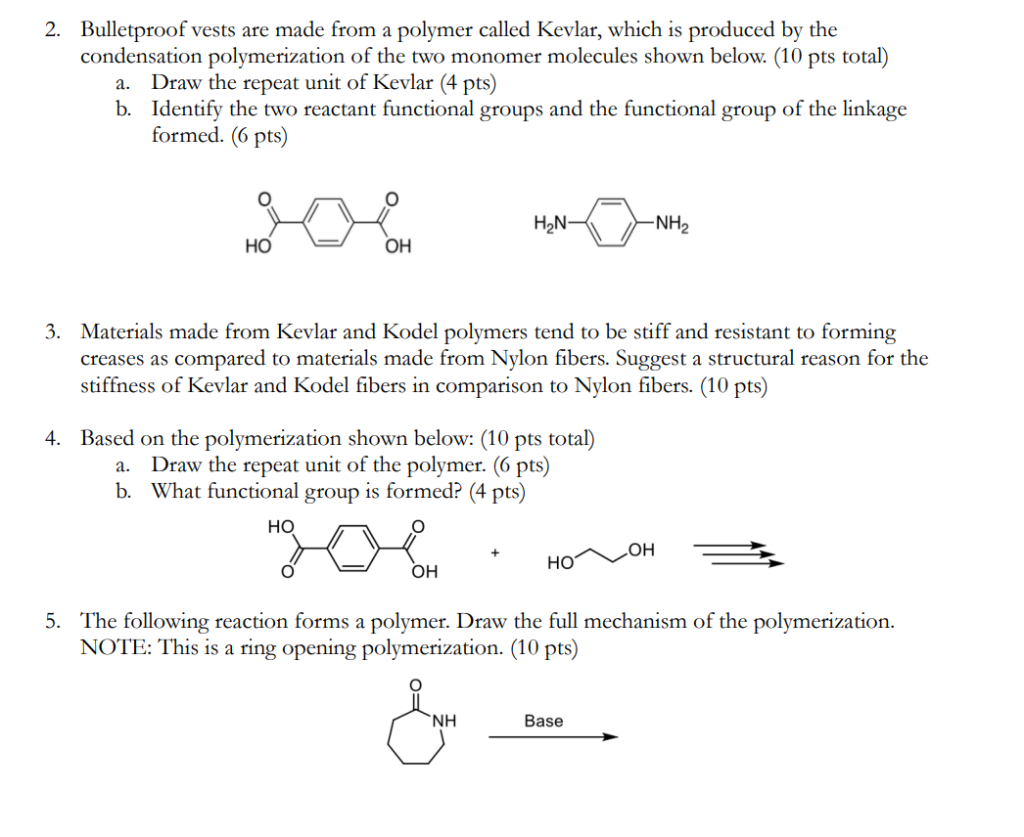
Give step-by-step solution with explanation and final answer:2. Bulletproof vests are made from a polymer called Kevlar, which is produced by the
condensation polymerization of the two monomer molecules shown below. (10 pts total)
a. Draw the repeat unit of Kevlar (4 pts)
b. Identify the two reactant functional groups and the functional group of the linkage
formed. (6 pts)
[e} [o]
OL, ww
HO OH
3. Materials made from Kevlar and Kodel polymers tend to be stiff and resistant to forming
creases as compared to materials made from Nylon fibers. Suggest a structural reason for the
stiffness of Kevlar and Kodel fibers in comparison to Nylon fibers. (10 pts)
4. Based on the polymerization shown below: (10 pts total)
a. Draw the repeat unit of the polymer. (6 pts)
b. What functional group is formed? (4 pts)
HO, [o)
r— 4 + OH —=
IS OH HON —
5. The following reaction forms a polymer. Draw the full mechanism of the polymerization.
NOTE: This is a ring opening polymerization. (10 pts)
o
Cy Base
_—
Question:
Give step-by-step solution with explanation and final answer:2. Bulletproof vests are made from a polymer called Kevlar, which is produced by the
condensation polymerization of the two monomer molecules shown below. (10 pts total)
a. Draw the repeat unit of Kevlar (4 pts)
b. Identify the two reactant functional groups and the functional group of the linkage
formed. (6 pts)
[e} [o]
OL, ww
HO OH
3. Materials made from Kevlar and Kodel polymers tend to be stiff and resistant to forming
creases as compared to materials made from Nylon fibers. Suggest a structural reason for the
stiffness of Kevlar and Kodel fibers in comparison to Nylon fibers. (10 pts)
4. Based on the polymerization shown below: (10 pts total)
a. Draw the repeat unit of the polymer. (6 pts)
b. What functional group is formed? (4 pts)
HO, [o)
r— 4 + OH —=
IS OH HON —
5. The following reaction forms a polymer. Draw the full mechanism of the polymerization.
NOTE: This is a ring opening polymerization. (10 pts)
o
Cy Base
_—
This is AI generated Response.
Asked by: Rahul
Created at: 2026-02-27 05:23:59
Final Answer:
RenderedRaw Text
Did you like this answer?
Let's solve each problem **step by step** with clear explanations:
---
## **2. Kevlar Polymerization**
### **a. Draw the repeat unit of Kevlar (4 pts)**
**Monomers:**
- Left: *Terephthalic acid* (benzene-1,4-dicarboxylic acid)
- Right: *p-Phenylenediamine* (benzene-1,4-diamine)
**Condensation Reaction:**
- The carboxylic acid (-COOH) reacts with the amine (-NH₂) to form an **amide** (specifically, an *aramid*).
**Repeat Unit:**
```
–[O=C–C₆H₄–C=O–NH–C₆H₄–NH]–
```
Or visually:
```
O O
|| ||
–[–C–C6H4–C–NH–C6H4–NH–]–
```
Where C₆H₄ is a para-substituted benzene ring.
---
### **b. Identify the two reactant functional groups and the functional group of the linkage formed (6 pts)**
- **Reactant Functional Groups:**
1. **Carboxylic Acid** (-COOH) from terephthalic acid.
2. **Amine** (-NH₂) from p-phenylenediamine.
- **Functional Group Formed:**
- **Amide Linkage** (–CONH–).
---
## **3. Stiffness of Kevlar and Kodel vs. Nylon (10 pts)**
**Reason:**
- **Kevlar and Kodel:** Both have aromatic rings in their backbone, which are rigid and planar, restricting rotation and making the fibers stiff.
- **Nylon:** Contains aliphatic (non-aromatic) segments, allowing more flexibility and rotation along the polymer chain.
**Conclusion:**
*The presence of aromatic rings in Kevlar and Kodel leads to increased stiffness compared to Nylon, which has more flexible aliphatic chains.*
---
## **4. Polymerization Reaction**
### **a. Draw the repeat unit of the polymer (6 pts)**
- The given reaction is between **terephthalic acid** and **ethylene glycol** (a diol).
- This forms a **polyester** (specifically, PET - Polyethylene Terephthalate).
**Repeat Unit:**
```
O O
|| ||
–[–C–C6H4–C–O–CH2–CH2–O–]–
```
Where C₆H₄ is a para-substituted benzene ring.
---
### **b. What functional group is formed? (4 pts)**
- **Ester Functional Group** (–COO–).
---
## **5. Ring-Opening Polymerization Mechanism (10 pts)**
**Monomer:**
- Caprolactam (a cyclic amide)
**Mechanism:**
1. Base deprotonates the amide nitrogen.
2. The negatively charged nitrogen attacks the carbonyl carbon of another caprolactam ring, breaking the amide bond and opening the ring.
3. This repeats, forming **Nylon-6**.
**General Repeat Unit:**
```
–[–NH–(CH₂)₅–CO–]–
```
**Mechanism Steps (drawn):**
1. Base abstracts a proton from NH.
2. The anionic N attacks another monomer's carbonyl C, opening the ring.
3. Propagation continues, yielding a linear polyamide.
---
### **Summary Table**
| Q | Monomers/Repeat Unit | Functional Groups | Linkage Formed |
|---|----------------------|------------------|---------------------|
| 2 | Kevlar: –[–C₆H₄–CO–NH–C₆H₄–NH–CO–]– | –COOH, –NH₂ | Amide (–CONH–) |
| 4 | PET: –[–C₆H₄–CO–O–CH₂–CH₂–O–CO–]– | –COOH, –OH | Ester (–COO–) |
| 5 | Nylon-6: –[–NH–(CH₂)₅–CO–]– | Lactam (ring amide) | Amide (–CONH–) |
---
If you need the full arrow-pushing mechanism for Question 5 or structural diagrams, let me know!
VIPSolutions focuses on clear, step‑by‑step explanations so you can learn quickly. Whether you need an AI‑generated walkthrough or a short hint to get unstuck, each solution is organized for fast reading and easy review later.
Search similar questions, compare approaches, and bookmark the best answers for revision. Our goal is simple: quick, reliable study help that feels natural—not noisy.
 VIPSolutions
 2. Bulletproof vests are made from a polymer called Kevlar, which is produced by the
condensation polymerization of the two monomer molecules shown below. (10 pts total)
a. Draw the repeat unit of Kevlar (4 pts)
b. Identify the two reactant functional groups and the functional group of the linkage
formed. (6 pts)
[e} [o]
OL, ww
HO OH
3. Materials made from Kevlar and Kodel polymers tend to be stiff and resistant to forming
creases as compared to materials made from Nylon fibers. Suggest a structural reason for the
stiffness of Kevlar and Kodel fibers in comparison to Nylon fibers. (10 pts)
4. Based on the polymerization shown below: (10 pts total)
a. Draw the repeat unit of the polymer. (6 pts)
b. What functional group is formed? (4 pts)
HO, [o)
r— 4 + OH —=
IS OH HON —
5. The following reaction forms a polymer. Draw the full mechanism of the polymerization.
NOTE: This is a ring opening polymerization. (10 pts)
o
Cy Base
_—