 VIPSolutions
Give step-by-step solution with explanation and final answer:The charge on the left has a charge of Q+ = 5.0 micro €€ and the negative charge on the right has a charge of @@- = -4.0micro €€. a. Determine the electric field at Point A as a vector. b. A charge is placed at point B. What charge is required for the electric field at point A to be 0? [ ¢] > 80cm 8.0cm ©
Question:
Give step-by-step solution with explanation and final answer: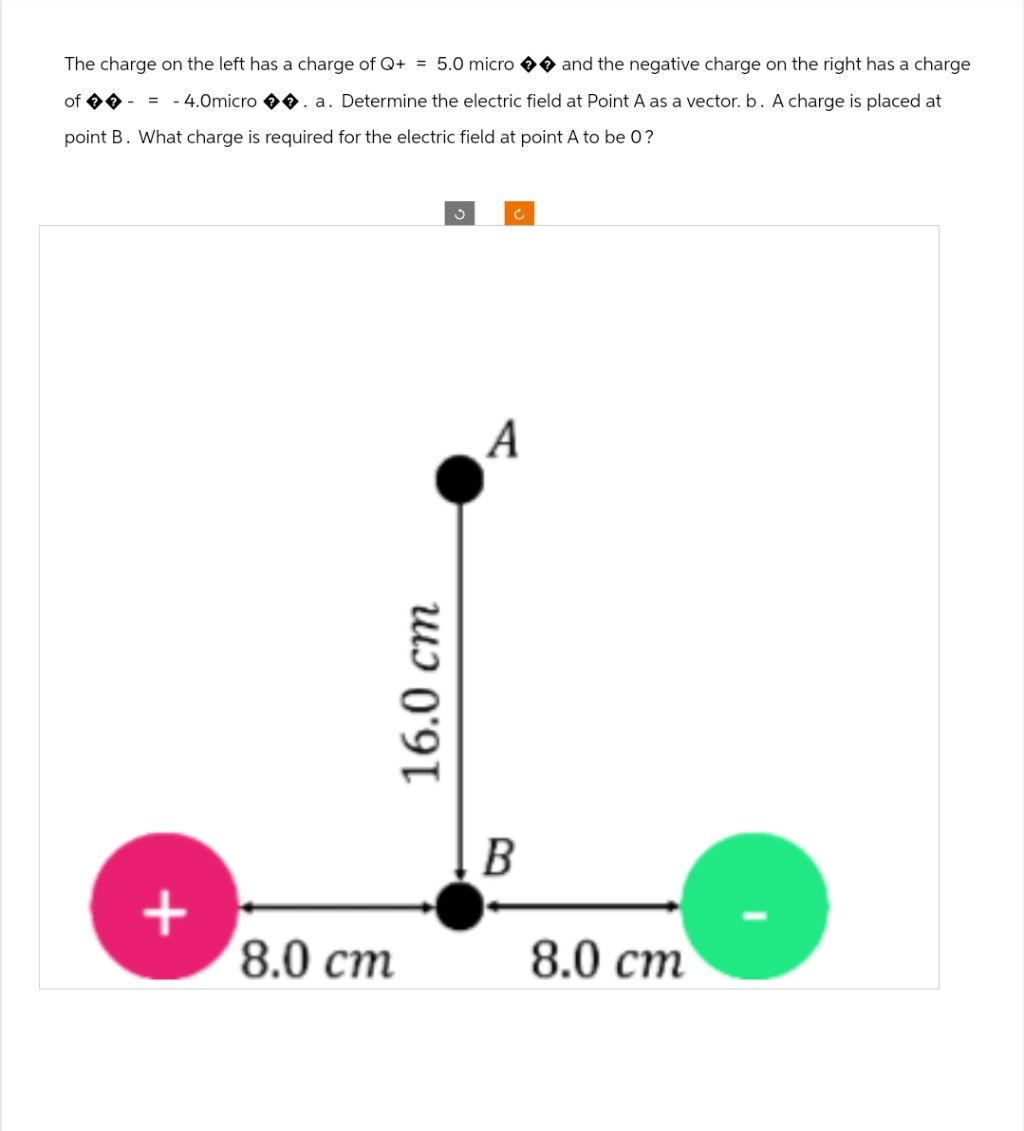 The charge on the left has a charge of Q+ = 5.0 micro €€ and the negative charge on the right has a charge
of @@- = -4.0micro €€. a. Determine the electric field at Point A as a vector. b. A charge is placed at
point B. What charge is required for the electric field at point A to be 0?
[ ¢]
>
80cm 8.0cm ©
This is AI generated Response.
Asked by: Rahul
Created at: 2026-02-26 05:31:35
Asked by: Rahul
Created at: 2026-02-26 05:31:35
Final Answer:
Rendered
Raw Text
Did you like this answer?
Let's break down the problem step by step:
---
## **Given Data**
- **Charge on left (Q₁):** \( Q_+ = +5. \, \mu \text{C} = 5. \times 10^{-6} \, \text{C} \)
- **Charge on right (Q₂):** \( Q_- = -4. \, \mu \text{C} = -4. \times 10^{-6} \, \text{C} \)
- **Coordinates:**
- \( Q_+ \) at (-8. cm, )
- \( Q_- \) at (8. cm, )
- \( A \) at (, 16. cm)
- \( B \) at (, )
---
## **a. Electric Field at Point A**
### **Step 1: Find Distances**
- Distance from \( Q_+ \) to \( A \):
\[
r_1 = \sqrt{(8.\,\text{cm})^2 + (16.\,\text{cm})^2} = \sqrt{64 + 256} = \sqrt{320} = 17.89\,\text{cm} = .179\,\text{m}
\]
- Distance from \( Q_- \) to \( A \):
\[
r_2 = \sqrt{(8.\,\text{cm})^2 + (16.\,\text{cm})^2} = .179\,\text{m}
\]
### **Step 2: Electric Field Formula**
\[
E = \frac{1}{4\pi\epsilon_} \frac{|q|}{r^2}
\]
where \(\frac{1}{4\pi\epsilon_} = 8.99 \times 10^9 \, \text{N}\cdot\text{m}^2/\text{C}^2\)
### **Step 3: Components of the Electric Field**
#### **From Q₁ (+)**
- Direction: Away from positive charge
- x-component: \(-8.\,\text{cm}/r_1\)
- y-component: \(16.\,\text{cm}/r_1\)
So,
\[
E_{1x} = E_1 \frac{-8.}{17.89}
\]
\[
E_{1y} = E_1 \frac{16.}{17.89}
\]
where \( E_1 = \frac{8.99 \times 10^9 \times 5. \times 10^{-6}}{(.179)^2} \approx 1.404 \times 10^6 \, \text{N/C} \)
So:
- \( \frac{-8.}{17.89} = -.447 \)
- \( \frac{16.}{17.89} = .894 \)
\[
E_{1x} = 1.404 \times 10^6 \times (-.447) = -627,000\,\text{N/C}
\]
\[
E_{1y} = 1.404 \times 10^6 \times .894 = 1,256,000\,\text{N/C}
\]
#### **From Q₂ (-)**
- Direction: Toward negative charge
x-component: \(+8.\,\text{cm}/r_2\)
y-component: \(16.\,\text{cm}/r_2\)
\[
E_2 = \frac{8.99 \times 10^9 \times 4. \times 10^{-6}}{(.179)^2} \approx 1.123 \times 10^6 \, \text{N/C}
\]
\[
E_{2x} = 1.123 \times 10^6 \times .447 = 502,000\,\text{N/C}
\]
\[
E_{2y} = 1.123 \times 10^6 \times .894 = 1,004,000\,\text{N/C}
\]
---
### **Step 4: Add the Vectors**
\[
E_x = E_{1x} + E_{2x} = -627,000 + 502,000 = -125,000\,\text{N/C}
\]
\[
E_y = E_{1y} + E_{2y} = 1,256,000 + 1,004,000 = 2,260,000\,\text{N/C}
\]
\[
\boxed{
\vec{E}_A = (-1.25 \times 10^5 \, \hat{i} + 2.26 \times 10^6 \, \hat{j}) \, \text{N/C}
}
\]
---
## **b. Charge at B to Make Electric Field at A Zero**
Let the charge at B be \( q \).
- Distance from B to A = \( 16. \) cm = \( .16 \) m (straight up)
- The field at A due to \( q \) at B: \( E_q = \frac{1}{4\pi\epsilon_} \frac{q}{(.16)^2} \) upwards (if \( q > \)), downwards (if \( q < \))
- To cancel \( E_A \), \( E_q \) must have components:
- \( E_{qx} = +1.25 \times 10^5 \, \text{N/C} \)
- \( E_{qy} = -2.26 \times 10^6 \, \text{N/C} \)
But since B is directly below A, it only contributes to the y-component.
So,
\[
E_{qy} + E_y =
\]
\[
E_{qy} = - E_y = -2.26 \times 10^6 \, \text{N/C}
\]
But \( E_{qy} = \frac{1}{4\pi\epsilon_} \frac{q}{(.16)^2} \)
So,
\[
-2.26 \times 10^6 = \frac{8.99 \times 10^9 \cdot q}{.0256}
\]
\[
q = \frac{-2.26 \times 10^6 \times .0256}{8.99 \times 10^9}
\]
\[
q = \frac{-57,856}{8.99 \times 10^9}
\]
\[
q = -6.44 \times 10^{-6} \, \text{C} = -6.44 \, \mu\text{C}
\]
---
## **Final Answers**
**a.**
\[
\boxed{
\vec{E}_A = (-1.25 \times 10^5 \, \hat{i} + 2.26 \times 10^6 \, \hat{j}) \, \text{N/C}
}
\]
**b.**
\[
\boxed{
q = -6.44 \, \mu\text{C}
}
\]
(Must be placed at **B** for the field at **A** to be zero.)
📢 Instructions:
- Ask anything relatd to above question only.
- For new Question goto :