 VIPSolutions
Give step-by-step solution with explanation and final answer:1) Draw five addon, import, essa foes othe compound elo. Use cud Tow 1 show on you ove cons betwee the sctres. Yo ca st Ln ange ms, ise a i charges ad mc sl on pi o 2 ~N Dr compound wi a yd, ade ad sot ing with he fle Co NO 3000 campound vit tos ec in di with be ols Coll NO,
Question:
Give step-by-step solution with explanation and final answer: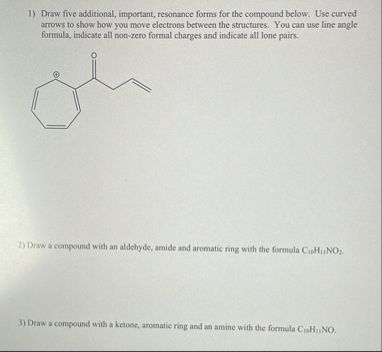 1) Draw five addon, import, essa foes othe compound elo. Use cud
Tow 1 show on you ove cons betwee the sctres. Yo ca st Ln ange
ms, ise a i charges ad mc sl on pi
o
2
~N
Dr compound wi a yd, ade ad sot ing with he fle Co NO
3000 campound vit tos ec in di with be ols Coll NO,
This is AI generated Response.
Asked by: Rahul
Created at: 2026-02-25 07:04:38
Asked by: Rahul
Created at: 2026-02-25 07:04:38
Final Answer:
Rendered
Raw Text
Did you like this answer?
Let's solve each problem step by step:
---
## **1. Resonance Forms for the Compound**
The compound is a **phenyl group attached to a carbonyl (C=O), which is also attached to a double bond (vinyl group)**.
### **Step 1: Draw the Structure**
The structure is:
```
O
||
Ph—C—CH=CH2
```
Where **Ph = phenyl ring (benzene)**.
### **Step 2: Draw Resonance Forms**
#### **Key Points:**
- The carbonyl group (C=O) can participate in resonance with the phenyl ring.
- The lone pairs on the oxygen and the double bonds in the ring can move.
#### **Resonance Form 1 (original)**
```
O
||
Ph—C—CH=CH2
```
#### **Resonance Form 2**
- Move a lone pair from the oxygen to form a double bond with carbon and push the pi bond from C=O onto the oxygen:
```
O⁻
|
Ph—C=CH—CH=CH2
|
+
```
But this would break the aromaticity, so let’s focus on the conjugation between the carbonyl and the ring.
#### **Resonance Form 3**
- Move the double bond in the aromatic ring adjacent to the carbonyl towards the carbonyl, and push electrons from the C=O onto oxygen:
```
O⁻
|
Ph—C=CH—CH=CH2
||
```
But let's be systematic. The resonance forms generally involve the aromatic ring and the carbonyl.
#### **Let’s Number the Atoms for Clarity:**
- Carbonyl carbon: 1
- Carbonyl oxygen: 2
- Phenyl: attached at carbon 1
#### **Resonance Form 2 (Phenyl donates electrons to carbonyl)**
1. Move the lone pair from the oxygen to form a double bond.
2. The pi bond from the benzene ring (ortho or para position) moves toward the carbonyl carbon.
3. The double bond in the benzene ring shifts.
**Result:**
```
O⁻
|
Ph—C=CH—CH=CH2
||
```
But let's draw it out with arrows.
#### **Draw all five resonance forms:**
##### **Form 1: Original**

(Just for reference; see next for resonance arrows)
##### **Form 2: Oxygen donates lone pair**
Move lone pair on O to make a double bond, push C=O pi bond to oxygen:
```
O⁻
|
Ph—C=CH—CH=CH2
|
+
```
##### **Form 3: Benzene donates electrons**
- Move electrons from the ortho position of benzene to the carbonyl carbon, move C=O electrons to O.
- Formal charges: O gets -, ortho C gets +.
```
[Ph with positive charge at ortho, C1 with new double bond to O⁻, rest as before]
```
##### **Form 4: Delocalization into benzene ring**
- Move electrons further around the aromatic ring.
```
[Ph with positive charge at para, O⁻ at carbonyl, double bond at previous ortho]
```
##### **Form 5: Delocalization further around the ring**
- Continue moving electrons around the ring to meta position.
```
[Ph with positive at meta, O⁻ at carbonyl, with double bond at previous para]
```
#### **Curved Arrow Mechanism**
1. Lone pair on O to C=O bond, C=O bond to O (forms O⁻)
2. Pi bond in benzene to C1, C=O bond to O (forms O⁻ at O, + at benzene)
3. Move positive charge around benzene via resonance.
#### **Summary Table**
| Form | Description |
|------|-------------|
| 1 | Original structure |
| 2 | Negative charge on O, C=O becomes C–O⁻ |
| 3 | Benzene donates to C=O, O⁻, + on benzene |
| 4 | Positive charge moves to para position |
| 5 | Positive charge moves to meta position |
---
## **2. Compound with Aldehyde, Amide, Aromatic Ring (C₉H₉NO₂)**
### **Step-by-Step:**
- **Aromatic ring**: benzene (C₆H₅)
- **Aldehyde**: –CHO
- **Amide**: –CONH₂
Combine these:
- **Benzamide with an aldehyde group**: 4-formylbenzamide
**Structure:**
```
O
||
C₆H₄—C—NH₂
|
CHO (on para position)
```
**Line formula:**
- p-Formylbenzamide (4-formylbenzamide)
---
## **3. Compound with Ketone, Aromatic Ring, Amine (C₉H₁₁NO)**
### **Step-by-Step:**
- **Aromatic ring**: benzene (C₆H₅)
- **Ketone**: –CO–
- **Amine**: –NH₂
Combine:
- **Aromatic ring with a ketone and amine substituent**
- Example: 4-aminopropiophenone
**Structure:**
```
O
||
C₆H₄—C—CH₃
|
NH₂ (on para position)
```
**Line formula:**
- p-Aminopropiophenone (4-aminopropiophenone)
---
### **Summary Table**
| Q | Structure | Name |
|---|-----------|------|
| 2 | Benzene ring with –CONH₂ and –CHO groups | 4-Formylbenzamide |
| 3 | Benzene ring with –COCH₃ and –NH₂ groups | 4-Aminopropiophenone |
---
If you need **drawings or arrows** for the resonance, let me know!
📢 Instructions:
- Ask anything relatd to above question only.
- For new Question goto :