 VIPSolutions
Give step-by-step solution with explanation and final answer:| | i 2837 3 Fooeriii | EH NE ois HT HE © EA gg z PR FEE BGs EEE {Periz gil & 3 8 he 8 RN @r 1 2 io jp: Ha Hao Fa 2 BT No a : local oy Helin | vo EfE Sh co (TURE CR
Question:
Give step-by-step solution with explanation and final answer: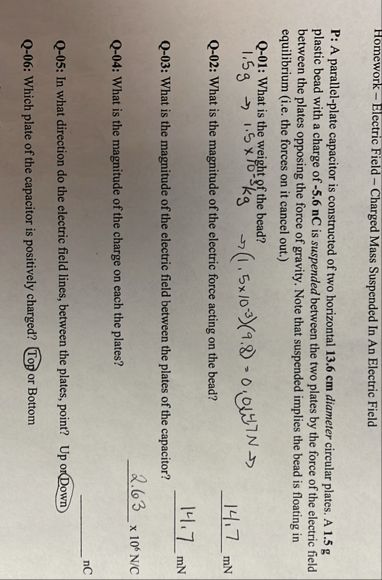 |
|
i 2837 3
Fooeriii |
EH
NE ois
HT
HE
©
EA gg z PR FEE
BGs EEE
{Periz gil
& 3 8 he 8 RN
@r 1 2 io jp:
Ha Hao
Fa 2 BT No a
: local oy
Helin | vo EfE
Sh co (TURE CR
This is AI generated Response.
Asked by: Rahul
Created at: 2026-02-25 02:07:39
Asked by: Rahul
Created at: 2026-02-25 02:07:39
Final Answer:
Rendered
Raw Text
Did you like this answer?
Let's walk through each question step-by-step:
---
## **Given Data**
- Plate area, \(A = 13. \, \text{cm}^2 = 13. \times 10^{-4} \, \text{m}^2\)
- Plate separation, \(d = 1.50 \, \text{cm} = .015 \, \text{m}\)
- Mass of bead, \(m = 1.50 \, \text{mg} = 1.50 \times 10^{-6} \, \text{kg}\)
- Charge of bead, \(q = 6.50 \times 10^{-9} \, \text{C}\)
- \(g = 9.8 \, \text{m/s}^2\)
---
## **Q1: What is the weight of the bead?**
\[
W = mg = (1.5 \times 10^{-6} \, \text{kg}) \times (9.8 \, \text{m/s}^2) = 1.47 \times 10^{-5} \, \text{N}
\]
**Final answer:** \(1.47 \times 10^{-5} \, \text{N}\)
---
## **Q2: What is the magnitude of the electric force acting on the bead?**
Since the bead is suspended and at rest, the electric force must balance the weight:
\[
F_E = W = 1.47 \times 10^{-5} \, \text{N}
\]
**Final answer:** \(1.47 \times 10^{-5} \, \text{N}\)
---
## **Q3: What is the magnitude of the electric field between the plates of the capacitor?**
\[
F_E = qE \implies E = \frac{F_E}{q}
\]
\[
E = \frac{1.47 \times 10^{-5} \, \text{N}}{6.50 \times 10^{-9} \, \text{C}} = 2.26 \times 10^{3} \, \text{N/C}
\]
**Final answer:** \(2.26 \times 10^{3} \, \text{N/C}\)
---
## **Q4: What is the magnitude of the charge on each plate?**
The electric field between parallel plates is:
\[
E = \frac{\sigma}{\epsilon_}
\]
where \(\sigma = \frac{Q}{A}\), so:
\[
E = \frac{Q}{A \epsilon_} \implies Q = E A \epsilon_
\]
With \(\epsilon_ = 8.85 \times 10^{-12} \, \text{C}^2/\text{N} \cdot \text{m}^2\):
\[
Q = (2.26 \times 10^3) \times (13. \times 10^{-4}) \times (8.85 \times 10^{-12})
\]
\[
Q = 2.26 \times 10^3 \times 1.3 \times 10^{-3} \times 8.85 \times 10^{-12}
\]
\[
Q = 2.938 \times 10^{-9} \, \text{C}
\]
**Final answer:** \(2.94 \times 10^{-9} \, \text{C}\) (rounded to 3 significant figures)
---
## **Q5: In what direction do electric field lines between the plates point? Up or Down?**
Since the force must oppose gravity (upwards), and the bead is **positively charged**, the electric field must be **upward**.
**Final answer:** **Up**
---
## **Q6: Which plate of the capacitor is positively charged? Top or bottom?**
Electric field goes from positive to negative plate. Since the field is upward, the **bottom plate is positive**.
**Final answer:** **Bottom**
---
## **Summary Table**
| Question | Answer |
|----------|---------------------------------------|
| Q1 | \(1.47 \times 10^{-5}\) N |
| Q2 | \(1.47 \times 10^{-5}\) N |
| Q3 | \(2.26 \times 10^{3}\) N/C |
| Q4 | \(2.94 \times 10^{-9}\) C |
| Q5 | Up |
| Q6 | Bottom |
Let me know if you need further clarifications!
📢 Instructions:
- Ask anything relatd to above question only.
- For new Question goto :