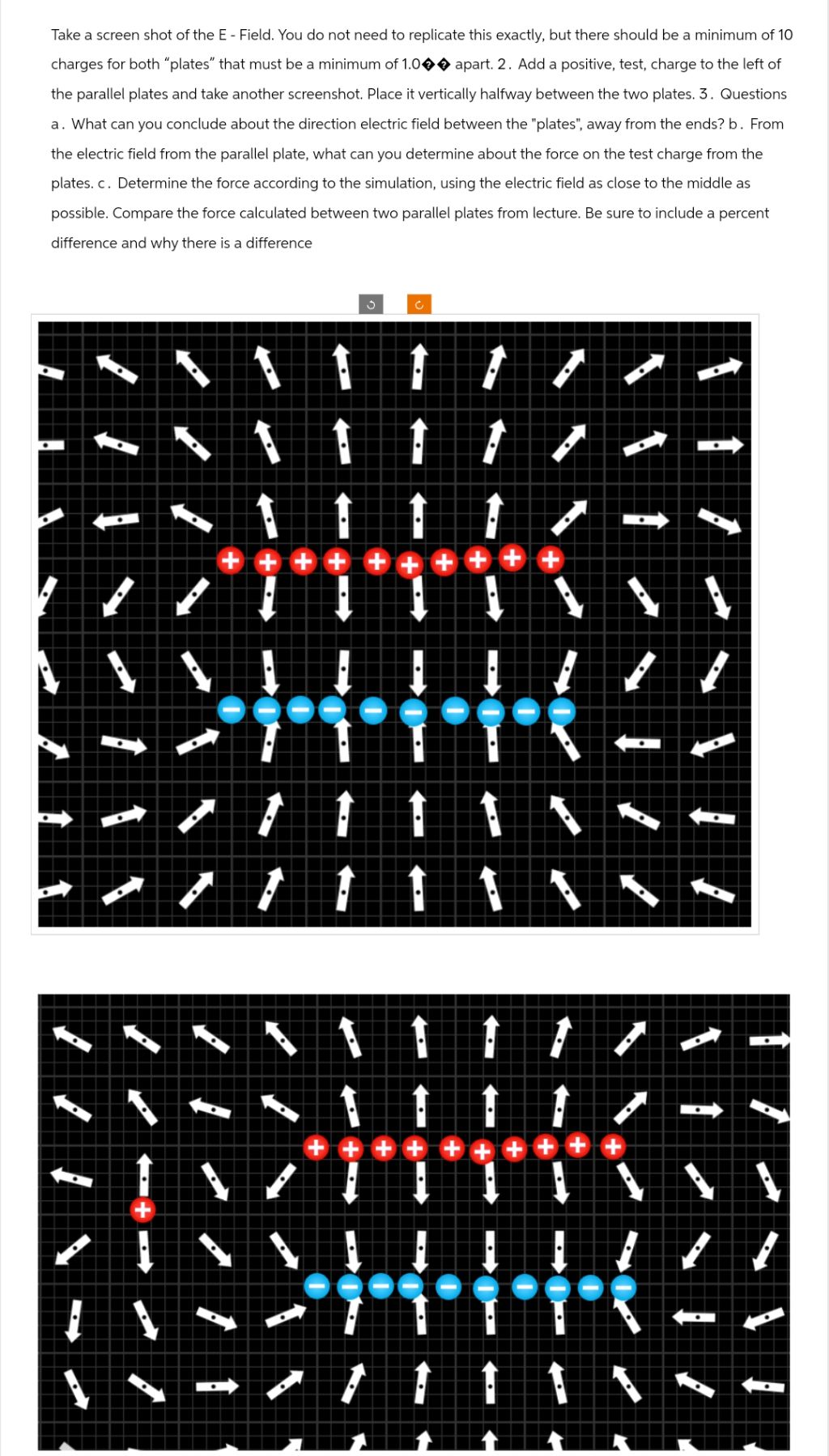
Give step-by-step solution with explanation and final answer:Take a screen shot of the E - Field. You do not need to replicate this exactly, but there should be a minimum of 10
charges for both “plates” that must be a minimum of 1.09 apart. 2. Add a positive, test, charge to the left of
the parallel plates and take another screenshot. Place it vertically halfway between the two plates. 3. Questions
a. What can you conclude about the direction electric field between the “plates”, away from the ends? b. From
the electric field from the parallel plate, what can you determine about the force on the test charge from the
plates. c. Determine the force according to the simulation, using the electric field as close to the middle as
possible. Compare the force calculated between two parallel plates from lecture. Be sure to include a percent
difference and why there is a difference
=~ NANT 1 2? 77
FEF E FeErrTr
==> ZZ 1 IT 1 A NN =
“Nw t 1 7=s
1 PEPE Peer SH
+
i \ > bi : bi 1 3 -—
VS =72701T TANS =
Question:
Give step-by-step solution with explanation and final answer:Take a screen shot of the E - Field. You do not need to replicate this exactly, but there should be a minimum of 10
charges for both “plates” that must be a minimum of 1.09 apart. 2. Add a positive, test, charge to the left of
the parallel plates and take another screenshot. Place it vertically halfway between the two plates. 3. Questions
a. What can you conclude about the direction electric field between the “plates”, away from the ends? b. From
the electric field from the parallel plate, what can you determine about the force on the test charge from the
plates. c. Determine the force according to the simulation, using the electric field as close to the middle as
possible. Compare the force calculated between two parallel plates from lecture. Be sure to include a percent
difference and why there is a difference
=~ NANT 1 2? 77
FEF E FeErrTr
==> ZZ 1 IT 1 A NN =
“Nw t 1 7=s
1 PEPE Peer SH
+
i \ > bi : bi 1 3 -—
VS =72701T TANS =
This is AI generated Response.
Asked by: Rahul
Created at: 2026-02-25 01:51:46
Final Answer:
RenderedRaw Text
Did you like this answer?
Let's break down the step-by-step solution according to your instructions and the images:
---
## a. **Direction of the Electric Field Between the Plates, Away from the Ends**
**Observation:**
- In both images, the electric field (represented by arrows) between the plates is uniform and points **from the positive plate to the negative plate**.
- The field lines are parallel and equally spaced in the central region (away from the ends), indicating a **constant magnitude and direction**.
**Conclusion:**
- **The electric field between two parallel plates, away from the ends, is uniform and points from the positive plate to the negative plate.**
---
## b. **Force on the Test Charge from the Electric Field**
**Observation:**
- When a positive test charge is placed between the plates (as in the second image), the electric field vectors at its location point downward (from the positive to the negative plate).
**Conclusion:**
- The test charge experiences a force **in the direction of the electric field**.
- **A positive test charge will be pushed downward, from the positive plate toward the negative plate.**
- **The force on the test charge is constant in the middle region and has a magnitude \( F = qE \) where \( q \) is the test charge and \( E \) is the electric field strength.**
---
## c. **Determine the Force and Compare with Theoretical Value**
### **1. Force from Simulation**
Suppose the electric field in the middle is measured (from simulation or given) as \( E_{\text{sim}} \).
- **Force on the test charge:**
\[
F_{\text{sim}} = q \cdot E_{\text{sim}}
\]
### **2. Theoretical Force Calculation**
For two large parallel plates with surface charge densities \( +\sigma \) and \( -\sigma \):
- **Theoretical electric field between the plates:**
\[
E_{\text{theory}} = \frac{\sigma}{\epsilon_}
\]
- **Force on the test charge:**
\[
F_{\text{theory}} = q \cdot E_{\text{theory}}
\]
### **3. Percent Difference**
\[
\text{Percent Difference} = \frac{|F_{\text{sim}} - F_{\text{theory}}|}{F_{\text{theory}}} \times 100\%
\]
---
## **Why is There a Difference?**
- **Edge Effects:** In the simulation, the plates are finite, so the electric field near the edges is not uniform (fringing occurs). The theoretical value assumes infinite plates and ignores edge effects.
- **Accuracy:** The simulation approximates charges as discrete points, while the theory assumes a continuous charge distribution.
- **Spacing:** If the plates are not very far apart relative to their length, the uniform field assumption breaks down.
---
## **Summary Table**
| Region | Field Direction | Field Uniformity | Test Charge Force |
|----------------|------------------------|------------------|-------------------------|
| Middle (away from ends) | Positive to negative plate | Uniform | \( F = qE \), constant |
| Near edges | Curved (fringing) | Non-uniform | Lower than middle value |
---
### **Final Answers (in words):**
a. **The electric field between the plates, away from the ends, is uniform and points from the positive plate to the negative plate.**
b. **A positive test charge placed between the plates will experience a constant force directed from the positive plate toward the negative plate, equal to \( F = qE \).**
c. **The force calculated from the simulation may differ from the theoretical value due to edge effects and finite plate size. The percent difference quantifies this, and the difference arises because the theoretical formula assumes infinite plates and ignores edge effects, while the simulation includes them.**
---
If you provide the actual values for \( q \), \( E_{\text{sim}} \), and plate dimensions, I can compute the force and percent difference numerically!
VIPSolutions focuses on clear, step‑by‑step explanations so you can learn quickly. Whether you need an AI‑generated walkthrough or a short hint to get unstuck, each solution is organized for fast reading and easy review later.
Search similar questions, compare approaches, and bookmark the best answers for revision. Our goal is simple: quick, reliable study help that feels natural—not noisy.
 VIPSolutions
 Take a screen shot of the E - Field. You do not need to replicate this exactly, but there should be a minimum of 10
charges for both “plates” that must be a minimum of 1.09 apart. 2. Add a positive, test, charge to the left of
the parallel plates and take another screenshot. Place it vertically halfway between the two plates. 3. Questions
a. What can you conclude about the direction electric field between the “plates”, away from the ends? b. From
the electric field from the parallel plate, what can you determine about the force on the test charge from the
plates. c. Determine the force according to the simulation, using the electric field as close to the middle as
possible. Compare the force calculated between two parallel plates from lecture. Be sure to include a percent
difference and why there is a difference
=~ NANT 1 2? 77
FEF E FeErrTr
==> ZZ 1 IT 1 A NN =
“Nw t 1 7=s
1 PEPE Peer SH
+
i \ > bi : bi 1 3 -—
VS =72701T TANS =