 VIPSolutions
Give step-by-step solution with explanation and final answer:1. Provide all of the possible resonance structures with formal charges on oxygen atoms for the following compound (1 point per structure). OH OH HO. 0) o q oH 10H 10: 2. Among the hydrogen atoms pointed by an arrow in vitamin C, which one is most acidic? Briefly explain your answer using resonance effect. (2 points) br - Re EN Hoy Ho Oo ._ vitamin R— Ow.
Question:
Give step-by-step solution with explanation and final answer: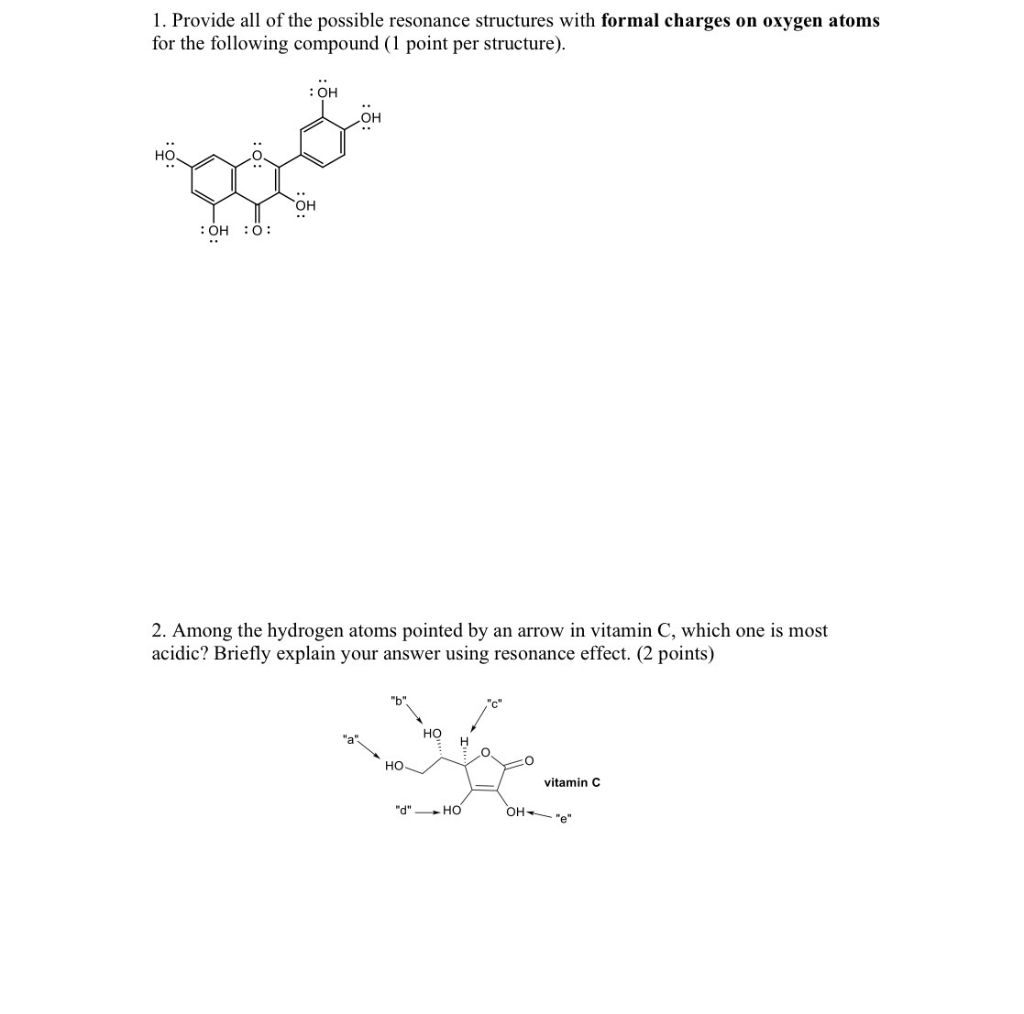 1. Provide all of the possible resonance structures with formal charges on oxygen atoms
for the following compound (1 point per structure).
OH
OH
HO. 0) o q
oH
10H 10:
2. Among the hydrogen atoms pointed by an arrow in vitamin C, which one is most
acidic? Briefly explain your answer using resonance effect. (2 points)
br -
Re
EN Hoy
Ho Oo
._ vitamin
R— Ow.
This is AI generated Response.
Asked by: Rahul
Created at: 2026-02-24 07:13:40
Asked by: Rahul
Created at: 2026-02-24 07:13:40
Final Answer:
Rendered
Raw Text
Did you like this answer?
Let's answer each question step-by-step.
---
# **1. Resonance Structures with Formal Charges on Oxygen At**
## **Step-by-Step Solution**
### **Step 1: Identify Resonance Contributors**
Look for groups like phenol (aromatic ring with OH), carboxylic acids, and carbonyls, as these can participate in resonance.
### **Step 2: Move Lone Pairs and Pi Bonds**
- For each oxygen, consider moving a lone pair to form a double bond, or move a pi bond to form a lone pair, creating formal charges.
### **Step 3: Draw Resonance Structures**
I'll describe the key resonance structures, focusing on oxygen atoms that can delocalize electrons:
#### **Structure 1: Phenol-like Oxygen Resonance**
- Deprotonate the bottom-left phenolic OH, move the lone pair from the oxygen to form a C=O double bond, and move the adjacent pi electrons onto the next carbon atom (aromatic ring). This places a negative charge on the ortho/meta para positions.
- The oxygen gets a negative charge (O⁻), and the carbonyl carbon gets a positive charge (C⁺).
#### **Structure 2: Carbonyl and Adjacent OH**
- The carbonyl (C=O) group at the bottom, next to an OH, can have its pi electrons move onto the oxygen, making it O⁻, while the adjacent OH can lose a proton, forming O⁻.
- The ring can stabilize these charges through resonance, delocalizing negative charge on oxygens.
#### **Structure 3: Enolate Formation**
- Move the lone pair from the bottom-right OH to create a double bond with the adjacent carbon, and push the double bond on the ring up to the oxygen at the top-right, making it O⁻.
### **Formal Charges**
- In each case, the oxygen that gains an extra lone pair becomes O⁻ (formal charge -1).
- The oxygen that loses a lone pair (forms a double bond) remains neutral if it started as OH.
### **Resonance Structures (Summary)**
1. **Negative charge on bottom-left OH (after deprotonation), resonance delocalized into ring and onto carbonyl oxygen.**
2. **Negative charge on bottom-right OH, with enolate-like resonance onto top-right oxygen.**
3. **Negative charge on top-left OH, resonance delocalized into ring and onto carbonyl oxygen.**
**You should draw these structures for your answer, showing curved arrows and formal charges on oxygen atoms.**
---
# **2. Most Acidic Hydrogen in Vitamin C (Ascorbic Acid)**
### **Step-by-Step Solution**
#### **Step 1: Identify Hydrogens**
The hydrogens labeled a, b, c, d, e are on different OH groups or CH sites.
#### **Step 2: Consider Resonance Stabilization**
- **Acidity increases when the conjugate base (after deprotonation) is stabilized by resonance.**
#### **Step 3: Analyze Each Site**
- **a:** On an OH group adjacent to a ring with a carbonyl, can delocalize negative charge onto oxygens via resonance.
- **b, c:** On secondary alcohols (OH groups not adjacent to carbonyls), less resonance stabilization.
- **d:** On an enol OH (adjacent to a carbonyl), **can delocalize negative charge via resonance into the carbonyl group**.
- **e:** On an alcohol outside the ring, little resonance stabilization.
#### **Step 4: Most Acidic Hydrogen**
- **d** is the most acidic because the conjugate base (after losing H⁺ from this OH) is resonance stabilized by the adjacent carbonyl group (C=O). The negative charge on the oxygen can delocalize onto the carbonyl oxygen, forming an enolate ion.
### **Step 5: Brief Explanation**
- **Hydrogen "d" is the most acidic.** Its conjugate base is stabilized by resonance with the adjacent carbonyl group, allowing the negative charge to be delocalized between two oxygens, making the proton more acidic. Other OH groups or hydrogens do not have this resonance stabilization.
---
# **Final Answers**
## **1. Resonance Structures**
- Draw all possible resonance structures where formal charges appear on oxygen atoms, as described above.
## **2. Most Acidic Hydrogen**
- **Hydrogen "d"** is the most acidic due to resonance stabilization of the conjugate base with the adjacent carbonyl group.
**If you need the resonance structures drawn out, let me know and I can sketch them step by step!**
📢 Instructions:
- Ask anything relatd to above question only.
- For new Question goto :