 VIPSolutions
Give step-by-step solution with explanation and final answer:Bayes’ theorem is used to: A) Compute joint probability B) Update probabilities given new evidence ©) Find variance D) Calculate sample mean
Question:
Give step-by-step solution with explanation and final answer: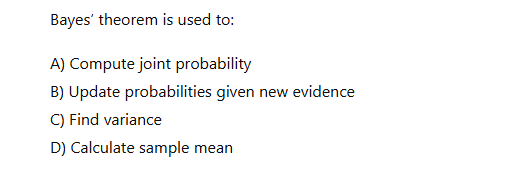 Bayes’ theorem is used to:
A) Compute joint probability
B) Update probabilities given new evidence
©) Find variance
D) Calculate sample mean
This is AI generated Response.
Asked by: Rahul
Created at: 2026-02-24 05:44:58
Asked by: Rahul
Created at: 2026-02-24 05:44:58
Final Answer:
Rendered
Raw Text
Did you like this answer?
## Step-by-Step Solution
### Step 1: Understand Bayes' Theorem
Bayes' theorem is a fundamental rule in probability theory. It describes how to **update the probability of a hypothesis given new evidence**.
### Step 2: Recall the Formula
Bayes' theorem states:
\[
P(A|B) = \frac{P(B|A) \cdot P(A)}{P(B)}
\]
Where:
- \( P(A|B) \): Probability of event A given B (posterior)
- \( P(B|A) \): Probability of event B given A (likelihood)
- \( P(A) \): Probability of event A (prior)
- \( P(B) \): Probability of event B (marginal)
### Step 3: Analyze Each Option
- **A) Compute joint probability:**
Joint probability is calculated as \( P(A \cap B) \), but Bayes' theorem is primarily for conditional probabilities, not direct joint probability.
- **B) Update probabilities given new evidence:**
This is exactly what Bayes' theorem is for—it updates the probability of a hypothesis as new evidence (data) is observed.
- **C) Find variance:**
Variance is a measure of spread; Bayes' theorem does not compute variance.
- **D) Calculate sample mean:**
Sample mean is an average; Bayes' theorem is unrelated.
### Step 4: Select the Correct Answer
The correct answer is:
**B) Update probabilities given new evidence**
---
## Final Answer
**Bayes' theorem is used to:**
**B) Update probabilities given new evidence**
📢 Instructions:
- Ask anything relatd to above question only.
- For new Question goto :