 VIPSolutions
Give step-by-step solution with explanation and final answer:Be ie oe Ly, 90 (11) I " ce a in al 3) o villa (¢jv653) ~ HWS Ch. | rr El. Cr CON 005 (part 5 of 5) 10.0 points. en PRR meee 2 oon Doce? CE EER 5) 7) send of Berl he Soest (C2) pm Ya (ERT a] 1%] Arle roam 22 (1 1) rn dL = LQ gal TE A ) ke a ALS) Cand = Qut P EE es oes ) Cy eT 5: Woe =0 5 HG) 4 EL 1 0 om sl de 4000 Vp cL (LE ee a) Cils Fre (& 5) b ; net (=) 006 (pat 1 of 4) 10.0 points { meng (2-0) An air-filled Fain consists of to patgl
Question:
Give step-by-step solution with explanation and final answer: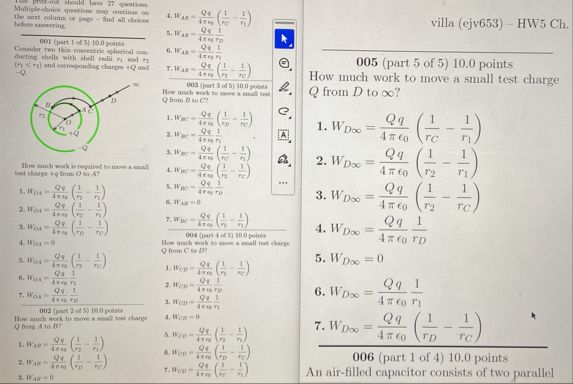 Be ie oe Ly, 90 (11) I "
ce a in al 3) o villa (¢jv653) ~ HWS Ch. |
rr El.
Cr CON 005 (part 5 of 5) 10.0 points.
en PRR
meee 2 oon Doce?
CE EER 5)
7) send of Berl
he Soest (C2) pm Ya (ERT
a] 1%] Arle
roam 22 (1 1) rn dL = LQ gal
TE A )
ke a ALS) Cand = Qut P
EE es oes )
Cy eT 5: Woe =0 5
HG) 4
EL 1 0
om sl de 4000 Vp cL (LE
ee a) Cils Fre (& 5) b
; net (=) 006 (pat 1 of 4) 10.0 points
{ meng (2-0) An air-filled Fain consists of to patgl
This is AI generated Response.
Asked by: Rahul
Created at: 2026-02-24 05:39:48
Asked by: Rahul
Created at: 2026-02-24 05:39:48
Final Answer:
Rendered
Raw Text
Did you like this answer?
Let's solve **Question 005**:
**How much work to move a small test charge \( Q \) from \( D \) \( \infty \)?**
### **Step 1: Find the Electric Potential at D**
The work required to move a charge \( Q \) from point D to infinity is:
\[
W_{D \to \infty} = Q \cdot (V_{\infty} - V_D)
\]
But \( V_{\infty} = \), so:
\[
W_{D \to \infty} = -Q V_D
\]
The potential at D (from a source charge \( q \) at O) is:
\[
V_D = \frac{q}{4\pi \epsilon_ r_D}
\]
where \( r_D \) is the distance from O to D.
---
### **Step 2: Substitute in the Work Formula**
\[
W_{D \to \infty} = -Q \left( \frac{q}{4\pi \epsilon_ r_D} \right)
= -\frac{Qq}{4\pi\epsilon_ r_D}
\]
---
### **Step 3: Match to Answer Choices**
Looking at the options, the answer that matches is:
\[
\boxed{4. \quad W_{D\infty} = -\frac{Qq}{4\pi\epsilon_ r_D}}
\]
---
## **Final Answer**
\[
\boxed{4}
\]
This is the correct choice for the work required to move a small test charge \( Q \) from \( D \) to \( \infty \).
Question:
All parts solved
This is AI generated Response.
Asked by: Rahul
Created at: 2026-02-24 05:40:11
Asked by: Rahul
Created at: 2026-02-24 05:40:11
Final Answer:
Rendered
Raw Text
Did you like this answer?
# Step-by-Step Solution to Work Calculation
## Problem Statement
Calculate the work required to move a small test charge \( Q \) from point \( D \) to infinity due to a source charge \( q \) located at point \( O \).
## Step 1: Electric Potential at Point D
The work done \( W \) to move a charge \( Q \) from point \( D \) to infinity is given by:
\[
W_{D \to \infty} = Q \cdot (V_{\infty} - V_D)
\]
Since the electric potential at infinity \( V_{\infty} = 0 \), this simplifies to:
\[
W_{D \to \infty} = -Q V_D
\]
The potential \( V_D \) at point \( D \) due to the charge \( q \) at point \( O \) is expressed as:
\[
V_D = \frac{q}{4\pi \epsilon_0 r_D}
\]
where \( r_D \) is the distance from \( O \) to \( D \) and \( \epsilon_0 \) is the permittivity of free space.
## Step 2: Substitute \( V_D \) into the Work Formula
Substituting for \( V_D \):
\[
W_{D \to \infty} = -Q \left( \frac{q}{4\pi \epsilon_0 r_D} \right)
\]
This can be rearranged to:
\[
W_{D \to \infty} = -\frac{Qq}{4\pi \epsilon_0 r_D}
\]
## Step 3: Identify the Correct Answer Choice
Reviewing the options provided in the original question, we look for an expression matching:
\[
W_{D \to \infty} = -\frac{Qq}{4\pi \epsilon_0 r_D}
\]
## Final Answer
The correct choice for the work required to move the small test charge \( Q \) from \( D \) to \( \infty \) is:
\[
\boxed{4}
\]
📢 Instructions:
- Ask anything relatd to above question only.
- For new Question goto :