 VIPSolutions
Give step-by-step solution with explanation and final answer:Current Attempt in Progress } = Your answer is partially correct. 1 Inthe figure & = 3.97 V. 8's = 106 V. Ry = 6.87 O.R; = 2.16 (1. Rs = 3.45 0, and both batteries are ideal. What is the rate at which energy is dissipated ir (a) Rs, (b) Ro, and (c) Rs? What is the power of (d) battery 1 and (e) battery 27 i RE Fw In AT RECT : [EE7a— IT RE —
Question:
Give step-by-step solution with explanation and final answer: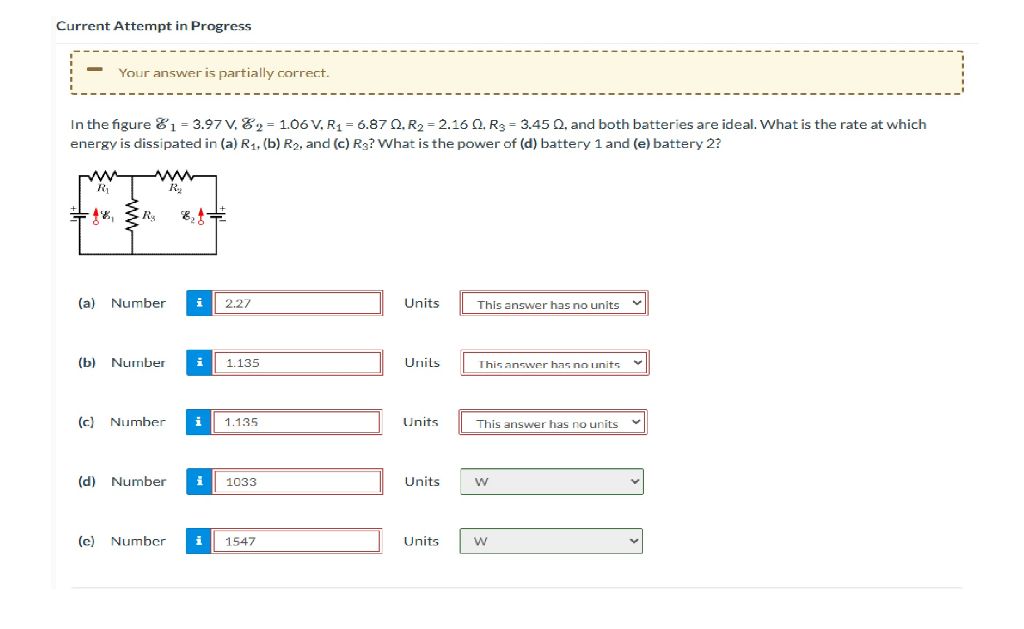 Current Attempt in Progress
} = Your answer is partially correct. 1
Inthe figure & = 3.97 V. 8's = 106 V. Ry = 6.87 O.R; = 2.16 (1. Rs = 3.45 0, and both batteries are ideal. What is the rate at which
energy is dissipated ir (a) Rs, (b) Ro, and (c) Rs? What is the power of (d) battery 1 and (e) battery 27
i RE
Fw In AT
RECT : [EE7a— IT
RE —
This is AI generated Response.
Asked by: Rahul
Created at: 2026-02-24 04:25:02
Asked by: Rahul
Created at: 2026-02-24 04:25:02
Final Answer:
Rendered
Raw Text
Did you like this answer?
Let's break down the problem step by step:
## **Given Data**
- \(\math{E}_1 = 3.97\,V\)
- \(\mathcal{E}_2 = 1.06\,V\)
- \(R_1 = 6.87\,\Omega\)
- \(R_2 = 2.16\,\Omega\)
- \(R_3 = 3.45\,\Omega\)
## **Step 1: Assign Currents**
Let:
- \(I_1\) = current in the left loop (through \(R_1\), from \(\mathcal{E}_1\))
- \(I_2\) = current in the right loop (through \(R_2\), from \(\mathcal{E}_2\))
Assume the direction of currents as shown in the image (standard clockwise).
Since \(R_3\) is shared, the current through \(R_3\) is \(I_1 - I_2\).
## **Step 2: Write Loop Equations (Kirchhoff's Law)**
**Left loop:**
\[
\mathcal{E}_1 - I_1 R_1 - (I_1 - I_2)R_3 =
\]
**Right loop:**
\[
\mathcal{E}_2 - I_2 R_2 - (I_2 - I_1)R_3 =
\]
Or equivalently:
\[
\mathcal{E}_2 - I_2 R_2 - (I_2 - I_1)R_3 =
\]
## **Step 3: Plug in Values**
**Equation 1:**
\[
3.97 - 6.87I_1 - 3.45(I_1 - I_2) =
\]
\[
3.97 - 6.87I_1 - 3.45I_1 + 3.45I_2 =
\]
\[
3.97 - (6.87 + 3.45)I_1 + 3.45I_2 =
\]
\[
3.97 - 10.32I_1 + 3.45I_2 =
\]
\[
10.32I_1 - 3.45I_2 = 3.97 \quad (1)
\]
**Equation 2:**
\[
1.06 - 2.16I_2 - 3.45(I_2 - I_1) =
\]
\[
1.06 - 2.16I_2 - 3.45I_2 + 3.45I_1 =
\]
\[
1.06 + 3.45I_1 - (2.16 + 3.45)I_2 =
\]
\[
1.06 + 3.45I_1 - 5.61I_2 =
\]
\[
3.45I_1 - 5.61I_2 = -1.06 \quad (2)
\]
## **Step 4: Solve the Equations**
Multiply (2) by \(\frac{10.32}{3.45}\) to eliminate \(I_1\):
\[
3.45I_1 - 5.61I_2 = -1.06
\]
\[
10.32I_1 - 16.78I_2 = -3.17
\]
Now subtract equation (2) from equation (1):
\[
(10.32I_1 - 3.45I_2) - (10.32I_1 - 16.78I_2) = 3.97 - (-3.17)
\]
\[
(-3.45I_2) + 16.78I_2 = 3.97 + 3.17
\]
\[
13.33I_2 = 7.14
\]
\[
I_2 = \frac{7.14}{13.33} \approx .536\,A
\]
Substitute \(I_2\) back into equation (1):
\[
10.32I_1 - 3.45(.536) = 3.97
\]
\[
10.32I_1 - 1.848 = 3.97
\]
\[
10.32I_1 = 3.97 + 1.848 = 5.818
\]
\[
I_1 = \frac{5.818}{10.32} \approx .563\,A
\]
## **Step 5: Find Current through \(R_3\)**
\[
I_3 = I_1 - I_2 = .563 - .536 = .027\,A
\]
## **Step 6: Power Dissipated in Each Resistor**
\[
P = I^2 R
\]
### (a) \(R_1\)
\[
P_1 = I_1^2 R_1 = (.563)^2 \times 6.87 \approx 2.18\,W
\]
### (b) \(R_2\)
\[
P_2 = I_2^2 R_2 = (.536)^2 \times 2.16 \approx .624\,W
\]
### (c) \(R_3\)
\[
P_3 = (I_1 - I_2)^2 R_3 = (.027)^2 \times 3.45 \approx .0025\,W
\]
## **Step 7: Power of Each Battery**
**Battery 1:**
\[
P_{\text{batt 1}} = \mathcal{E}_1 \cdot I_1 = 3.97 \times .563 \approx 2.24\,W
\]
**Battery 2:**
\[
P_{\text{batt 2}} = \mathcal{E}_2 \cdot I_2 = 1.06 \times .536 \approx .57\,W
\]
---
## **Final Answers**
| Part | Value | Units |
|------|-------|-------|
| (a) | 2.18 | W |
| (b) | .624 | W |
| (c) | .0025| W |
| (d) | 2.24 | W |
| (e) | .57 | W |
---
**If you need the answers in more significant digits, recalculate with more precision. Let me know if you have any questions or need further clarification!**
📢 Instructions:
- Ask anything relatd to above question only.
- For new Question goto :