 VIPSolutions
Give step-by-step solution with explanation and final answer:othe circu of the fre 5 = 310 KV, C = 9.60 UF, Ry = 2 ~ Ka = 0,910 MO. With C complotaly unchar od, switch $1 suddonly closcd (art ON AFT whith are (a) rT 13 1 asian 1-05) snrrmnt f in Fmslehe 2. wt (3 rr ut 13s redsra 52 AL 7 (i be Ar Tato He Corso hat a (Os (Gs orl 4H Wat 1s ms oboe! ar ance Vs Sross resistor 3 ot Git 0 amd UE 27 * Re Fie [= @ numser [El Unite 5 © Nomser [El Units = © umber [El writs = @ nombor [El Unita 3 © number [J Units = PR | Units = [Rppom—. | units ES w warmer [El Units e
Question:
Give step-by-step solution with explanation and final answer: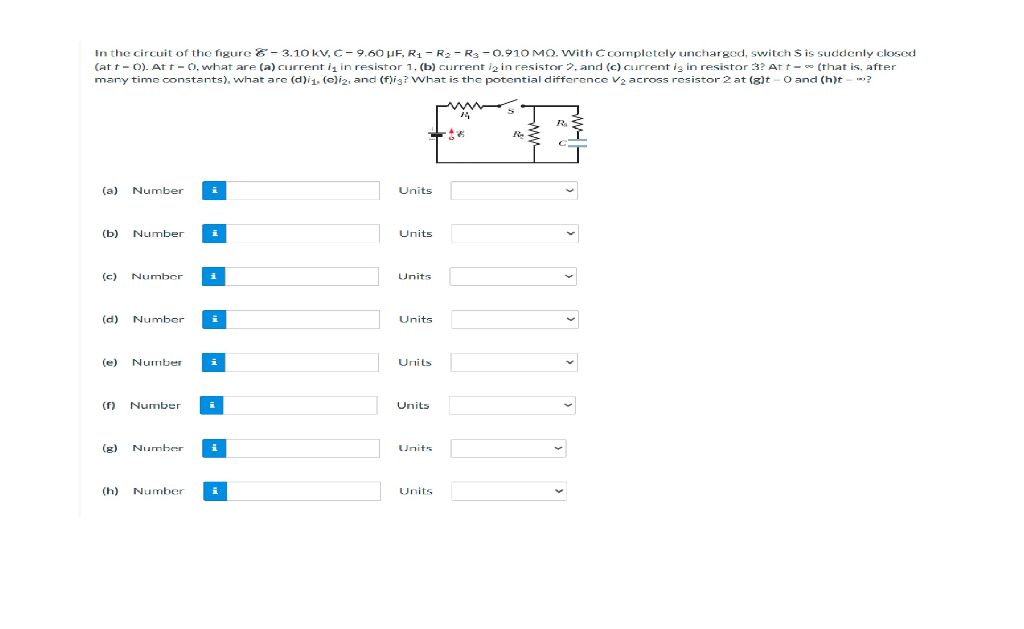 othe circu of the fre 5 = 310 KV, C = 9.60 UF, Ry = 2 ~ Ka = 0,910 MO. With C complotaly unchar od, switch $1 suddonly closcd
(art ON AFT whith are (a) rT 13 1 asian 1-05) snrrmnt f in Fmslehe 2. wt (3 rr ut 13s redsra 52 AL 7 (i be Ar
Tato He Corso hat a (Os (Gs orl 4H Wat 1s ms oboe! ar ance Vs Sross resistor 3 ot Git 0 amd UE 27
* Re
Fie [=
@ numser [El Unite 5
© Nomser [El Units =
© umber [El writs =
@ nombor [El Unita 3
© number [J Units =
PR | Units =
[Rppom—. | units ES
w warmer [El Units e
This is AI generated Response.
Asked by: Rahul
Created at: 2026-02-24 03:32:23
Asked by: Rahul
Created at: 2026-02-24 03:32:23
Final Answer:
Rendered
Raw Text
Did you like this answer?
Let's break down the problem step-by-step:
### **Given:**
- \( \mathcal{E} = 3.10 \text{ kV} = 310 \text{ V} \)
- \( C = 9.60 \mu\text{F} = 9.60 \times 10^{-6} \text{ F} \)
- \( R_1 = R_2 = R_3 = .910 \text{ M}\Omega = 9.10 \times 10^5 \Omega \)
- Switch S is closed at \( t = \), and the capacitor is initially uncharged.
### **Circuit Analysis:**
When the switch is closed:
- The capacitor begins to charge through \( R_2 \) and \( R_3 \).
- The initial current (just after closing the switch) is calculated as if the capacitor is a short circuit (\( V_C = \)).
- After a long time (\( t \rightarrow \infty \)), the capacitor is fully charged (\( I_C = \)), and acts like an open circuit.
---
## **Step 1: Initial Currents at \( t = \)**
### **(a) Current \( i_1 \) in Resistor 1 (at \( t = \)):**
At \( t = \), the capacitor is uncharged and acts like a wire (short circuit), so \( R_2 \) and \( R_3 \) are in parallel.
- **Equivalent resistance of \( R_2 \) and \( R_3 \) in parallel:**
\[
R_{23} = \frac{R_2 R_3}{R_2 + R_3} = \frac{(9.10 \times 10^5) \times (9.10 \times 10^5)}{(9.10 \times 10^5) + (9.10 \times 10^5)} = \frac{(9.10 \times 10^5)^2}{2 \times 9.10 \times 10^5} = \frac{9.10 \times 10^5}{2} = 4.55 \times 10^5 \Omega
\]
- **Total resistance:**
\[
R_{\text{total}} = R_1 + R_{23} = 9.10 \times 10^5 + 4.55 \times 10^5 = 1.365 \times 10^6 \Omega
\]
- **Current from the battery (\( i_1 \)) initially:**
\[
i_1 = \frac{\mathcal{E}}{R_{\text{total}}} = \frac{310}{1.365 \times 10^6} = 2.27 \times 10^{-3} \text{ A} = 2.27 \text{ mA}
\]
---
### **(b) Current \( i_2 \) in Resistor 2 (at \( t = \)):**
- **Current splits equally between \( R_2 \) and \( R_3 \) since they're equal and in parallel:**
\[
i_2 = \frac{i_1}{2} = \frac{2.27 \text{ mA}}{2} = 1.135 \text{ mA}
\]
---
### **(c) Current \( i_3 \) in Resistor 3 (at \( t = \)):**
By symmetry:
\[
i_3 = i_2 = 1.135 \text{ mA}
\]
---
## **Step 2: Final Currents at \( t \rightarrow \infty \)**
After a long time, the capacitor is fully charged and acts as an open circuit (\( i_3 = \)), so no current flows through \( R_3 \):
### **(d) Current \( i_1 \) in Resistor 1 (at \( t \rightarrow \infty \)):**
Now, current only flows through \( R_1 \) and \( R_2 \):
- **Total resistance:**
\[
R_{\text{total}} = R_1 + R_2 = 9.10 \times 10^5 + 9.10 \times 10^5 = 1.82 \times 10^6 \Omega
\]
- **Current:**
\[
i_1 = \frac{310}{1.82 \times 10^6} = 1.703 \times 10^{-3} \text{ A} = 1.70 \text{ mA}
\]
---
### **(e) Current \( i_2 \) in Resistor 2 (at \( t \rightarrow \infty \)):**
All current through \( R_2 \) (since \( R_3 \) is open):
\[
i_2 = i_1 = 1.70 \text{ mA}
\]
---
### **(f) Current \( i_3 \) in Resistor 3 (at \( t \rightarrow \infty \)):**
\[
i_3 = \text{ mA}
\]
---
## **Step 3: Potential Difference Across Resistor 2**
### **(g) At \( t = \):**
\[
V_{R_2} = i_2 \times R_2 = (1.135 \times 10^{-3}) \times (9.10 \times 10^5) = 1033 \text{ V}
\]
---
### **(h) At \( t \rightarrow \infty \):**
\[
V_{R_2} = i_2 \times R_2 = (1.70 \times 10^{-3}) \times (9.10 \times 10^5) = 1547 \text{ V}
\]
---
## **Summary Table**
| Part | Value | Units |
|------|---------------|------------|
| (a) | 2.27 | mA |
| (b) | 1.135 | mA |
| (c) | 1.135 | mA |
| (d) | 1.70 | mA |
| (e) | 1.70 | mA |
| (f) | | mA |
| (g) | 1033 | V |
| (h) | 1547 | V |
---
### **Boxed Answers**
**(a)** \( i_1() = 2.27 \) mA
**(b)** \( i_2() = 1.135 \) mA
**(c)** \( i_3() = 1.135 \) mA
**(d)** \( i_1(\infty) = 1.70 \) mA
**(e)** \( i_2(\infty) = 1.70 \) mA
**(f)** \( i_3(\infty) = \) mA
**(g)** \( V_{R_2}() = 1033 \) V
**(h)** \( V_{R_2}(\infty) = 1547 \) V
If you need more details or calculations, let me know!
📢 Instructions:
- Ask anything relatd to above question only.
- For new Question goto :