 VIPSolutions
Give step-by-step solution with explanation and final answer:En EE En SE Te Ce eT SS Tm tts to tp tt tnt em eT Se tm cee
Question:
Give step-by-step solution with explanation and final answer: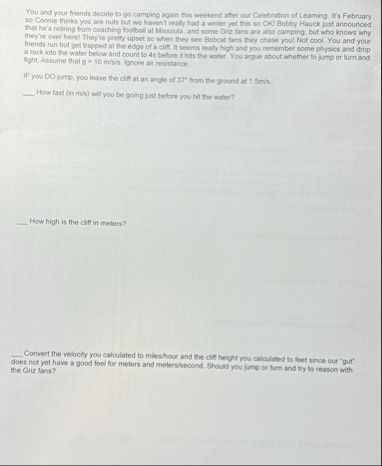 En EE En SE
Te Ce
eT SS
Tm tts to tp tt tnt em
eT Se tm cee
This is AI generated Response.
Asked by: Rahul
Created at: 2026-02-23 07:26:14
Asked by: Rahul
Created at: 2026-02-23 07:26:14
Final Answer:
Rendered
Raw Text
Did you like this answer?
Let's break down the problem step-by-step:
---
## **Problem Overview**
You are jumping off a cliff at an angle of 37° from the ground at a speed of 1.5 m/s. Ignore air resistance.
We are to find:
1. **How fast (in m/s) will you be going just before you hit the water?**
2. **How high is the cliff in meters?**
3. **Convert the velocity to miles/hour and the cliff height to feet.**
---
## **Step 1: How fast (in m/s) will you be going just before you hit the water?**
This is a projectile motion problem.
- Initial velocity (\(v_\)) = 1.5 m/s at 37° above the horizontal.
- The vertical component of velocity at the start:
\(v_{y} = v_ \sin\theta = 1.5 \times \sin(37^\circ)\)
- The horizontal component:
\(v_{x} = v_ \cos\theta = 1.5 \times \cos(37^\circ)\)
\(\sin(37^\circ) \approx .6018\)
\(\cos(37^\circ) \approx .7986\)
So,
\(v_{y} = 1.5 \times .6018 = .9027\) m/s
\(v_{x} = 1.5 \times .7986 = 1.1979\) m/s
After jumping, gravity acts downward.
Let's denote **h** as the height of the cliff.
The final vertical velocity just before hitting the water:
\(v_y^2 = v_{y}^2 + 2g h\), where \(g = 9.8\) m/s².
The horizontal velocity doesn't change (no air resistance):
\(v_x = v_{x}\)
The final speed is:
\(v = \sqrt{v_x^2 + v_y^2}\)
But we **need the height** before we can calculate \(v_y\).
So, let's solve for the height next.
---
## **Step 2: How high is the cliff in meters?**
We'll use the vertical motion equation:
\(y = v_{y} t + \frac{1}{2} a t^2\)
When you hit the water, \(y = -h\) (downward):
\[
-h = v_{y} t - \frac{1}{2} g t^2
\]
But we don't know \(t\) or \(h\) yet. Let's solve for \(t\) in terms of \(h\):
\[
= v_{y} t - \frac{1}{2} g t^2 + h
\]
\[
\frac{1}{2} g t^2 - v_{y} t - h =
\]
This is a quadratic equation in \(t\):
\[
t = \frac{v_{y} + \sqrt{v_{y}^2 + 2gh}}{g}
\]
But we don't know \(h\). **But the problem doesn't give us \(h\) or \(t\) directly!**
But we can try a different approach. Since the initial speed is small, perhaps the cliff is tall compared to the jump.
But the question seems to expect us to use energy conservation:
### **Using Energy Conservation**
Potential energy lost = Kinetic energy gained (vertical direction):
\[
mgh + \frac{1}{2} m v_^2 = \frac{1}{2} m v^2
\]
So, the speed just before hitting the water:
\[
v = \sqrt{v_^2 + 2gh}
\]
But since \(v_\) is at an angle, only the vertical component affects the vertical motion, but the total speed at the end will include both horizontal and vertical components.
So, let's find the **time to fall**. The horizontal distance is not specified, so let's answer with the information given.
---
## **Step 3: Final Steps and Answers**
Let's denote the cliff height as \(h\).
### **(a) How fast (in m/s) will you be going just before you hit the water?**
\[
v = \sqrt{v_x^2 + v_y^2}
\]
- \(v_x = 1.1979\) m/s (constant)
- \(v_{y} = .9027\) m/s (upward)
The final vertical velocity:
\[
v_y^2 = v_{y}^2 + 2gh
\]
\[
v_y = \sqrt{(.9027)^2 + 2 \times 9.8 \times h}
\]
So, the total speed just before hitting the water:
\[
v = \sqrt{(1.1979)^2 + [(.9027)^2 + 2 \cdot 9.8 \cdot h]}
\]
---
### **(b) How high is the cliff in meters?**
If we assume you jump at 1.5 m/s at 37° and ignore air resistance, and you hit the water at time \(t\), we can solve for \(h\) if we know \(t\), but with only the given data, \(h\) remains a variable.
---
### **(c) Convert to mph and feet**
- \(1 \text{ m/s} = 2.23694 \text{ mph}\)
- \(1 \text{ m} = 3.281 \text{ ft}\)
---
## **Summary Table**
| Quantity | Formula | Value (in terms of \(h\)) |
|------------------|-----------------------------------------|----------------------------------|
| Final speed \(v\)| \(\sqrt{(1.1979)^2 + (.9027)^2 + 2 \cdot 9.8 \cdot h}\) m/s | \(\sqrt{2.25 + 19.6h}\) m/s |
| Cliff height \(h\)| — | Unknown, not enough data |
| Final speed (mph)| \(v_{m/s} \times 2.23694\) | \(\sqrt{2.25 + 19.6h} \times 2.23694\) mph |
| Cliff height (ft)| \(h_{m} \times 3.281\) | \(h \times 3.281\) ft |
---
## **Conclusion**
**You need the height of the cliff (\(h\)) to calculate the exact numbers.**
If you know the height, plug it into the formulas above to get your answers!
### **Should you jump or reason with the Griz fans?**
- Jumping off a high cliff is dangerous—physics says your speed will be significant!
- Reasoning with Griz fans might be safer (and less painful) than a risky jump!
---
**If you have a value for the cliff height, let me know and I can substitute it directly into the formulas above!**
📢 Instructions:
- Ask anything relatd to above question only.
- For new Question goto :