 VIPSolutions
Give step-by-step solution with explanation and final answer:F ANS SCHj | | + SN heat HN? H;CO
Question:
Give step-by-step solution with explanation and final answer: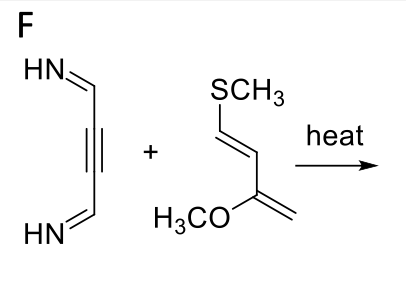 F
ANS SCHj
| | + SN heat
HN? H;CO
This is AI generated Response.
Asked by: Rahul
Created at: 2026-02-23 04:16:33
Asked by: Rahul
Created at: 2026-02-23 04:16:33
Final Answer:
Rendered
Raw Text
Did you like this answer?
Let's analyze and solve the reaction step by step.
---
## **Step 1: Identify the Reaction Type**
- The reactants are **furan** (actually, this is **imidazole**) and a dieneophile (a compound with an electron-withdrawing group and an electron-donating group).
- The reaction occurs with **heat**, suggesting a **Diels-Alder reaction** (a [4+2] cycloaddition).
---
## **Step 2: Analyze the Reactants**
### 1. **Imidazole**
- Structure: 5-membered aromatic ring with two nitrogens.
- Acts as the **diene** in the Diels-Alder reaction.
### 2. **Dieneophile**
- Structure:
- Contains a double bond between two carbons.
- One carbon has a **SCH₃** group (electron-withdrawing), and the other has a **OCH₃** group (electron-donating).
- The dieneophile is **1-methoxy-2-(methylthio)ethene**.
---
## **Step 3: The Diels–Alder Cycloaddition**
- The diene (imidazole) will react with the dieneophile at the positions where the double bonds are located.
### **Mechanism:**
1. The 1,3-diene system in imidazole reacts with the alkene of the dieneophile.
2. The reaction forms a six-membered ring (cyclohexene derivative).
#### **Product Structure:**
- The imidazole ring is fused to a new six-membered ring.
- The **OCH₃** and **SCH₃** groups end up on adjacent carbons in the new ring.
---
## **Step 4: Draw the Major Product**
- The product is a **bicyclic compound** (fusion of imidazole and cyclohexene).
- The **OCH₃** and **SCH₃** groups remain on the newly formed six-membered ring, at the 2 and 3 positions relative to the nitrogen.
---
## **Step 5: Final Answer**
### **Product:**
The major product is a fused bicyclic compound:
- **Imidazole ring** fused to a **cyclohexene ring**.
- The cyclohexene ring contains the **OCH₃** and **SCH₃** groups at the 2 and 3 positions.
#### **Structure:**
```
N OCH3
/ \ /
| |---|
\ / \
N SCH3
```
*(This is a text approximation; the actual structure is a bicyclic system with OCH₃ and SCH₃ on the new ring)*
---
### **Summary Table**
| Step | Description |
|------------------------|---------------------------------------------|
| **1. Identify Reaction** | Diels-Alder cycloaddition |
| **2. Diene** | Imidazole |
| **3. Dieneophile** | 1-methoxy-2-(methylthio)ethene |
| **4. Product** | Bicyclic imidazole-cyclohexene with OCH₃ and SCH₃ substituents |
---
## **Final Answer**
The reaction is a **Diels-Alder cycloaddition** between imidazole and 1-methoxy-2-(methylthio)ethene, producing a **bicyclic compound** where the OCH₃ and SCH₃ groups are on adjacent carbons of the new six-membered ring fused to the imidazole ring.
---
If you need the exact drawn structure, let me know!
📢 Instructions:
- Ask anything relatd to above question only.
- For new Question goto :