 VIPSolutions
Give step-by-step solution with explanation and final answer:deve op dpi mn es en os eT pi cm JE ee re ER eee toe) EE me Myre ea esl eet cha i meee OL ee.
Question:
Give step-by-step solution with explanation and final answer: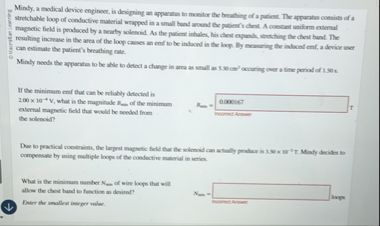 deve op dpi mn es en os eT pi cm
JE ee re
ER eee toe)
EE me
Myre ea esl eet cha i
meee OL
ee.
This is AI generated Response.
Asked by: Rahul
Created at: 2026-02-22 03:25:51
Asked by: Rahul
Created at: 2026-02-22 03:25:51
Final Answer:
Rendered
Raw Text
Did you like this answer?
Let's break down the problem step by step.
---
## **Step 1: the Scenario**
- A loop of material is wrapped around a patient's chest.
- The loop is placed in a constant magnetic field (\( B \)), and as the patient inhales, the loop's area (\( A \)) changes.
- The device detects changes in the magnetic flux (\( \Phi = BA \)) as an induced emf (\( \mathcal{E} \)).
---
## **Step 2: Relevant Equation - Faraday's Law**
The induced emf in a loop is:
\[
\mathcal{E} = -N \frac{d\Phi}{dt}
\]
Where:
- \( N \) = number of loops,
- \( \Phi = BA \) (if \( B \) is constant and perpendicular to the loop),
- \( \frac{d\Phi}{dt} = B \frac{dA}{dt} \) (since \( B \) is constant).
So,
\[
\mathcal{E} = -N B \frac{dA}{dt}
\]
---
## **Step 3: Problem 1**
**If the minimum emf that can be reliably detected is \( 2.00 \times 10^{-6} \) V, what is the magnitude \( B_{\text{min}} \) of the minimum external magnetic field needed (assuming \( N=1 \))?**
Given:
- \( \mathcal{E}_{\text{min}} = 2.00 \times 10^{-6} \) V
- \( \Delta A = 5.00 \, \text{cm}^2 = 5.00 \times 10^{-4} \, \text{m}^2 \)
- \( \Delta t = 1.50 \) s
- \( N = 1 \)
Calculate \( \frac{dA}{dt} \):
\[
\frac{dA}{dt} = \frac{\Delta A}{\Delta t} = \frac{5.00 \times 10^{-4}}{1.50} = 3.33 \times 10^{-4} \, \text{m}^2/\text{s}
\]
Solve for \( B_{\text{min}} \):
\[
\mathcal{E}_{\text{min}} = N B_{\text{min}} \frac{dA}{dt}
\]
\[
B_{\text{min}} = \frac{\mathcal{E}_{\text{min}}}{N \frac{dA}{dt}}
\]
Plug in values:
\[
B_{\text{min}} = \frac{2.00 \times 10^{-6}}{1 \times 3.33 \times 10^{-4}}
\]
\[
B_{\text{min}} = 6.00 \times 10^{-3} \, \text{T}
\]
**Final Answer for (1):**
\[
\boxed{6.00 \times 10^{-3} \ \text{T}}
\]
---
## **Step 4: Problem 2**
**The solenoid can produce at most \( 3.50 \times 10^{-3} \) T. What is the minimum number \( N_{\text{min}} \) of wire loops that will allow the device to function as desired?**
Given:
- \( B = 3.50 \times 10^{-3} \) T
- All other values same as before.
\[
\mathcal{E}_{\text{min}} = N_{\text{min}} \cdot B \cdot \frac{dA}{dt}
\]
Solve for \( N_{\text{min}} \):
\[
N_{\text{min}} = \frac{\mathcal{E}_{\text{min}}}{B \frac{dA}{dt}}
\]
Plug in values:
\[
N_{\text{min}} = \frac{2.00 \times 10^{-6}}{3.50 \times 10^{-3} \times 3.33 \times 10^{-4}}
\]
\[
= \frac{2.00 \times 10^{-6}}{1.166 \times 10^{-6}}
\]
\[
= 1.715
\]
Since you can't have a fraction of a loop, **round up to the next whole number**:
\[
N_{\text{min}} = 2
\]
**Final Answer for (2):**
\[
\boxed{2}
\]
---
## **Summary Table**
| Part | Answer |
|------|--------|
| 1 | \( 6.00 \times 10^{-3} \) T |
| 2 | 2 loops |
📢 Instructions:
- Ask anything relatd to above question only.
- For new Question goto :