Give step-by-step solution with explanation and final answer:Circuit Description:
Consider the following DC circuit:
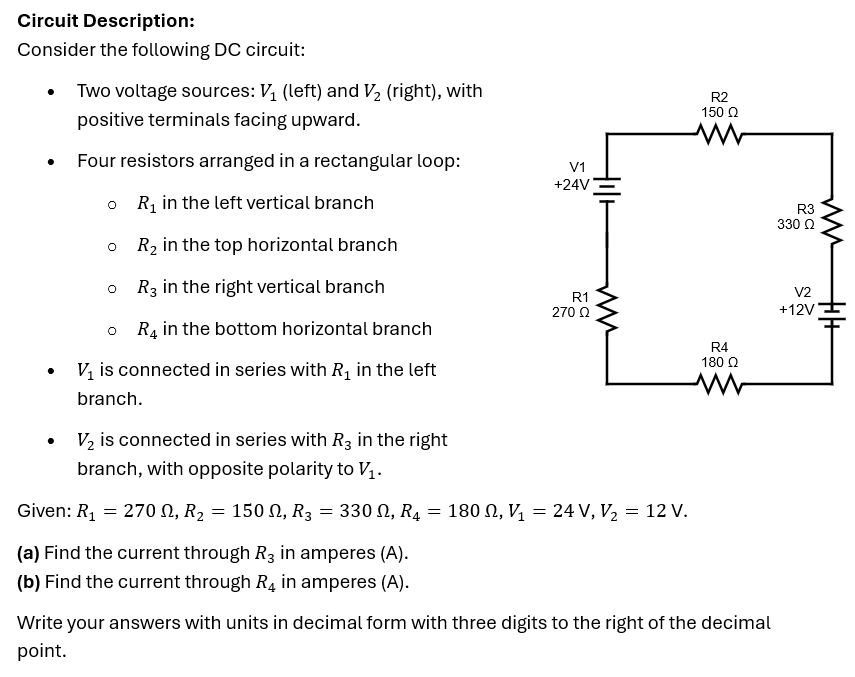
«Two voltage sources: V; (left) and V, (right), with re
positive terminals facing upward. 50a
+ Fourresistors arranged in a rectangular loop: vi
+24V =
o Rjinthe left vertical branch R3
3300
o Rj inthe top horizontal branch
o Rjzintheright vertical branch Ri v2
2700 +12V
o Ry inthe bottom horizontal branch
R4
«Vy is connected in series with R; in the left Jeo
branch.
+ V, is connected in series with R3 in the right
branch, with opposite polarity to V;.
Given: R, = 270 0, R, = 150 0, R; = 3300, R, = 180 Q, V; = 24V, V, = 12V.
(a) Find the current through R3 in amperes (A).
(b) Find the current through R, in amperes (A).
Write your answers with units in decimal form with three digits to the right of the decimal
point.
Question:
Give step-by-step solution with explanation and final answer:Circuit Description:
Consider the following DC circuit:
«Two voltage sources: V; (left) and V, (right), with re
positive terminals facing upward. 50a
+ Fourresistors arranged in a rectangular loop: vi
+24V =
o Rjinthe left vertical branch R3
3300
o Rj inthe top horizontal branch
o Rjzintheright vertical branch Ri v2
2700 +12V
o Ry inthe bottom horizontal branch
R4
«Vy is connected in series with R; in the left Jeo
branch.
+ V, is connected in series with R3 in the right
branch, with opposite polarity to V;.
Given: R, = 270 0, R, = 150 0, R; = 3300, R, = 180 Q, V; = 24V, V, = 12V.
(a) Find the current through R3 in amperes (A).
(b) Find the current through R, in amperes (A).
Write your answers with units in decimal form with three digits to the right of the decimal
point.
This is AI generated Response.
Asked by: Alok Kumar
Created at: 2026-02-22 02:26:45
Final Answer:
RenderedRaw Text
Did you like this answer?
Let's solve the circuit step by step using **Kirchhoff’s Voltage Law (KVL)**.
---
## **Step 1: Assign Current Direction**
Assume the current \( I \) flows clockwise (from \( V_1 \) up through \( R_2 \), down through \( R_3 \), left through \( R_4 \), and up through \( R_1 \)).
---
## **Step 2: Write KVL Equation**
Starting at the bottom left (after \( R_1 \)), moving clockwise:
1. **Through \( V_1 \) (up):** \( +24\,V \)
2. **Through \( R_2 \) (right):** \( -I \cdot 150 \)
3. **Through \( R_3 \) (down):** \( -I \cdot 330 \)
4. **Through \( V_2 \) (down):** \( -12\,V \)
5. **Through \( R_4 \) (left):** \( -I \cdot 180 \)
6. **Through \( R_1 \) (up):** \( -I \cdot 270 \)
Sum (KVL, total voltage drop = ):
\[
(+24) - (I \cdot 150) - (I \cdot 330) - 12 - (I \cdot 180) - (I \cdot 270) =
\]
---
## **Step 3: Combine Terms**
Combine all terms involving \( I \):
\[
24 - 12 - I(150 + 330 + 180 + 270) =
\]
\[
12 - I(930) =
\]
---
## **Step 4: Solve for \( I \)**
\[
12 = 930I
\]
\[
I = \frac{12}{930}
\]
\[
I = .012903\, \text{A}
\]
---
## **Step 5: Write Final Answers**
**(a) Current through \( R_3 \):**
\[
I_{R_3} = .0129\, \text{A}
\]
**(b) Current through \( R_4 \):**
\[
I_{R_4} = .0129\, \text{A}
\]
> **Both are the same, since it’s a single-series loop.**
---
## **Final Answers (to three decimal places):**
\[
\boxed{
\begin{aligned}
&\text{(a) Current through } R_3 = .0129\, \text{A} \\
&\text{(b) Current through } R_4 = .0129\, \text{A}
\end{aligned}
}
\]
VIPSolutions focuses on clear, step‑by‑step explanations so you can learn quickly. Whether you need an AI‑generated walkthrough or a short hint to get unstuck, each solution is organized for fast reading and easy review later.
Search similar questions, compare approaches, and bookmark the best answers for revision. Our goal is simple: quick, reliable study help that feels natural—not noisy.
 VIPSolutions
 Circuit Description:
Consider the following DC circuit:
«Two voltage sources: V; (left) and V, (right), with re
positive terminals facing upward. 50a
+ Fourresistors arranged in a rectangular loop: vi
+24V =
o Rjinthe left vertical branch R3
3300
o Rj inthe top horizontal branch
o Rjzintheright vertical branch Ri v2
2700 +12V
o Ry inthe bottom horizontal branch
R4
«Vy is connected in series with R; in the left Jeo
branch.
+ V, is connected in series with R3 in the right
branch, with opposite polarity to V;.
Given: R, = 270 0, R, = 150 0, R; = 3300, R, = 180 Q, V; = 24V, V, = 12V.
(a) Find the current through R3 in amperes (A).
(b) Find the current through R, in amperes (A).
Write your answers with units in decimal form with three digits to the right of the decimal
point.