 VIPSolutions
Give step-by-step solution with explanation and final answer:4 EF \ ‘E LEE Ta iE 7 | [E : [3 Nl: § 211; Ll : in
Question:
Give step-by-step solution with explanation and final answer: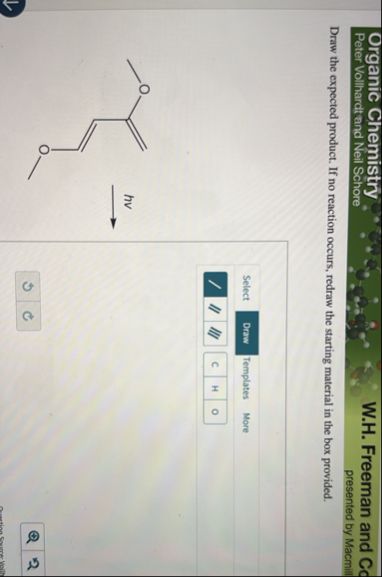 4
EF
\ ‘E
LEE
Ta iE
7 | [E
:
[3 Nl: §
211; Ll
:
in
This is AI generated Response.
Asked by: Rahul
Created at: 2026-02-21 08:06:39
Asked by: Rahul
Created at: 2026-02-21 08:06:39
Final Answer:
Rendered
Raw Text
Did you like this answer?
Let's analyze the problem step by step.
## 1. **Recognize the Reaction Type**
You are given a molecule with a structure typical of an α,β-unsaturated carbonyl compound (enone) and exposed to **hv (light)**. This suggests a **photochemical reaction**. The classic photochemical reaction for compounds like this is the **Norrish Type I or Type II cleavage**.
### **Norrish Type II Reaction**
- The Norrish Type II reaction occurs in γ,δ-unsaturated carbonyl compounds under light.
- Here, an intramolecular γ-hydrogen abstraction occurs, generating a 1,4-biradical.
- This biradical can fragment, giving an enol (which tautomerizes to a ketone or aldehyde) and an alkene.
## 2. **Identify the Structure**
- The starting compound is a 1,4-dicarbonyl system (specifically, a methyl group at the end, and an α,β-unsaturated ester).
## 3. **Mechanism**
- The carbonyl group absorbs light, promoting an electron and generating an excited state.
- The γ-hydrogen (relative to the carbonyl) is abstracted, forming a 1,4-biradical.
- The molecule splits between the α and β positions relative to the carbonyl, yielding two fragments.
## 4. **Draw out the Mechanism**
Let's number the carbons for clarity:
- 1: Carbonyl carbon (ester group)
- 2: α-carbon (to the carbonyl)
- 3: β-carbon (double bond)
- 4: γ-carbon (methyl group attached)
The γ-hydrogen abstraction occurs from the methyl group.
### **Fragmentation**
The bond between the β and γ carbon breaks, resulting in:
- One fragment: an enol (which tautomerizes to a carbonyl group, usually an aldehyde or ketone)
- Second fragment: an alkene
## 5. **Final Products**
Let's draw the products:
### **Fragment 1:**
- The enol from the γ-carbon will tautomerize to a carbonyl.
- This forms **acetone** (from the methyl and carbonyl group).
### **Fragment 2:**
- The remaining part is a methyl acrylate (methyl ester of propenoic acid).
**Structures:**
- **Acetone:** CH₃COCH₃
- **Methyl Acrylate:** CH₂=CHCO₂Me
## **Summary Table**
| Step | Explanation |
|--------------|------------------------------------------------------------------------------|
| Light (hv) | Excites the molecule, leading to Norrish Type II cleavage |
| γ-H abstraction | Forms a 1,4-biradical intermediate |
| Fragmentation| Cleaves to form acetone and methyl acrylate |
---
## **Final Answer**
**The reaction produces acetone and methyl acrylate.**
### **Drawn Structures:**
```
O O
|| ||
CH3-C-CH=CH-COOCH3 + CH3-CO-CH3
(methyl acrylate) (acetone)
```
- The left fragment is methyl acrylate (CH₂=CHCO₂Me).
- The right fragment is acetone (CH₃COCH₃).
---
### **Summary**
The photochemical reaction (`hv`) of the given compound leads to a **Norrish Type II cleavage**, resulting in **acetone** and **methyl acrylate** as the products.
Let me know if you need the stepwise mechanism illustrated!
📢 Instructions:
- Ask anything relatd to above question only.
- For new Question goto :