 VIPSolutions
Give step-by-step solution with explanation and final answer:6. Link OA is rotating with a clockwise angular velocity = 10 rad/s and angular acceleration ot = 2 rad/s®. Determine the velocity v of point C at the position with 8=30° if 5=0.3 m. (3 pts) A © v7 2b a CI... cs > rie |
Question:
Give step-by-step solution with explanation and final answer: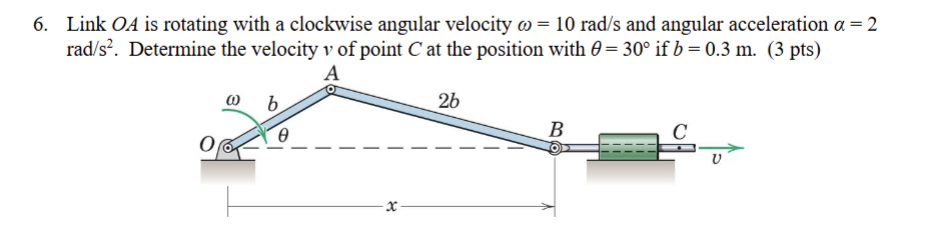 6. Link OA is rotating with a clockwise angular velocity = 10 rad/s and angular acceleration ot = 2
rad/s®. Determine the velocity v of point C at the position with 8=30° if 5=0.3 m. (3 pts)
A
© v7 2b
a CI...
cs > rie
|
This is AI generated Response.
Asked by: Rahul
Created at: 2026-02-21 07:06:46
Asked by: Rahul
Created at: 2026-02-21 07:06:46
Final Answer:
Rendered
Raw Text
Did you like this answer?
Let's break down the problem step by step:
---
## **Given Data**
- **Angular velocity of OA (\(\omega\))**: \(10\, \text{rad/s}\) (clockwise)
- **Angular acceleration (\(\alpha\))**: \(2\, \text{rad/s}^2\)
- **Angle (\(\theta\))**: \(30^\circ\)
- **Length \(b\)**: \(.3\, \text{m}\)
- **Find:** Linear velocity \(v\) of point \(C\).
---
## **Step 1: Find Velocity of Point \(A\)**
The linear velocity of point \(A\) (end of OA) with respect to \(O\):
\[
v_A = \omega \cdot OA = \omega \cdot b
\]
Given:
- \(\omega = 10\, \text{rad/s}\)
- \(b = .3\, \text{m}\)
\[
v_A = 10 \times .3 = 3\, \text{m/s}
\]
Direction: Perpendicular to \(OA\), so at \(30^\circ\) above the horizontal (since OA makes angle \(\theta\) with the horizontal).
---
## **Step 2: Velocity Components of Point \(A\)**
Resolve \(v_A\) into horizontal (\(x\)) and vertical (\(y\)) components:
\[
v_{A_x} = v_A \sin\theta
\]
\[
v_{A_y} = v_A \cos\theta
\]
Given \(\theta = 30^\circ\):
\[
v_{A_x} = 3 \times \sin(30^\circ) = 3 \times .5 = 1.5\, \text{m/s}
\]
\[
v_{A_y} = 3 \times \cos(30^\circ) = 3 \times .866 = 2.598\, \text{m/s}
\]
---
## **Step 3: Instantaneous Center of Rotation for Link \(AB\)**
Link \(AB\) rotates about \(A\), and point \(B\) has a horizontal velocity (since it is connected to slider C, which moves horizontally).
Let \(v_B\) be the velocity of point \(B\) (horizontal to the right).
Let the length \(AB = 2b = .6\, \text{m}\).
The velocity of \(B\) can be related to the velocity of \(A\) using relative velocity equation:
\[
\vec{v}_B = \vec{v}_A + \vec{\omega}_{AB} \times \vec{r}_{B/A}
\]
- \(\vec{v}_A\): Already found, split into \(x\) and \(y\).
- \(\vec{\omega}_{AB}\): Angular velocity of \(AB\).
- \(\vec{r}_{B/A}\): From \(A\) to \(B\), direction along \(AB\).
But since \(B\) moves horizontally,
\[
v_{B_y} =
\]
---
## **Step 4: Write Relative Velocity Equations**
Let \(\omega_{AB}\) be the angular velocity of link \(AB\).
The position vector from \(A\) to \(B\) is:
- Magnitude: \(2b = .6\, \text{m}\)
- Direction: Along the link, which makes \(30^\circ\) above the horizontal.
The velocity of \(B\) relative to \(A\) is perpendicular to \(AB\) (by right-hand rule), which is vertically downward.
So,
\[
\vec{v}_B = \vec{v}_A + \omega_{AB} \cdot (2b) \cdot (\text{perpendicular to } AB \text{, downward})
\]
Let \(v_B\) be entirely in the horizontal direction (\(\hat{i}\)), then:
\[
v_{B_y} = v_{A_y} - \omega_{AB} \cdot (2b) \cdot \cos\theta =
\]
\[
v_{B_x} = v_{A_x} + \omega_{AB} \cdot (2b) \cdot \sin\theta
\]
---
## **Step 5: Solve for \(\omega_{AB}\)**
Set vertical velocity of \(B\) to zero:
\[
= v_{A_y} - \omega_{AB} (2b) \cos\theta
\]
\[
\omega_{AB} = \frac{v_{A_y}}{(2b)\cos\theta}
\]
\[
\omega_{AB} = \frac{2.598}{.6 \times .866}
\]
\[
= \frac{2.598}{.5196}
\]
\[
\approx 5.\, \text{rad/s}
\]
---
## **Step 6: Find \(v_B\) (Which is \(v_C\))**
Now,
\[
v_B = v_{A_x} + \omega_{AB} (2b) \sin\theta
\]
\[
v_B = 1.5 + 5. \times .6 \times .5
\]
\[
= 1.5 + 5. \times .3
\]
\[
= 1.5 + 1.5 = 3.\, \text{m/s}
\]
---
## **Step 7: Final Answer**
\[
\boxed{v_C = 3.\, \text{m/s}}
\]
---
### **Summary Table**
| Quantity | Value | Units |
|----------|-------|-------|
| \(v_A\) | 3. | m/s |
| \(v_{A_x}\) | 1.5 | m/s |
| \(v_{A_y}\) | 2.598 | m/s |
| \(\omega_{AB}\) | 5. | rad/s |
| \(v_C\) | 3. | m/s |
---
### **Final Answer**
\[
\boxed{v_C = 3.\, \text{m/s}}
\]
Let me know if you need the acceleration as well!
📢 Instructions:
- Ask anything relatd to above question only.
- For new Question goto :