Question:
Give step-by-step solution with explanation and final answer:
Did you like this answer?
👍 0
👎 0
Let's solve each question step by step.
---
## **Question 1**
**Given:**
Lighthouse height above water = 49 ft
- Cliff extends from base = 19 ft (horizontal distance from base shore)
- Sailor's eye above water = 14 ft
- Angle above horizontal to top of lighthouse = \(30^\circ\)
- Find: Distance from ship to the rocks (horizontal distance from ship to base of cliff).
### **Step 1: Find the vertical distance between sailor's eye and top of lighthouse**
\[
\text{Vertical difference} = 49\,\text{ft} - 14\,\text{ft} = 35\,\text{ft}
\]
### **Step 2: Use trigonometry**
Let \( x \) = horizontal distance from sailor to base of lighthouse.
From the right triangle:
\[
\tan(30^\circ) = \frac{\text{vertical difference}}{x}
\]
\[
\tan(30^\circ) = \frac{35}{x}
\]
\[
x = \frac{35}{\tan(30^\circ)}
\]
\[
\tan(30^\circ) = \frac{1}{\sqrt{3}} \approx .577
\]
\[
x = \frac{35}{.577} \approx 60.66\, \text{ft}
\]
### **Step 3: Add the distance from base of cliff to rocks**
Total distance from ship to rocks:
\[
\text{Total distance} = x + 19 = 60.66 + 19 = 79.66\, \text{ft}
\]
**Final Answer:**
\[
\boxed{79.7\, \text{ft}}
\]
---
## **Question 2**
**Given:** Find the magnitude and direction of the resultant force.
\[
\begin{align*}
F_1 & = 40\, \text{N} \, (\text{up}) \\
F_2 & = 50\, \text{N} \, (60^\circ \text{ right of up}) \\
F_3 & = 30\, \text{N} \, (30^\circ \text{ right of down}) \\
F_4 & = 50\, \text{N} \, (down-left, 60^\circ \text{ left of down}) \\
\end{align*}
\]
### **Step 1: Resolve all forces into components**
Let up = positive \(y\), right = positive \(x\):
#### \(F_1\) (up)
\[
F_{1x} = , \quad F_{1y} = 40
\]
#### \(F_2\) (60° to the right of up)
\[
F_{2x} = 50 \sin(60^\circ) = 50 \times .866 = 43.3
\]
\[
F_{2y} = 50 \cos(60^\circ) = 50 \times .5 = 25
\]
#### \(F_3\) (30° to the right of down)
\[
F_{3x} = 30 \sin(30^\circ) = 30 \times .5 = 15
\]
\[
F_{3y} = -30 \cos(30^\circ) = -30 \times .866 = -25.98
\]
#### \(F_4\) (60° to the left of down)
\[
F_{4x} = -50 \sin(60^\circ) = -50 \times .866 = -43.3
\]
\[
F_{4y} = -50 \cos(60^\circ) = -50 \times .5 = -25
\]
### **Step 2: Sum up all \(x\) and \(y\) components**
\[
F_x = + 43.3 + 15 - 43.3 = 15
\]
\[
F_y = 40 + 25 - 25.98 - 25 = 40 + 25 - 25.98 - 25 = 14.02
\]
### **Step 3: Magnitude and direction**
\[
F_R = \sqrt{F_x^2 + F_y^2} = \sqrt{15^2 + 14.02^2} = \sqrt{225 + 196.56} = \sqrt{421.56} = 20.53\, \text{N}
\]
\[
\theta = \tan^{-1}\left(\frac{F_y}{F_x}\right) = \tan^{-1}\left(\frac{14.02}{15}\right) = \tan^{-1}(.9347) \approx 43.4^\circ \text{ above the } x\text{-axis}
\]
**Final Answer:**
\[
\boxed{20.5\, \text{N}, \quad 43.4^\circ \text{ above the } x\text{-axis}}
\]
---
## **Question 3**
### **(a) Time to hit the floor**
Given:
- Height, \( h = 1.00\,\text{m} \)
- Initial vertical velocity, \( v_{y} = \)
- \( g = 9.8\,\text{m/s}^2 \)
\[
h = \frac{1}{2} g t^2 \implies t = \sqrt{\frac{2h}{g}} = \sqrt{\frac{2 \times 1.00}{9.8}} = \sqrt{.204} = .452\,\text{s}
\]
### **(b) How far from the bench will the ball land?**
Horizontal speed \( v_x = 1.25\,\text{m/s} \):
\[
d = v_x \times t = 1.25 \times .452 = .565\,\text{m}
\]
**Final Answers:**
- (a) \( \boxed{.45\,\text{s}} \)
- (b) \( \boxed{.57\,\text{m}} \)
---
## **Question 4**
### **Step 1: Distance traveled during reaction time**
\[
d_1 = v \times t_{reaction} = 20 \times .5 = 10\,\text{m}
\]
### **Step 2: Braking distance**
Maximum deceleration \( a = -6.\,\text{m/s}^2 \), initial speed \(v_ = 20\,\text{m/s}\), final speed \(v = \):
\[
v^2 = v_^2 + 2ad
\]
\[
= (20)^2 + 2(-6)d_2
\]
\[
= 400 - 12d_2
\]
\[
12d_2 = 400 \implies d_2 = \frac{400}{12} \approx 33.33\,\text{m}
\]
### **Step 3: Total stopping distance**
\[
d_{total} = d_1 + d_2 = 10 + 33.33 = 43.33\,\text{m}
\]
Since the obstacle is 50 m ahead, and stopping distance is 43.33 m:
**Final Answer:**
\[
\boxed{\text{Yes, she can stop in time.}}
\]
 VIPSolutions
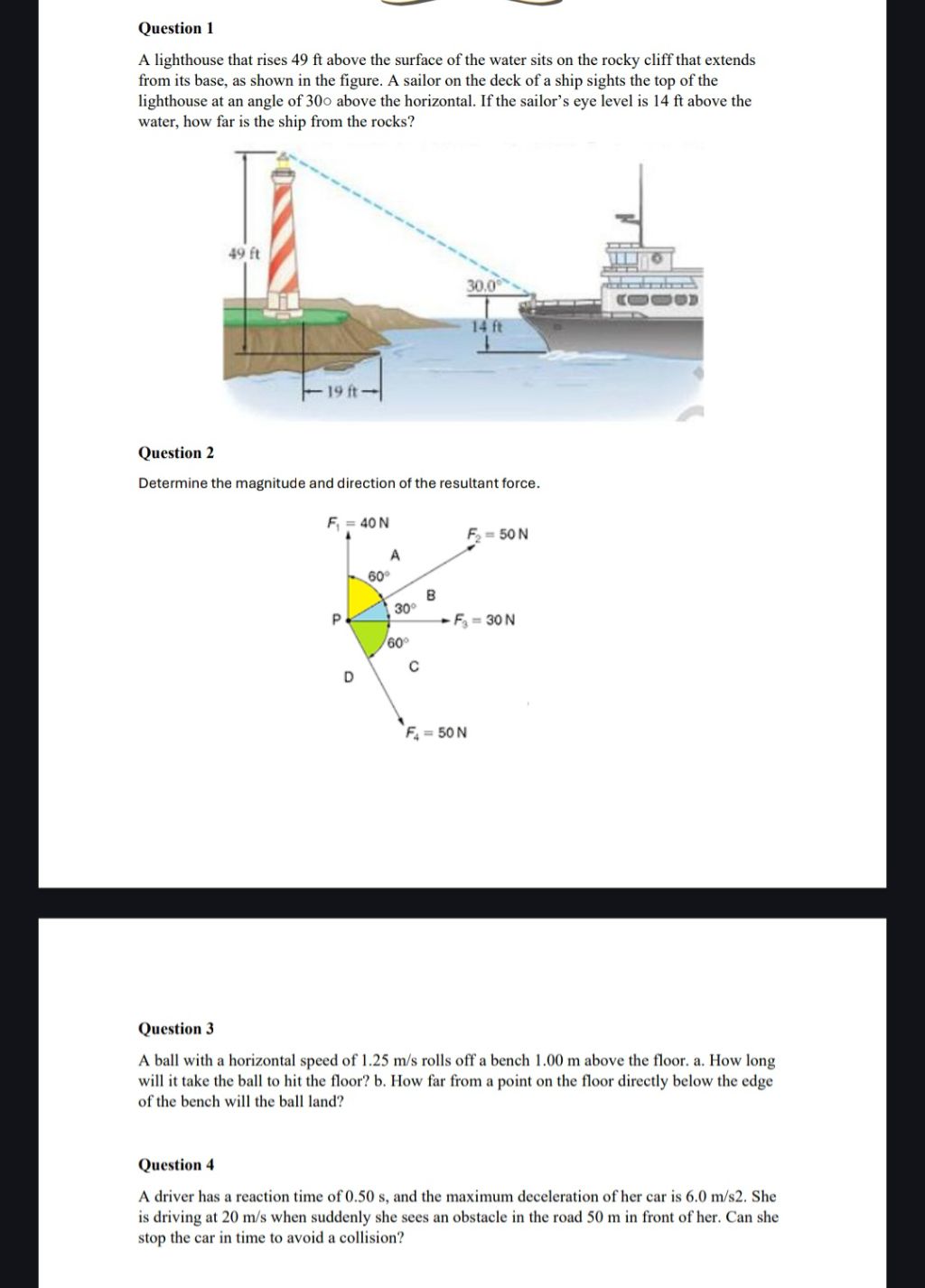 Question 1
A lighthouse that rises 49 ft above the surface of the water sits on the rocky cliff that extends
from its base, as shown in the figure. A sailor on the deck of a ship sights the top of the
lighthouse at an angle of 300 above the horizontal. If the sailor's eye level is 14 ft above the
water, how far is the ship from the rocks?
49 it / 11] ©
ill -— Tw Le (@@OD
un G——
191t fl
Question 2
Determine the magnitude and direction of the resultant force.
F, = 40N
‘ F,=50N
A -
60°
B
\ 30
P -F,=30N
60
0 Cc
\
F, = 50N
Question 3
A ball with a horizontal speed of 1.25 m/s rolls off a bench 1.00 m above the floor. a. How long
will it take the ball to hit the floor? b. How far from a point on the floor directly below the edge
of the bench will the ball land?
Question 4
A driver has a reaction time of 0.50 s, and the maximum deceleration of her car is 6.0 m/s2. She
is driving at 20 m/s when suddenly she sees an obstacle in the road 50 m in front of her. Can she
stop the car in time to avoid a collision?