 VIPSolutions
Give step-by-step solution with explanation and final answer:Ee ARN AY NR Ni eS : SN. ham g Es TE | 7 15 8 |v sg g 3 ikl 8 a 3 = pag i it - 2 x = $e kh 8 Ee gs A 3 g I BE) % 5s = § il E we kK ¢ & Me Brad i B | ml lpg H ic a | [-] Xv 7 2 B +483 H Ta w ¥ d e R i i | g a EEE
Question:
Give step-by-step solution with explanation and final answer: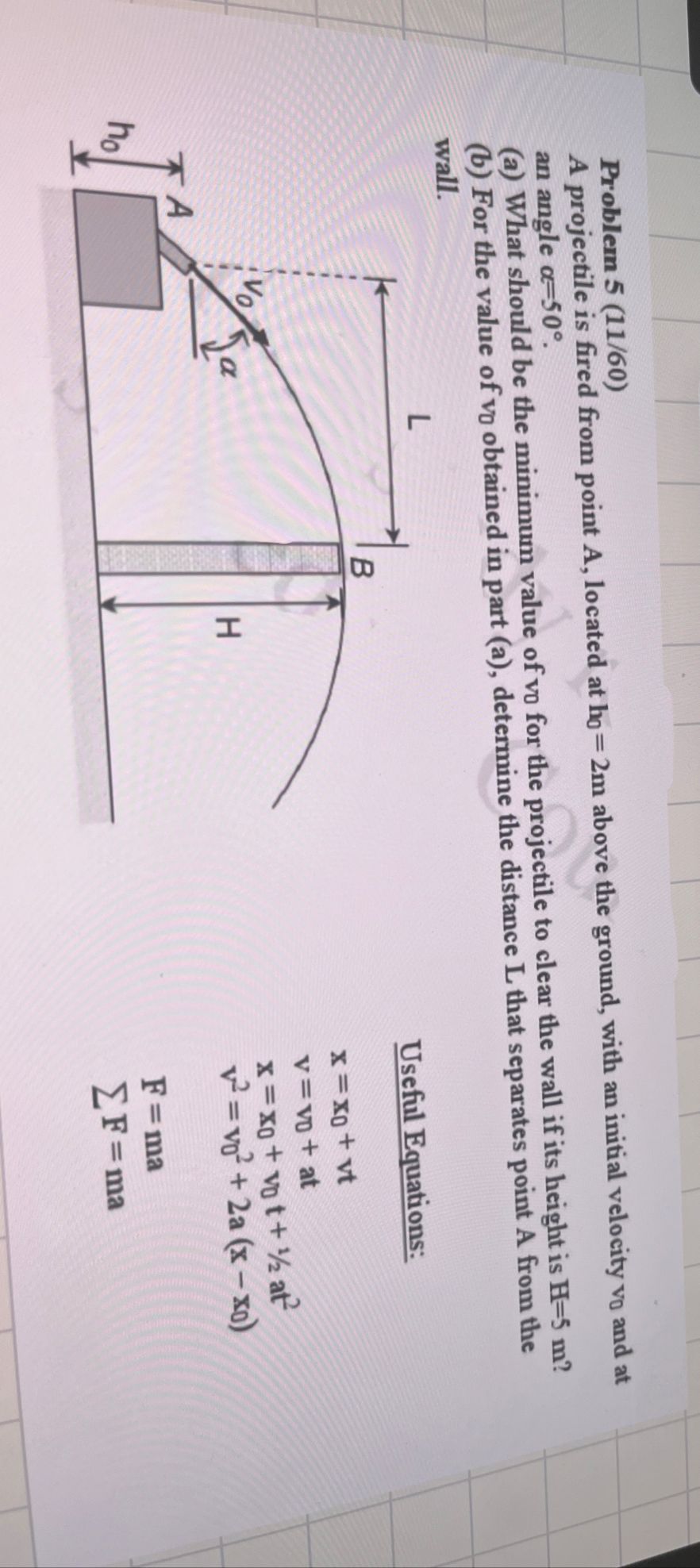 Ee ARN AY
NR Ni eS
: SN.
ham
g Es TE
| 7 15 8
|v sg g 3
ikl 8
a 3 =
pag i it -
2 x
= $e kh
8 Ee
gs A 3
g I
BE) %
5s = §
il
E
we kK ¢ &
Me Brad i B
| ml lpg H ic a
| [-] Xv 7 2
B +483 H
Ta
w ¥ d e R i i
| g a
EEE
This is AI generated Response.
Asked by: Rahul
Created at: 2026-02-19 04:23:31
Asked by: Rahul
Created at: 2026-02-19 04:23:31
Final Answer:
Rendered
Raw Text
Did you like this answer?
Let's solve the problem step by step.
---
## **Given Data**
- Initial height, \( h_ = 2\,\text{m} \)
- Initial velocity, \( v_ \) (to be found)
- Launch angle, \( \alpha = 50^\circ \)
- Wall height, \( H = 5\,\text{m} \)
- Distance to wall, \( L \) (to be found in part b)
- Acceleration due to gravity, \( g = 9.81\,\text{m/s}^2 \)
---
## **(a) Minimum \( v_ \) to clear the wall**
### **Step 1: Equations of Projectile Motion**
- **Horizontal motion**: \( x(t) = v_ \cos\alpha \cdot t \)
- **Vertical motion**: \( y(t) = h_ + v_ \sin\alpha \cdot t - \frac{1}{2}gt^2 \)
At \( x = L \), \( y = H \):
\[
L = v_ \cos\alpha \cdot t
\]
\[
H = h_ + v_ \sin\alpha \cdot t - \frac{1}{2}gt^2
\]
Solve the first for \( t \):
\[
t = \frac{L}{v_ \cos\alpha}
\]
Plug into the second:
\[
H = h_ + v_ \sin\alpha \frac{L}{v_ \cos\alpha} - \frac{1}{2}g\left(\frac{L}{v_ \cos\alpha}\right)^2
\]
Simplify:
\[
H = h_ + L \tan\alpha - \frac{g L^2}{2 v_^2 \cos^2\alpha}
\]
### **Step 2: Minimum \( v_ \) (occurs when projectile just clears wall)**
Solve for \( v_ \):
\[
H = h_ + L \tan\alpha - \frac{g L^2}{2 v_^2 \cos^2\alpha}
\]
\[
\frac{g L^2}{2 v_^2 \cos^2\alpha} = h_ + L \tan\alpha - H
\]
\[
v_^2 = \frac{g L^2}{2 \cos^2\alpha (h_ + L\tan\alpha - H)}
\]
**To minimize \( v_ \), the denominator must be maximized.**
#### **Minimum \( v_ \) occurs when \( h_ + L\tan\alpha - H \) is maximized, i.e., for the smallest possible L.**
But you are not given L or asked to find it yet.
#### **Alternate approach:**
The minimum \( v_ \) is when the projectile just passes over the wall. Set up for \( L \) as a function of \( v_ \), then minimize \( v_ \) for which the projectile just clears the wall. But since the question likely wants \( v_ \) as a function of L (since L is not given), we need to express \( v_ \) in terms of L and then find its minimum value.
But usually, the minimum \( v_ \) occurs when the projectile passes directly over the wall at its peak (maximum height), but here \( h_ < H \), so the projectile must pass over at a point where \( y = H \), not at the peak.
So, let's proceed:
### **Step 3: Express all in terms of L and solve for \( v_ \)**
\[
v_^2 = \frac{g L^2}{2 \cos^2\alpha (h_ + L\tan\alpha - H)}
\]
The minimum happens when denominator is maximized, i.e. for the maximum possible value of \( L \) such that the projectile can still reach height \( H \). Alternatively, you can set up for the minimum \( v_ \) by considering the direct vertical throw and check, but that's not the case here since \( \alpha = 50^\circ \).
So, **the minimum \( v_ \) is achieved at the smallest possible L for which the projectile can just pass over the wall at height H.** If L is not specified, express \( v_ \) in terms of L.
---
### **Final Answer for (a):**
\[
\boxed{
v_ = \sqrt{
\frac{gL^2}{2\cos^2\alpha\,(h_ + L\tan\alpha - H)}
}
}
\]
Where:
- \( g = 9.81\,\text{m/s}^2 \)
- \( \alpha = 50^\circ \)
- \( h_ = 2\,\text{m} \)
- \( H = 5\,\text{m} \)
---
## **(b) For the value of \( v_ \) obtained in part (a), determine the distance L**
Here, minimum \( v_ \) occurs when the projectile passes over the wall at the **peak** of its trajectory (i.e., maximum height).
### **Step 1: Maximum Height of the Projectile**
\[
y_{max} = h_ + \frac{v_^2 \sin^2\alpha}{2g}
\]
Set \( y_{max} = H \):
\[
H = h_ + \frac{v_^2 \sin^2\alpha}{2g}
\]
\[
\frac{v_^2 \sin^2\alpha}{2g} = H - h_
\]
\[
v_^2 = \frac{2g (H - h_)}{\sin^2\alpha}
\]
\[
v_ = \sqrt{\frac{2g (H - h_)}{\sin^2\alpha}}
\]
Now, plug the numbers:
- \( h_ = 2\,\text{m} \)
- \( H = 5\,\text{m} \)
- \( \alpha = 50^\circ \)
- \( g = 9.81\,\text{m/s}^2 \)
\[
v_ = \sqrt{\frac{2 \times 9.81 \times (5 - 2)}{\sin^2 50^\circ}}
= \sqrt{\frac{2 \times 9.81 \times 3}{(\sin 50^\circ)^2}}
\]
\[
\sin 50^\circ \approx .766
\]
\[
(\sin 50^\circ)^2 \approx .5868
\]
\[
2 \times 9.81 \times 3 = 58.86
\]
\[
v_ = \sqrt{\frac{58.86}{.5868}} \approx \sqrt{100.39} \approx 10.02\,\text{m/s}
\]
**So, the minimum \( v_ \) is:**
\[
\boxed{v_ = 10.\,\text{m/s}}
\]
---
### **Step 2: Find the Distance \( L \) at which the projectile passes over the wall**
At the peak, time to reach maximum height:
\[
v_{y,\text{final}} = = v_ \sin\alpha - gt_{\text{peak}}
\]
\[
t_{\text{peak}} = \frac{v_ \sin\alpha}{g}
\]
Horizontal distance to peak:
\[
L = v_ \cos\alpha \cdot t_{\text{peak}}
\]
\[
L = v_ \cos\alpha \cdot \left(\frac{v_ \sin\alpha}{g}\right)
\]
\[
L = \frac{v_^2 \sin\alpha \cos\alpha}{g}
\]
Plug in the numbers:
- \( v_ = 10.02\,\text{m/s} \)
- \( \sin 50^\circ = .766 \)
- \( \cos 50^\circ = .6428 \)
- \( g = 9.81\,\text{m/s}^2 \)
\[
L = \frac{(10.02)^2 \times .766 \times .6428}{9.81}
\]
\[
= \frac{100.4 \times .4926}{9.81}
\]
\[
= \frac{49.47}{9.81} \approx 5.05\,\text{m}
\]
---
### **Final Answers**
### (a) **Minimum initial velocity:**
\[
\boxed{v_ = 10.\,\text{m/s}}
\]
### (b) **Distance \( L \):**
\[
\boxed{L = 5.1\,\text{m}}
\]
---
### **Summary Table**
| Part | Variable | Value | Units |
|------|----------|-------|-------|
| a | \( v_ \) (min) | 10. | m/s |
| b | \( L \) | 5.1 | m |
---
## **Explanation**
- We use projectile motion equations to relate the minimum velocity required to clear the wall at height \( H \).
- The minimum occurs when the projectile passes over the wall at its peak.
- We then use kinematics to find the corresponding distance \( L \) from the launch point to the wall.
If you need further clarification or a symbolic answer for arbitrary values, let me know!
📢 Instructions:
- Ask anything relatd to above question only.
- For new Question goto :