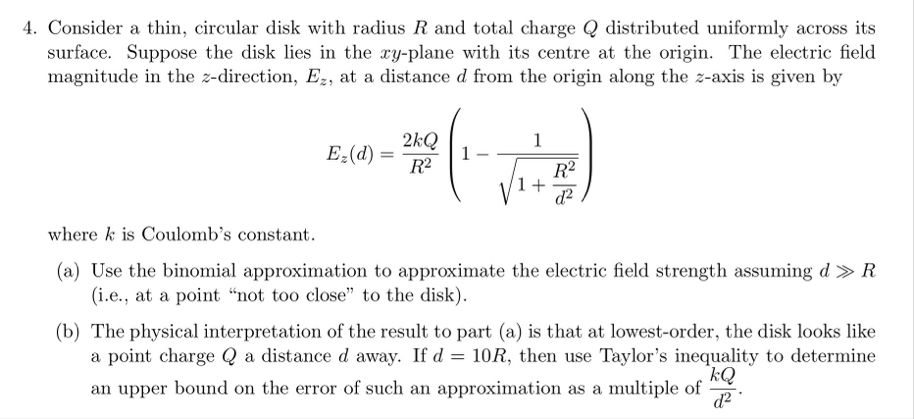
Give step-by-step solution with explanation and final answer:4. Consider a thin, circular disk with radius R and total charge Q distributed uniformly across its
surface. Suppose the disk lies in the zy-plane with its centre at the origin. The electric field
magnitude in the z-direction, E., at a distance d from the origin along the z-axis is given by
2kQ 1
Bd) = 2 | 1- JE
1+—
d?
where k is Coulomb's constant.
(a) Use the binomial approximation to approximate the electric field strength assuming d > R
(i.e. at a point “not too close” to the disk).
(b) The physical interpretation of the result to part (a) is that at lowest-order, the disk looks like
a point charge Q a distance d away. If d = 10R, then use Taylor's inequality to determine
5
an upper bound on the error of such an approximation as a multiple of Ls
Question:
Give step-by-step solution with explanation and final answer:4. Consider a thin, circular disk with radius R and total charge Q distributed uniformly across its
surface. Suppose the disk lies in the zy-plane with its centre at the origin. The electric field
magnitude in the z-direction, E., at a distance d from the origin along the z-axis is given by
2kQ 1
Bd) = 2 | 1- JE
1+—
d?
where k is Coulomb's constant.
(a) Use the binomial approximation to approximate the electric field strength assuming d > R
(i.e. at a point “not too close” to the disk).
(b) The physical interpretation of the result to part (a) is that at lowest-order, the disk looks like
a point charge Q a distance d away. If d = 10R, then use Taylor's inequality to determine
5
an upper bound on the error of such an approximation as a multiple of Ls
This is AI generated Response.
Asked by: Rahul
Created at: 2026-02-18 05:25:22
Final Answer:
RenderedRaw Text
Did you like this answer?
Let's solve both parts step by step:
---
## **(a) Binomial Approximation for \( d \gg R \)**
Given:
\[
E_z(d) = \frac{2kQ}{R^2} \left( 1 - \frac{1}{\sqrt{1 + \frac{R^2}{d^2}}} \right)
\]
For \( d \gg R \), \( \frac{R^2}{d^2} \ll 1 \).
Let's use the binomial approximation for \( (1 + x)^{-1/2} \) where \( x = \frac{R^2}{d^2} \):
\[
(1 + x)^{-1/2} \approx 1 - \frac{1}{2}x + \frac{3}{8}x^2
\]
So,
\[
\frac{1}{\sqrt{1 + \frac{R^2}{d^2}}} \approx 1 - \frac{1}{2}\left(\frac{R^2}{d^2}\right)
\]
Plug this into \( E_z(d) \):
\[
E_z(d) \approx \frac{2kQ}{R^2} \left[ 1 - \left( 1 - \frac{1}{2}\frac{R^2}{d^2} \right) \right]
= \frac{2kQ}{R^2} \left( \frac{1}{2}\frac{R^2}{d^2} \right)
= \frac{kQ}{d^2}
\]
**Explanation:**
At large distances, the electric field of the disk looks just like that of a point charge \( Q \) at the origin.
---
## **(b) Error Bound Using Taylor's Inequality**
For \( d = 10R \), \( x = \frac{R^2}{d^2} = \frac{1}{100} \).
The next term in the binomial expansion is:
\[
\frac{3}{8}x^2 = \frac{3}{8} \left( \frac{R^2}{d^2} \right)^2
\]
Taylor's inequality gives the error bound as the absolute value of the next term:
\[
\left| \text{Error} \right| \leq \frac{2kQ}{R^2} \cdot \frac{3}{8} \left( \frac{R^2}{d^2} \right)^2
= \frac{2kQ}{R^2} \cdot \frac{3}{8} \cdot \frac{R^4}{d^4}
= \frac{3kQ}{4} \cdot \frac{R^2}{d^4}
\]
Express this as a multiple of \( \frac{kQ}{d^2} \):
\[
\frac{3kQ}{4} \cdot \frac{R^2}{d^4} = \frac{3}{4} \frac{kQ}{d^2} \left( \frac{R^2}{d^2} \right)
\]
For \( d = 10R \):
\[
\frac{R^2}{d^2} = \frac{1}{100}
\]
So, the error bound is:
\[
\left| \text{Error} \right| \leq \frac{3}{4} \frac{kQ}{d^2} \left( \frac{1}{100} \right) = \frac{3}{400} \frac{kQ}{d^2}
\]
---
## **Final Answers**
### **(a)**
\[
E_z(d) \approx \frac{kQ}{d^2}
\]
### **(b)**
For \( d = 10R \), the upper bound on the error is:
\[
\boxed{
\left| \text{Error} \right| \leq \frac{3}{400} \frac{kQ}{d^2}
}
\]
VIPSolutions focuses on clear, step‑by‑step explanations so you can learn quickly. Whether you need an AI‑generated walkthrough or a short hint to get unstuck, each solution is organized for fast reading and easy review later.
Search similar questions, compare approaches, and bookmark the best answers for revision. Our goal is simple: quick, reliable study help that feels natural—not noisy.
 VIPSolutions
 4. Consider a thin, circular disk with radius R and total charge Q distributed uniformly across its
surface. Suppose the disk lies in the zy-plane with its centre at the origin. The electric field
magnitude in the z-direction, E., at a distance d from the origin along the z-axis is given by
2kQ 1
Bd) = 2 | 1- JE
1+—
d?
where k is Coulomb's constant.
(a) Use the binomial approximation to approximate the electric field strength assuming d > R
(i.e. at a point “not too close” to the disk).
(b) The physical interpretation of the result to part (a) is that at lowest-order, the disk looks like
a point charge Q a distance d away. If d = 10R, then use Taylor's inequality to determine
5
an upper bound on the error of such an approximation as a multiple of Ls