 VIPSolutions
Give step-by-step solution with explanation and final answer:vy g123” | e— B iil 2 EEL 1 HH] i i oa 3 ist hs HE 1 i RS il i i iH iE: fi gt { 3
Question:
Give step-by-step solution with explanation and final answer: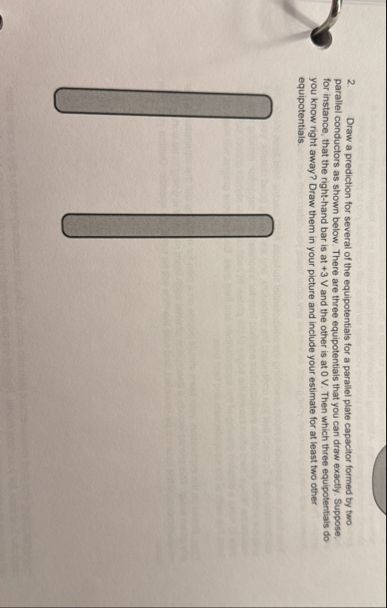 vy
g123”
| e—
B iil
2 EEL
1 HH]
i i
oa
3 ist
hs HE
1 i
RS il
i
i
iH
iE: fi
gt {
3
This is AI generated Response.
Asked by: Rahul
Created at: 2026-02-18 03:29:56
Asked by: Rahul
Created at: 2026-02-18 03:29:56
Final Answer:
Rendered
Raw Text
Did you like this answer?
Let's break down and solve the problem step by step.
---
## **Problem Restatement**
You are asked to:
1. **Draw a depiction of several equipotentials** for a parallel plate capacitor formed by two parallel conductors (as shown).
2. **Suppose the potential difference between the plates is 3 V**, with the top plate at V and the bottom at 3 V.
3. **Show the equipotentials clearly.**
4. **Estimate the spacing between them if the plates are separated by 6 cm.**
5. **Draw at least two other equipotentials and label your estimates.**
---
## **Step-by-Step Solution**
### **Step 1: Understanding Equipotentials in a Parallel Plate Capacitor**
- **Equipotentials** are lines (or surfaces, in 3D) where the electric potential is constant.
- For a parallel plate capacitor with plates at uniform potential difference, the equipotentials are **equally spaced straight lines parallel to the plates**.
---
### **Step 2: Setting Up Values**
- **Top plate**: \( V = \) V
- **Bottom plate**: \( V = 3 \) V
- **Separation**: \( d = 6 \) cm \( = .06 \) m
The electric field between the plates is uniform, so the potential varies **linearly** with distance between the plates.
---
### **Step 3: Equation for Potential**
Let \( y \) be the vertical distance from the top plate (top = , bottom = 6 cm):
\[
V(y) = \left(\frac{3 \text{ V}}{6 \text{ cm}}\right) y = .5y \text{ V/cm}
\]
---
### **Step 4: Calculating Equipotential Locations**
Let's pick at least **two intermediate equipotentials** (besides the plates):
- **Equipotential at 1 V:**
\[
1 = .5y \implies y = 2 \text{ cm}
\]
- **Equipotential at 2 V:**
\[
2 = .5y \implies y = 4 \text{ cm}
\]
So, the equipotentials are at:
- ** V**: Top plate ( cm)
- **1 V**: 2 cm from top
- **2 V**: 4 cm from top
- **3 V**: Bottom plate (6 cm)
---
### **Step 5: Drawing the Equipotentials**
Here’s how to draw and label them:
```
--------------------------------- (Top plate, V, y = cm)
--------------------------------- (Equipotential, 1 V, y = 2 cm)
--------------------------------- (Equipotential, 2 V, y = 4 cm)
--------------------------------- (Bottom plate, 3 V, y = 6 cm)
```
**Label each line** with its potential and distance from the top plate.
---
### **Step 6: Final Answer - Written Description**
#### **Equipotentials for Parallel Plate Capacitor**
- Equipotentials are straight horizontal lines parallel to the plates.
- For this case, the lines are located at:
- cm ( V, top plate)
- 2 cm (1 V)
- 4 cm (2 V)
- 6 cm (3 V, bottom plate)
- The spacing between adjacent equipotentials (for 1 V difference) is **2 cm**.
#### **Diagram Example**
```
|----------------| V (Top Plate, y = cm)
|----------------| 1 V (y = 2 cm)
|----------------| 2 V (y = 4 cm)
|----------------| 3 V (Bottom Plate, y = 6 cm)
```
---
## **Summary Table**
| Distance from Top Plate (cm) | Potential (V) |
|-----------------------------|---------------|
| | |
| 2 | 1 |
| 4 | 2 |
| 6 | 3 |
---
## **Final Answer**
**Equipotentials are straight, equally spaced lines parallel to the plates. For a 6 cm separation and 3 V across the plates:**
- V at top plate ( cm)
- 1 V at 2 cm
- 2 V at 4 cm
- 3 V at bottom plate (6 cm)
The **spacing between 1 V equipotentials is 2 cm**.
---
If you need this as a hand-drawn image, let me know!
📢 Instructions:
- Ask anything relatd to above question only.
- For new Question goto :