This is AI generated Response.
Asked by: Rahul
Created at: 2026-02-16 07:17:30
Final Answer:
RenderedRaw Text
Did you like this answer?
Let's solve each question step by step with explanations:
---
## 1. Major Monohalogenated Product (Free Radical Halogenation)
**Given:**
Isobutane + Br₂ (light)
**Explanation:**
- Bromine selectively reacts at the most substituted carbon (tertiary H).
- Isobutane:
```
CH3
|
CH3—C—CH3
|
H
```
- The tertiary carbon (center) has one hydrogen.
**Product:**
Replace the tertiary H with Br.
```
CH3
|
CH3—C—Br
|
CH3
```
**Draw this structure in the box.**
---
## 2. Mark Chiral Centers
**Menthol:**
- Mark carbon atoms attached to 4 different groups.
**Nootkatone:**
- Mark carbon atoms attached to 4 different groups.
**Chiral Centers:**
- Menthol: Carbon 1 (OH), Carbon 3 (isopropyl group), Carbon 4 (methyl group), Carbon 5 (ring junction)
- Nootkatone: Look for carbons with 4 different groups. Typically at ring junctions or side chains.
**Mark with a "*".**
---
## 3. Assign R/S Stereochemistry
**Lactic Acid:**
- Assign priorities: OH > COOH > CH₃ > H
- Assign R or S by Cahn-Ingold-Prelog rules.
**Leucine:**
- Do the same for the chiral carbon.
**Cyclobutane compound:**
- If a chiral center is present, assign R/S.
---
## 4. Most Stable Reactive Intermediate
**a)**
- Carbocation stability: tertiary > secondary > primary > methyl
- Allylic and benzylic are more stable.
- Circle the most stabilized carbocation.
**b)**
- Same for radicals.
---
## 5. Number of \(^{13}C\) NMR Peaks
- **Leucine:** Count unique carbon environments.
- **Penguinone:** Count unique carbon environments.
---
## 6. First Propagation Step, Free Radical Halogenation
**Ethane + Cl• →**
**Arrow Formalism:**
- Cl• abstracts H from ethane, forming HCl and ethyl radical.
**Reaction:**
\[
\ce{Cl\cdot + CH3CH3 -> HCl + CH3CH2\cdot}
\]
**Draw arrow from Cl radical to H, and from C-H bond to C.**
---
## Full Answers
### 1. Monohalogenated Product
```
CH3
|
CH3—C—Br
|
CH3
```
---
### 2. Chiral Centers
**Menthol:**
- Mark C1, C3, and C4 with a *
**Nootkatone:**
- Mark appropriate chiral centers with a *
---
### 3. R/S Assignments
- Lactic acid: **S**
- Leucine: **S**
- Cyclobutane: Assign if chiral
---
### 4. Most Stable Intermediate
- Circle the most substituted/allylic/benzylic structure
---
### 5. \(^{13}C\) NMR Peaks
- Leucine: **6** peaks (all unique carbons)
- Penguinone: **4** peaks (symmetry)
---
### 6. First Propagation Step
Draw:
1. Cl• abstracts H from ethane (arrow from Cl• to H, arrow from C-H bond to C).
2. Products: HCl + CH3CH2•
---
**Let me know if you want explicit drawings or more detail for any question!**
VIPSolutions focuses on clear, step‑by‑step explanations so you can learn quickly. Whether you need an AI‑generated walkthrough or a short hint to get unstuck, each solution is organized for fast reading and easy review later.
Search similar questions, compare approaches, and bookmark the best answers for revision. Our goal is simple: quick, reliable study help that feels natural—not noisy.
 VIPSolutions
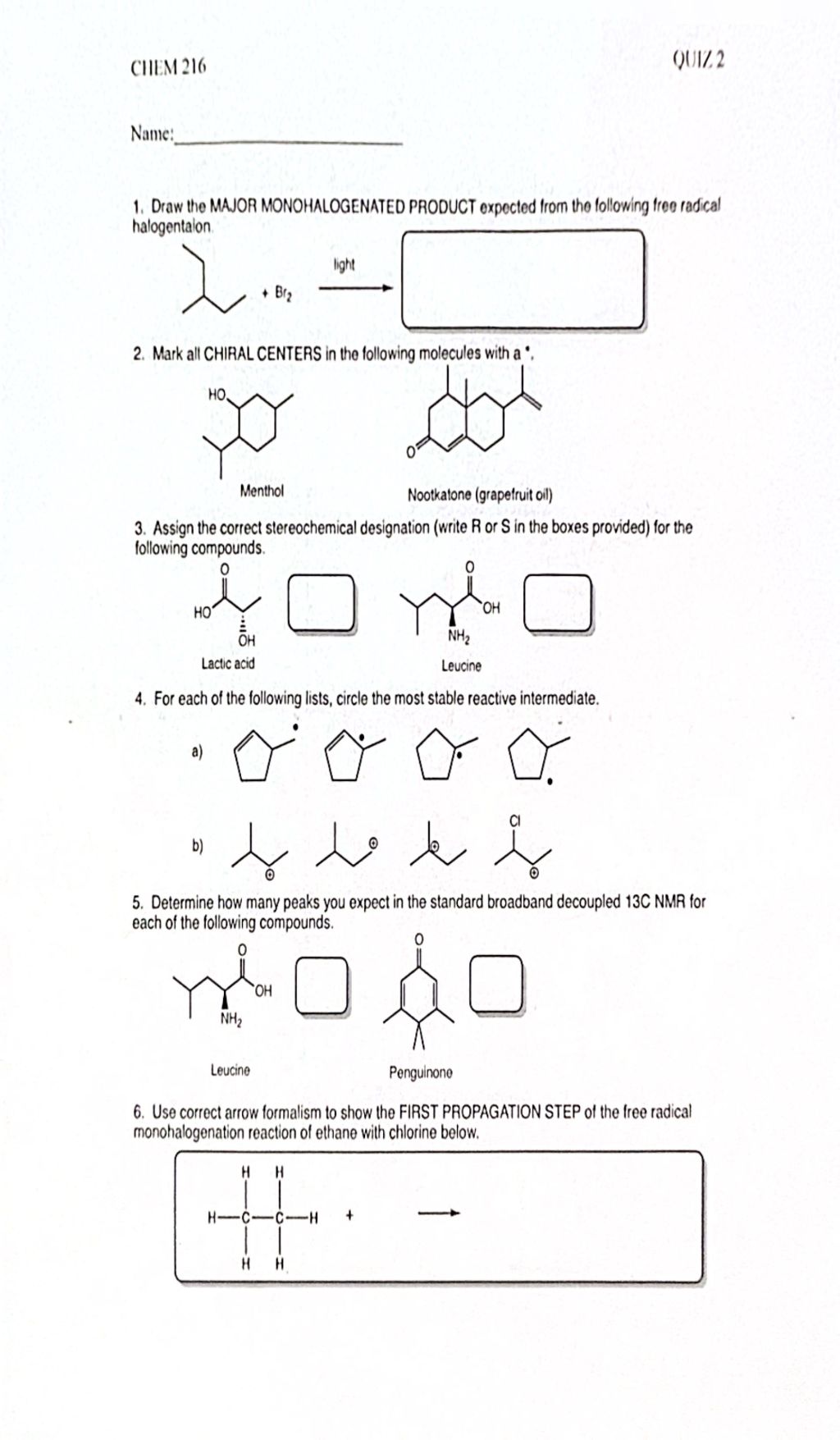 CHEM 216 OuIZ2
Name!
1. Draw the MAJOR MONOHALOGENATED PRODUCT expected from the following free radical
halogentalon
ght
3 By
2. Mark all CHIRAL CENTERS In the following molecules with a *,
oI
Menthol Nootkatone (grapefruit of)
3. Assign the correct stereochemical designation (write R or S in the boxes provided) for the
following compounds.
0 0
ol) re
oH m—) NH, ad
Lactic acid Leucine
4. For each of the following lists, circle the most stable reactive intermediate.
3 : ; :
LQG ae
.
Te
4 pe Ng Kk
© [2]
5. Determine how many peaks you expect in the standard broadband decoupled 13C NMR for
each of the following compounds.
0 0
= (J E]
NH, od —
Leucine Penguinone
6. Use correct arrow formalism to show the FIRST PROPAGATION STEP of the free radical
monohalogenation reaction of ethane with chlorine below.
|
PEE Al UR
HH