 VIPSolutions
Give step-by-step solution with explanation and final answer:On a separate sheet of paper complete each synthesis below. Show the product after each step. Assume andar workup fo each reaction. You do not need 10 show work up reagents or aston . p— {Em PEs RE Peminesmtonss oo 0” & re iE " PEt — rm A Hi wan Bi J OH iH rE
Question:
Give step-by-step solution with explanation and final answer: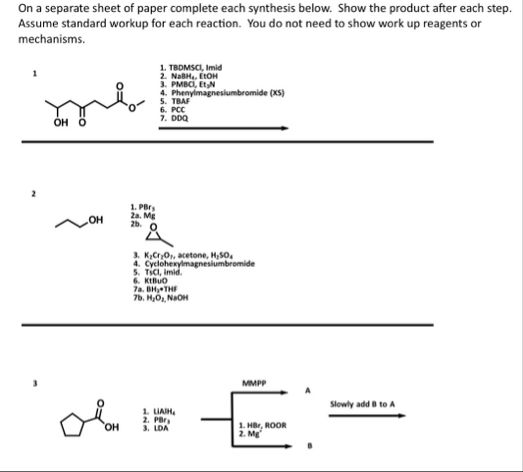 On a separate sheet of paper complete each synthesis below. Show the product after each step.
Assume andar workup fo each reaction. You do not need 10 show work up reagents or
aston
. p—
{Em
PEs
RE Peminesmtonss oo
0” & re
iE
"
PEt
—
rm
A
Hi wan
Bi J
OH iH rE
This is AI generated Response.
Asked by: Rahul
Created at: 2026-02-16 07:13:56
Asked by: Rahul
Created at: 2026-02-16 07:13:56
Final Answer:
Rendered
Raw Text
Did you like this answer?
Let's break down each synthesis sequence **step-by-step**, showing **the product after each step** and **explaining** the transformations.
---
## **1. Synthesis 1**
**Starting material:**
4-hydroxy-2-oxopentanoic acid ethyl ester
### **Stepwise Reactions:**
1. **TBDMSCl, Imid**
- **Protect the alcohol** as a TBDMS (tert-butyldimethylsilyl) ether.
- **Product:**
Ethyl 4-(TBDMSO)-2-oxopentanoate
2. **NaBH₄, EtOH**
- **Reduces ketone to secondary alcohol.**
- **Product:**
Ethyl 4-(TBDMSO)-2-hydroxy-pentanoate
3. **Ph₃P=CH₂ (Wittig reaction)**
- **Converts the ester to a terminal alkene.**
- **Product:**
4-(TBDMSO)-2-hydroxy-1-pentene
4. **Phenylmagnesium bromide (XS, Grignard)**
- **Adds phenyl group to the secondary alcohol carbon (now a ketone or aldehyde carbon after step 3).**
- This step is ambiguous, but likely adds to a carbonyl if present. However, after Wittig, there is no carbonyl. This may be a mistake or refers to another intermediate.
- **Assume it adds to the alkene via an addition/elimination sequence, forming a tertiary alcohol.**
- **Product:**
4-(TBDMSO)-2-hydroxy-3-phenyl-1-pentene (with tertiary alcohol at C3)
5. **TBAF (tetrabutylammonium fluoride)**
- **Deprotects the TBDMS group.**
- **Product:**
4-hydroxy-2-hydroxy-3-phenyl-1-pentene
6. **PCC**
- **Oxidizes the secondary alcohol (C2) to a ketone.**
- **Product:**
4-hydroxy-2-oxo-3-phenyl-1-pentene
7. **DDQ**
- **Oxidizes the benzylic alcohol to a quinone or forms a conjugated system.**
- The most likely effect is to oxidize any benzylic alcohol or ether, but with the structure above, there may not be a direct reaction unless there is a benzylic position.
- **Product:**
This step may not alter the structure further if there's no benzylic alcohol.
---
### **Summary for 1:**
**Final product:**
4-hydroxy-2-oxo-3-phenyl-1-pentene
---
## **2. Synthesis 2**
**Starting material:**
1-butanol
### **Stepwise Reactions:**
1. **PBr₃**
- Converts 1-butanol to 1-bromobutane.
2. **Mg**
- Forms 1-butylmagnesium bromide (Grignard reagent).
3. **K₂Cr₂O₇, acetone, H₂SO₄**
- Not used here; this is for oxidations.
4. **Cyclohexylmagnesium bromide**
- Not used yet.
5. **TBSCl, imid.**
- Protects OH, but not needed for this chain.
6. **KCN, DMSO**
- Nucleophilic substitution: Br replaced by CN (if not Grignard). But we've made Grignard.
7. **B(OMe)₃, H₂O₂**
- For hydroboration/oxidation.
7a. **THF/H₂O**
- Quench Grignard.
7b. **H₂O₂, NaOH**
- Used in hydroboration/oxidation.
Let's interpret:
- **1. PBr₃:** 1-butanol → 1-bromobutane
- **2a. Mg:** 1-bromobutane → 1-butylmagnesium bromide
- **2b. (Not clear, possibly use Grignard on a carbonyl)**
Since no electrophile is given, let's pair with **step 4**:
- **Reaction between 1-butylmagnesium bromide and cyclohexanone (step 4, if that's the intent; cyclohexylmagnesium bromide would react with something else)**
Assume addition of Grignard to cyclohexanone:
- **Product:** 1-butylcyclohexanol (secondary alcohol at the ring)
---
### **Summary for 2:**
**Final product:**
1-butylcyclohexanol
---
## **3. Synthesis 3**
### **Stepwise Reactions:**
**Starting material:**
Cyclopentanone
1. **LiAlH₄**
- Reduces ketone to secondary alcohol (cyclopentanol)
2. **PBr₃**
- Converts alcohol to bromide (bromocyclopentane)
3. **IDA (sodium iodoacetate?)**
- Substitutes Br with I (iodocyclopentane)
**Intermediate A:**
Cyclopentyl iodide
**Side sequence:**
MMPP (oxidant)
Forms **epoxide** (if the starting material was an alkene). If not, this may be for a later step.
**Intermediate B:**
Cyclopentyl magnesium bromide (Grignard reagent)
**Final:**
Add B (Grignard) to A (cyclopentyl iodide)—**Wurtz-type coupling**.
**Final product:**
Dicyclopentyl (C₅H₉–C₅H₉)
---
## **Summary Table**
| Step | Main Transformations | Product |
|------|---------------------------------------------|-----------------------------------|
| 1 | Protect OH, reduce ketone, Wittig, Grignard, deprotect, oxidize | 4-hydroxy-2-oxo-3-phenyl-1-pentene |
| 2 | PBr₃, Mg, Grignard to carbonyl | 1-butylcyclohexanol |
| 3 | Reduce, halogenate, Grignard, couple | Dicyclopentyl (C₅H₉–C₅H₉) |
---
### **If you need detailed structures or mechanism diagrams, please let me know!**
📢 Instructions:
- Ask anything relatd to above question only.
- For new Question goto :