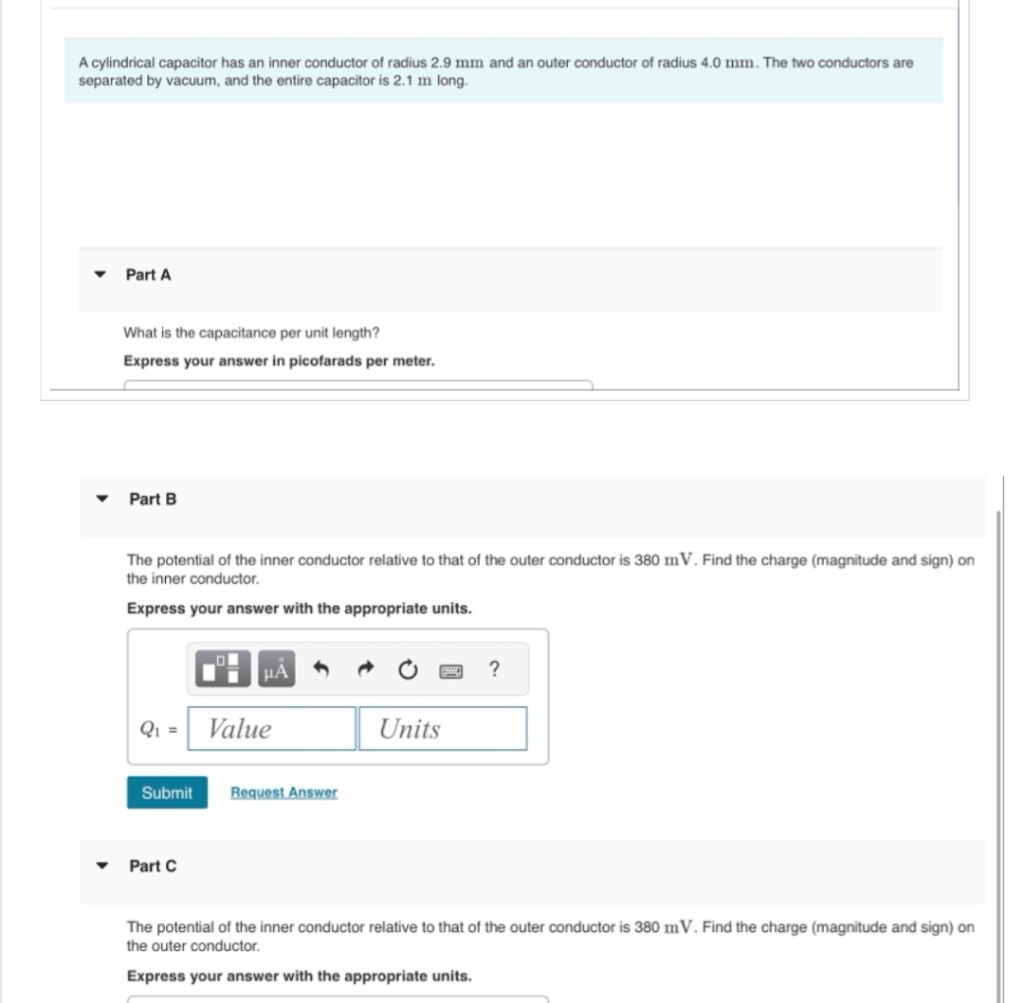
Give step-by-step solution with explanation and final answer:Acylindrical capacitor has an inner conductor of radius 2.9 mum and an outer conductor of radius 4.0 mm. The two conductors are
separated by vacuum, and the entire capacitor is 2.1m long.
v PartA
What is the capacitance per unit length?
Express your answer in picofarads per meter.
v PartB
The potential of the inner conductor relative to that of the outer conductor is 380 mV . Find the charge (magnitude and sign) on
the inner conductor.
Express your answer with the appropriate units.
HB. os
@ =| Value | Units
[suomi | Request Answer
v PartC
The potential of the inner conductor relative to that of the outer conductor is 380 mV. Find the charge (magnitude and sign) on
the outer conductor.
Express your answer with the appropriate units.
Question:
Give step-by-step solution with explanation and final answer:Acylindrical capacitor has an inner conductor of radius 2.9 mum and an outer conductor of radius 4.0 mm. The two conductors are
separated by vacuum, and the entire capacitor is 2.1m long.
v PartA
What is the capacitance per unit length?
Express your answer in picofarads per meter.
v PartB
The potential of the inner conductor relative to that of the outer conductor is 380 mV . Find the charge (magnitude and sign) on
the inner conductor.
Express your answer with the appropriate units.
HB. os
@ =| Value | Units
[suomi | Request Answer
v PartC
The potential of the inner conductor relative to that of the outer conductor is 380 mV. Find the charge (magnitude and sign) on
the outer conductor.
Express your answer with the appropriate units.
This is AI generated Response.
Asked by: Rahul
Created at: 2026-02-16 04:12:10
Final Answer:
RenderedRaw Text
Did you like this answer?
Let's solve each part step by step:
---
## **Given Data**
- Inner conductor radius, \( a = 2.9 \) mm \( = 2.9 \times 10^{-3} \) m
- Outer conductor radius, \( b = 4. \) mm \( = 4. \times 10^{-3} \) m
- Length of capacitor, \( L = 2.1 \) m
- Vacuum between conductors
- Potential difference (\( V \)) for parts B & C: \( 380 \) mV \( = .380 \) V
---
## **Part A: Capacitance per unit length**
### **Formula for Cylindrical Capacitor Capacitance per unit length:**
\[
C' = \frac{2\pi \varepsilon_}{\ln(b/a)}
\]
Where:
- \( C' \) = capacitance per unit length (F/m)
- \( \varepsilon_ = 8.854 \times 10^{-12} \) F/m (vacuum permittivity)
- \( a \) = inner radius (m)
- \( b \) = outer radius (m)
### **Calculation**
1. Calculate \( \ln(b/a) \):
\[
\ln\left(\frac{b}{a}\right) = \ln\left(\frac{4. \times 10^{-3}}{2.9 \times 10^{-3}}\right) = \ln(1.37931) \approx .321
\]
2. Substitute values:
\[
C' = \frac{2 \pi (8.854 \times 10^{-12})}{.321}
\]
\[
= \frac{2 \times 3.1416 \times 8.854 \times 10^{-12}}{.321}
\]
\[
= \frac{55.614 \times 10^{-12}}{.321}
\]
\[
= 173.25 \times 10^{-12} \text{ F/m}
\]
\[
= 173.25 \text{ pF/m}
\]
**Final Answer Part A:**
\[
\boxed{173 \ \text{pF/m}}
\]
---
## **Part B: Charge on the Inner Conductor**
### **Formula:**
\[
Q = C \cdot V
\]
But for the total capacitor:
\[
C = C' \cdot L
\]
So:
\[
Q = (C' \cdot L) \cdot V
\]
### **Calculation:**
\[
C' = 173.25 \times 10^{-12} \ \text{F/m}
\]
\[
L = 2.1 \ \text{m}
\]
\[
V = .380 \ \text{V}
\]
\[
C = 173.25 \times 10^{-12} \times 2.1 = 363.825 \times 10^{-12} \ \text{F}
\]
\[
Q = 363.825 \times 10^{-12} \times .380 = 138.25 \times 10^{-12} \ \text{C}
\]
\[
Q \approx 1.38 \times 10^{-10} \ \text{C}
\]
**Final Answer Part B:**
\[
\boxed{1.38 \times 10^{-10} \ \text{C}}
\]
(The charge is **positive** on the inner conductor.)
---
## **Part C: Charge on the Outer Conductor**
- By conservation of charge, if inner is \( +Q \), outer is \( -Q \).
**Final Answer Part C:**
\[
\boxed{-1.38 \times 10^{-10} \ \text{C}}
\]
(The charge is **negative** on the outer conductor.)
---
### **Summary Table**
| Part | Quantity | Value |
|------|------------------------------|--------------------------------|
| A | Capacitance per unit length | \( 173 \) pF/m |
| B | Charge on inner conductor | \( +1.38 \times 10^{-10} \) C |
| C | Charge on outer conductor | \( -1.38 \times 10^{-10} \) C |
Let me know if you need any clarifications!
VIPSolutions focuses on clear, step‑by‑step explanations so you can learn quickly. Whether you need an AI‑generated walkthrough or a short hint to get unstuck, each solution is organized for fast reading and easy review later.
Search similar questions, compare approaches, and bookmark the best answers for revision. Our goal is simple: quick, reliable study help that feels natural—not noisy.
 VIPSolutions
 Acylindrical capacitor has an inner conductor of radius 2.9 mum and an outer conductor of radius 4.0 mm. The two conductors are
separated by vacuum, and the entire capacitor is 2.1m long.
v PartA
What is the capacitance per unit length?
Express your answer in picofarads per meter.
v PartB
The potential of the inner conductor relative to that of the outer conductor is 380 mV . Find the charge (magnitude and sign) on
the inner conductor.
Express your answer with the appropriate units.
HB. os
@ =| Value | Units
[suomi | Request Answer
v PartC
The potential of the inner conductor relative to that of the outer conductor is 380 mV. Find the charge (magnitude and sign) on
the outer conductor.
Express your answer with the appropriate units.