 VIPSolutions
Give step-by-step solution with explanation and final answer:Previous Answers X Submission 1 (0/357 points) Thursday, February 12, 2026 06:17 PM CST A platinum resistance thermometer has resistances of 210.0 © when placed in a 0°C ice bath and 257.8 0 when immersed in a crucible containing a melting substance What is the melting point of this substance? (Hint: First determine the resistance of the platinum resistance thermometer at room temperature, 20.0°C.) x Your response is within 10% of the correct value. This may be due to roundoff era; o you could have a mistake in your calculation. Carry out ail intermediate results to at east four-digit accuracy to minimize roundoff errorC Submission 2 (0/357 points) Thursday, February 12, 2026 06:17 PM CST Serce12 175 p03 A platinum resistance thermometer has resistances of 210.0 © when placed In a 0°C ice bath and 257.8 0 when immersed in a crucble containing a melting substance. What is the melting point of this substance? (Hint: First determine the resistance of the platinum resistance thermometer at room temperature, 20.0°C.) x Your response s within 10% of the correct value. This may be due to roundoff ert, o you could have a mistake In your calculation. Carry out all Intermediate results to at least four-digit accuracy to minimize roundoff error SC Submission 3 (0/357 points) Thursday, February 12,2026 06:18 PM CST sercPi2 175.7034 A platinum resistance thermometer has resistances of 210.0 © when placed In a 0°C ice bath and 257.8 0 when Immersed in a crucle containing a melting substance. What is the melting point of ths substance? (Hint: First determine the resistance of the platinum resistance thermometer at room temperature, 20.0°C.) x Your response s within 10% of the correct value. This may be due to roundoff error, or you could have a mistake In your calculation. Carry out al Intermediate results to at least four-digit accuracy to minimize roundoff errorsC
Question:
Give step-by-step solution with explanation and final answer: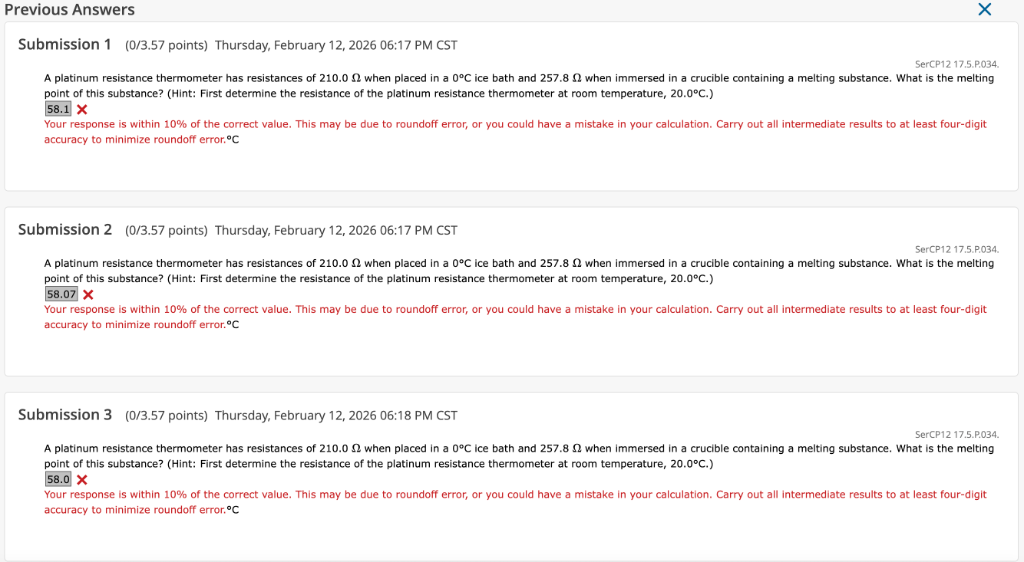 Previous Answers X
Submission 1 (0/357 points) Thursday, February 12, 2026 06:17 PM CST
A platinum resistance thermometer has resistances of 210.0 © when placed in a 0°C ice bath and 257.8 0 when immersed in a crucible containing a melting substance What is the melting
point of this substance? (Hint: First determine the resistance of the platinum resistance thermometer at room temperature, 20.0°C.)
x
Your response is within 10% of the correct value. This may be due to roundoff era; o you could have a mistake in your calculation. Carry out ail intermediate results to at east four-digit
accuracy to minimize roundoff errorC
Submission 2 (0/357 points) Thursday, February 12, 2026 06:17 PM CST
Serce12 175 p03
A platinum resistance thermometer has resistances of 210.0 © when placed In a 0°C ice bath and 257.8 0 when immersed in a crucble containing a melting substance. What is the melting
point of this substance? (Hint: First determine the resistance of the platinum resistance thermometer at room temperature, 20.0°C.)
x
Your response s within 10% of the correct value. This may be due to roundoff ert, o you could have a mistake In your calculation. Carry out all Intermediate results to at least four-digit
accuracy to minimize roundoff error SC
Submission 3 (0/357 points) Thursday, February 12,2026 06:18 PM CST
sercPi2 175.7034
A platinum resistance thermometer has resistances of 210.0 © when placed In a 0°C ice bath and 257.8 0 when Immersed in a crucle containing a melting substance. What is the melting
point of ths substance? (Hint: First determine the resistance of the platinum resistance thermometer at room temperature, 20.0°C.)
x
Your response s within 10% of the correct value. This may be due to roundoff error, or you could have a mistake In your calculation. Carry out al Intermediate results to at least four-digit
accuracy to minimize roundoff errorsC
Asked by: Rahul
Created at: 2026-02-16 04:02:14
Final Answer:
📢 Instructions:
- Ask anything relatd to above question only.
- For new Question goto :