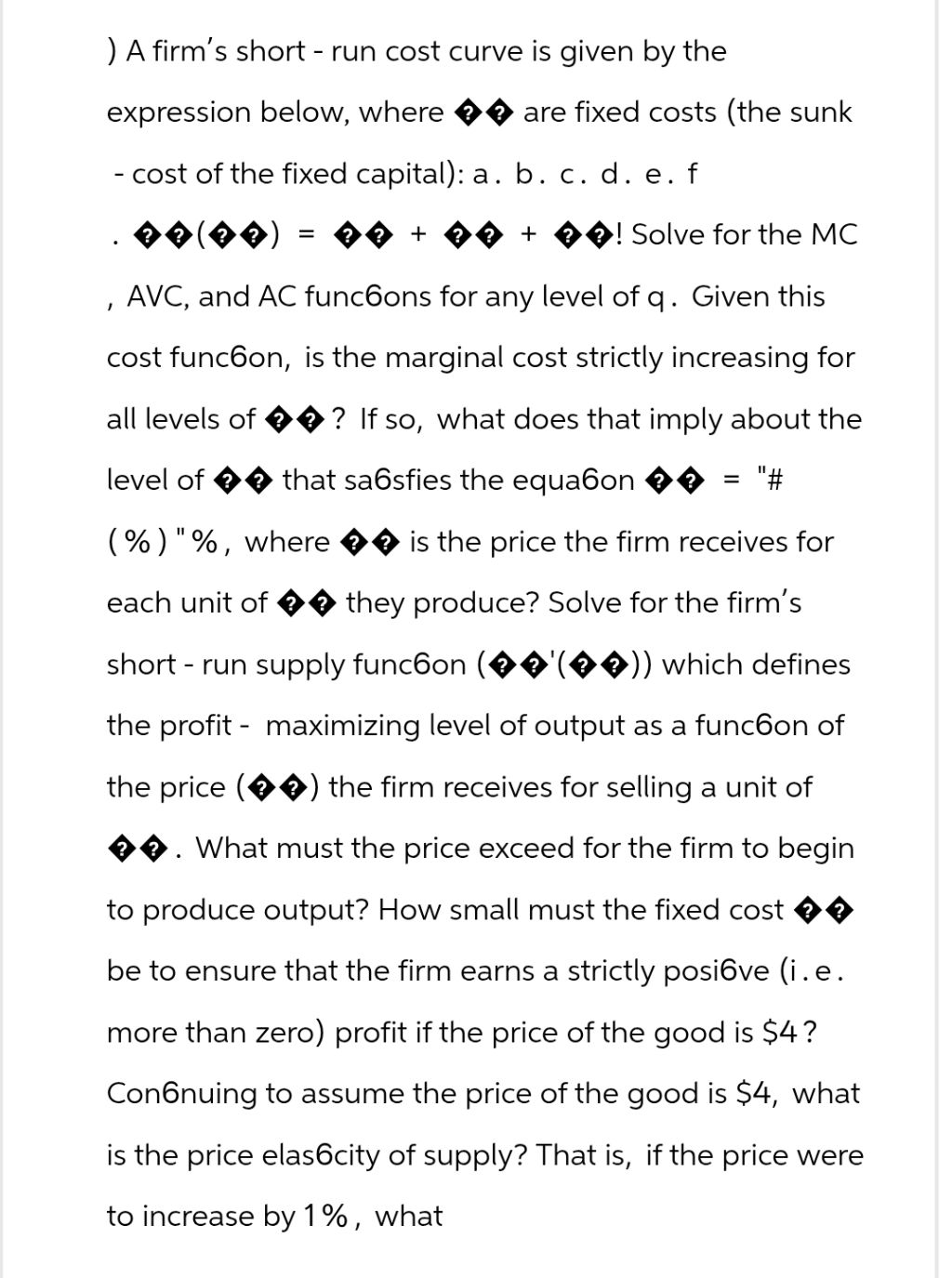
Give step-by-step solution with explanation and final answer:) A firm's short - run cost curve is given by the
expression below, where €€ are fixed costs (the sunk
- cost of the fixed capital):a. b. c. d. e. f
. 0009) = 00 + QO + ©! Solve for the MC
, AVC, and AC func6ons for any level of q. Given this
cost funcBon, is the marginal cost strictly increasing for
all levels of @€ ? If so, what does that imply about the
level of €€ that saBsfies the equabon @€@ = "#
(%)"%, where @€ is the price the firm receives for
each unit of © € they produce? Solve for the firm's
short - run supply func6on (@€'(€€)) which defines
the profit - maximizing level of output as a func6on of
the price (@€) the firm receives for selling a unit of
© ©. What must the price exceed for the firm to begin
to produce output? How small must the fixed cost @€
be to ensure that the firm earns a strictly posi6ve (i.e.
more than zero) profit if the price of the good is $4?
Conbnuing to assume the price of the good is $4, what
is the price elas6city of supply? That is, if the price were
to increase by 1%, what
Question:
Give step-by-step solution with explanation and final answer:
This is AI generated Response. Asked by: Rahul Created at: 2026-02-15 05:16:53
Did you like this answer?
👍 0
👎 0
Let's break down the problem **step by step**:
---
## **1. Given Cost Function**
\[
C(q) = F + q + q^2
\]
where:
- \( F \) = fixed cost
- \( q \) = output produced
---
## **2. Marginal Cost (MC), Average Variable Cost (AVC), Average Cost (AC)**
### **Marginal Cost (MC)**
\[
MC(q) = \frac{dC}{dq} = \frac{d}{dq}(F + q + q^2) = 1 + 2q
\]
---
### **Average Variable Cost (AVC)**
Variable cost: \( VC(q) = q + q^2 \)
\[
AVC(q) = \frac{VC(q)}{q} = \frac{q + q^2}{q} = 1 + q
\]
---
### **Average Cost (AC)**
\[
AC(q) = \frac{C(q)}{q} = \frac{F + q + q^2}{q} = \frac{F}{q} + 1 + q
\]
---
## **3. Is the Marginal Cost Strictly Increasing?**
\[
MC(q) = 1 + 2q
\]
The derivative w.r.t \( q \) is \( 2 > \).
**Yes, MC is strictly increasing for all \( q \).**
---
## **4. Profit-Maximizing Output (\( q^* \))**
Set **MC = P**, where \( P \) is the market price:
\[
1 + 2q = P \implies q^* = \frac{P - 1}{2}
\]
---
## **5. Short-Run Supply Function**
The supply function gives the profit-maximizing output as a function of price:
\[
q^*(P) =
\begin{cases}
& \text{if } P < 1 \\
\frac{P - 1}{2} & \text{if } P \geq 1
\end{cases}
\]
---
## **6. Minimum Price to Produce Output**
The firm will **begin to produce** when \( P = AVC \):
\[
P \geq AVC(q)
\]
At \( q = \): \( AVC() = 1 \)
**Minimum price to produce:** \( P \geq 1 \)
---
## **7. Minimum Fixed Cost for Strictly Positive Profit if \( P = \$4 \)**
Profit:
\[
\pi = PQ - C(Q) = 4q - (F + q + q^2)
\]
Using \( q^* = \frac{4-1}{2} = 1.5 \):
\[
\pi = 4(1.5) - (F + 1.5 + (1.5)^2)
\]
\[
\pi = 6 - (F + 1.5 + 2.25) = 6 - F - 3.75 = 2.25 - F
\]
For positive profit: \( 2.25 - F > \implies F < 2.25 \)
---
## **8. Price Elasticity of Supply at \( P = \$4 \)**
Price elasticity of supply (\( \epsilon \)):
\[
\epsilon = \frac{dq}{dP} \cdot \frac{P}{q}
\]
From supply function: \( q = \frac{P - 1}{2} \implies \frac{dq}{dP} = \frac{1}{2} \)
At \( P = 4 \), \( q = 1.5 \):
\[
\epsilon = \frac{1}{2} \cdot \frac{4}{1.5} = \frac{4}{3}
\]
---
## **Summary of Answers**
1. **MC**: \( 1 + 2q \), **AVC**: \( 1 + q \), **AC**: \( \frac{F}{q} + 1 + q \)
2. **MC is strictly increasing**.
3. **Profit-maximizing \( q \)**: \( q^* = \frac{P-1}{2} \)
4. **Short-run supply function**: \( q^*(P) = \) if \( P < 1 \), \( q^*(P) = \frac{P-1}{2} \) if \( P \geq 1 \)
5. **Minimum price to produce**: \( P \geq 1 \)
6. **Maximum fixed cost for positive profit when \( P = 4 \)**: \( F < 2.25 \)
7. **Price elasticity of supply at \( P = 4 \)**: \( \frac{4}{3} \)
---
Let me know if you'd like any step explained further!
📢 Instructions:
Ask anything relatd to above question only.
For new Question goto :
🚀 Submit (-0.25 Credits🪙)
Study Help, Fast Answers
VIPSolutions focuses on clear, step‑by‑step explanations so you can learn quickly. Whether you need an AI‑generated walkthrough or a short hint to get unstuck, each solution is organized for fast reading and easy review later.
Search similar questions, compare approaches, and bookmark the best answers for revision. Our goal is simple: quick, reliable study help that feels natural—not noisy.
 VIPSolutions
 ) A firm's short - run cost curve is given by the
expression below, where €€ are fixed costs (the sunk
- cost of the fixed capital):a. b. c. d. e. f
. 0009) = 00 + QO + ©! Solve for the MC
, AVC, and AC func6ons for any level of q. Given this
cost funcBon, is the marginal cost strictly increasing for
all levels of @€ ? If so, what does that imply about the
level of €€ that saBsfies the equabon @€@ = "#
(%)"%, where @€ is the price the firm receives for
each unit of © € they produce? Solve for the firm's
short - run supply func6on (@€'(€€)) which defines
the profit - maximizing level of output as a func6on of
the price (@€) the firm receives for selling a unit of
© ©. What must the price exceed for the firm to begin
to produce output? How small must the fixed cost @€
be to ensure that the firm earns a strictly posi6ve (i.e.
more than zero) profit if the price of the good is $4?
Conbnuing to assume the price of the good is $4, what
is the price elas6city of supply? That is, if the price were
to increase by 1%, what