 VIPSolutions
Give step-by-step solution with explanation and final answer:
Question:
Give step-by-step solution with explanation and final answer: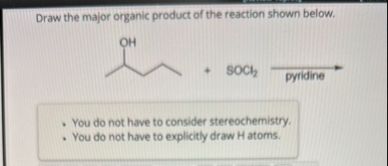
This is AI generated Response.
Asked by: Rahul
Created at: 2026-02-15 04:34:28
Asked by: Rahul
Created at: 2026-02-15 04:34:28
Final Answer:
Rendered
Raw Text
Did you like this answer?
Let's break down the reaction step-by-step:
---
## **Step 1: Identify the Reactants**
- **Alcohol:** The given structure is **2-pentanol** (CH₃-CH(OH)-CH₂-CH₂-CH₃).
- **Reagent:** Thionyl chloride (SOCl₂) in the presence of pyridine.
---
## **Step 2: Recognize the Reaction Type**
- **SOCl₂** is commonly used to convert **alcohols** to **alkyl chlorides**.
- **Pyridine** is used as a base to neutralize the HCl produced and to facilitate the reaction.
---
## **Step 3: Predict the Product**
- The -OH group of 2-pentanol is replaced by a -Cl atom.
So, the product is **2-chloropentane**.
---
## **Step 4: Draw the Major Organic Product**
**Structure:**
```
Cl
|
CH3-CH-CH2-CH2-CH3
```
Or, in condensed form: **CH₃-CH(Cl)-CH₂-CH₂-CH₃**
---
## **Step 5: Final Answer**
### **Major Organic Product**
**2-chloropentane** (CH₃-CH(Cl)-CH₂-CH₂-CH₃)
---
**Summary Table:**
| Reactant (Alcohol) | Reagent | Product |
|-----------------------|-----------------|--------------------|
| 2-pentanol | SOCl₂, pyridine | 2-chloropentane |
---
**No stereochemistry needs to be considered, as specified.**
📢 Instructions:
- Ask anything relatd to above question only.
- For new Question goto :