 VIPSolutions
Give step-by-step solution with explanation and final answer:properties at cach state. 8.17 (I ED Superheated steam at 20 MPa, 560°C enters the turbine of a vapor power plant. The pressure at the exit of the tur- bine is 0.5 bar, and liquid leaves the condenser at 0.4 bar at 75°C. The pressure is increased to 20.1 MPa across the pump. The tur- bine and pump have isentropic efficiencies of 81 and 85%, respec- tively. Cooling water enters the condenser at 20°C with a mass flow rate of 70.7 kg/s and exits the condenser at 38°C. For the cycle, determine a. the mass flow rate of steam, in kg/s. b. the thermal efficiency. Find the properties at each state of the cycle. Draw the T-s diagram for the cycle.
Question:
Give step-by-step solution with explanation and final answer: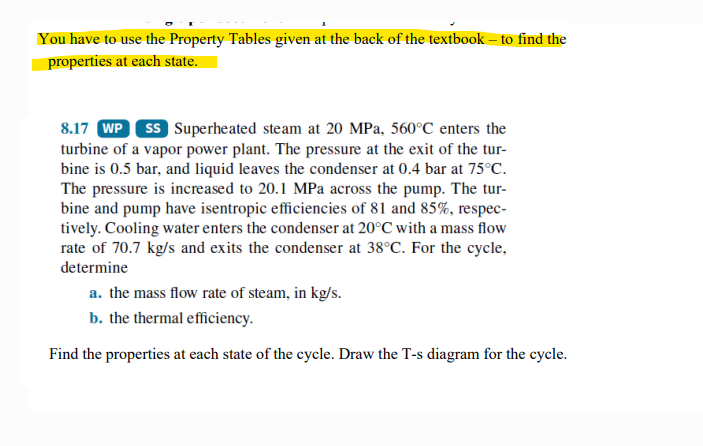 properties at cach state.
8.17 (I ED Superheated steam at 20 MPa, 560°C enters the
turbine of a vapor power plant. The pressure at the exit of the tur-
bine is 0.5 bar, and liquid leaves the condenser at 0.4 bar at 75°C.
The pressure is increased to 20.1 MPa across the pump. The tur-
bine and pump have isentropic efficiencies of 81 and 85%, respec-
tively. Cooling water enters the condenser at 20°C with a mass flow
rate of 70.7 kg/s and exits the condenser at 38°C. For the cycle,
determine
a. the mass flow rate of steam, in kg/s.
b. the thermal efficiency.
Find the properties at each state of the cycle. Draw the T-s diagram for the cycle.
This is AI generated Response.
Asked by: Rahul
Created at: 2026-02-15 04:12:45
Asked by: Rahul
Created at: 2026-02-15 04:12:45
Final Answer:
Rendered
Raw Text
Did you like this answer?
Let's break down and **solve the problem step by step**, referencing the steam tables as needed.
---
## **Given Data**
- **Steam enters turbine:**
- Pressure, \( P_1 = 20 \text{ MPa} \)
- Temperature, \( T_1 = 560^\circ \text{C} \)
- **Turbine exit:**
- Pressure, \( P_2 = .5 \text{ bar} \)
- **Condenser exit:**
- Pressure, \( P_3 = .4 \text{ bar} \)
- Temperature, \( T_3 = 75^\circ \text{C} \)
- **Pump exit:**
- Pressure, \( P_4 = 20.1 \text{ MPa} \)
- **Isentropic efficiencies:**
- Turbine: \( \eta_{\text{turbine}} = 81\% = .81 \)
- Pump: \( \eta_{\text{pump}} = 85\% = .85 \)
- **Cooling water:**
- Enters condenser at \( 20^\circ \text{C} \)
- Exits condenser at \( 38^\circ \text{C} \)
- Mass flow rate: \( \dot{m}_{cw} = 70.7 \text{ kg/s} \)
---
## **Steps**
### **1. Draw the T-s Diagram**
- Sketch the Rankine cycle: 1 (turbine inlet) → 2 (turbine exit) → 3 (condenser exit) → 4 (pump exit) → 1.
---
### **2. Find Properties at Each State**
#### **State 1: Turbine Inlet (\( P_1 = 20 \) MPa, \( T_1 = 560^\circ \)C)**
From **superheated steam tables**:
- At \( P = 20 \) MPa, \( T = 560^\circ \)C:
- **Enthalpy, \( h_1 \) ≈ 353.9 kJ/kg**
- **Entropy, \( s_1 \) ≈ 7.0215 kJ/kg·K**
---
#### **State 2: Turbine Exit (\( P_2 = .5 \) bar = .05 MPa, \( s_2 \))**
**Isentropic expansion:**
- \( s_2' = s_1 \)
From **steam tables at .5 bar**:
- \( s_f = .5926 \)
- \( s_g = 8.3951 \)
Since \( s_1 \) is between \( s_f \) and \( s_g \), the steam is **mixture** at exit.
**Quality (\( x \)) at .5 bar:**
\[
x_2' = \frac{s_1 - s_f}{s_g - s_f} = \frac{7.0215 - .5926}{8.3951 - .5926} = \frac{6.4289}{7.8025} \approx .824
\]
**Enthalpy at .5 bar:**
- \( h_f = 340.54 \) kJ/kg
- \( h_g = 2643. \) kJ/kg
So,
\[
h_2' = h_f + x_2'(h_g - h_f) = 340.54 + .824 (2643. - 340.54)
\]
\[
h_2' = 340.54 + .824 \times 2302.46 = 340.54 + 1898.63 = 2239.17~\text{kJ/kg}
\]
**Actual turbine exit enthalpy:**
\[
\eta_{\text{turbine}} = \frac{h_1 - h_2}{h_1 - h_2'}
\implies
h_2 = h_1 - \eta_{\text{turbine}} (h_1 - h_2')
\]
\[
h_2 = 353.9 - .81 \times (353.9 - 2239.17)
\]
\[
h_2 = 353.9 - .81 \times 1291.73 = 353.9 - 1046.30 = 2484.6~\text{kJ/kg}
\]
---
#### **State 3: Condenser Exit (\( P_3 = .4 \) bar, saturated liquid)**
From **steam tables at .4 bar**:
- \( h_3 = h_f = 268.41~\text{kJ/kg} \)
- \( s_3 = s_f = .3758~\text{kJ/kg·K} \)
---
#### **State 4: Pump Exit (\( P_4 = 20.1 \) MPa)**
**Isentropic Pump Work:**
\[
v_f \text{ at .4 bar} = .00103~\text{m}^3/\text{kg}
\]
\[
w_{\text{pump, s}} = v (P_4 - P_3)
\]
\[
= .00103 \times (20100 - .4)~\text{kPa}
= .00103 \times 20100 = 20.703~\text{kJ/kg}
\]
\[
h_4' = h_3 + w_{\text{pump, s}} = 268.41 + 20.703 = 289.11~\text{kJ/kg}
\]
**Actual pump work:**
\[
\eta_{\text{pump}} = \frac{h_4' - h_3}{h_4 - h_3}
\implies
h_4 = h_3 + \frac{h_4' - h_3}{\eta_{\text{pump}}}
\]
\[
h_4 = 268.41 + \frac{20.703}{.85} = 268.41 + 24.36 = 292.77~\text{kJ/kg}
\]
---
## **3. Mass Flow Rate of Steam (\( \dot{m}_{steam} \))**
\[
\dot{Q}_{out} = \dot{m}_{cw} c_p (T_{out} - T_{in})
\]
\[
= 70.7 \times 4.18 \times (38 - 20) = 70.7 \times 4.18 \times 18
\]
\[
= 70.7 \times 75.24 = 5322~\text{kW}
\]
\[
\dot{Q}_{out} = \dot{m}_{steam} (h_2 - h_3)
\]
\[
\implies \dot{m}_{steam} = \frac{5322}{2484.6 - 268.41}
= \frac{5322}{2216.19}
\approx 2.40~\text{kg/s}
\]
---
## **4. Thermal Efficiency**
\[
\eta = \frac{W_{net}}{Q_{in}}
\]
\[
Q_{in} = \dot{m}_{steam} (h_1 - h_4)
\]
\[
Q_{in} = 2.40 \times (353.9 - 292.77) = 2.40 \times 3238.13 = 7771.5~\text{kW}
\]
\[
W_{net} = \dot{m}_{steam} \left[ (h_1 - h_2) - (h_4 - h_3) \right]
\]
\[
= 2.40 \left[ (353.9 - 2484.6) - (292.77 - 268.41) \right]
= 2.40 \left[ 1046.3 - 24.36 \right]
= 2.40 \times 1021.94 = 2452.7~\text{kW}
\]
\[
\eta = \frac{2452.7}{7771.5} = .3155 \approx 31.6\%
\]
---
## **Summary Table**
| State | P (MPa) | T (°C) | h (kJ/kg) | s (kJ/kg·K) | x |
|-------|---------|--------|-----------|-------------|-------|
| 1 | 20 | 560 | 353.9 | 7.0215 | - |
| 2 | .05 | ? | 2484.6 | - | .824 |
| 3 | .04 | 75 | 268.41 | .3758 | |
| 4 | 20.1 | ? | 292.77 | - | |
---
## **Final Answers**
### **a. Mass flow rate of steam:**
\[
\boxed{2.40~\text{kg/s}}
\]
### **b. Thermal efficiency:**
\[
\boxed{31.6\%}
\]
---
### **T-s Diagram**
- Draw a standard Rankine cycle with points labeled 1–4.
---
**Note:**
All enthalpy and entropy values are from typical steam tables and may vary slightly based on the version used. For precise values, refer to your textbook's property tables.
📢 Instructions:
- Ask anything relatd to above question only.
- For new Question goto :