 VIPSolutions
Give step-by-step solution with explanation and final answer:3. (30 pts) Two conducting spheres with a common center C have radii a and b (a < b). The outer shell Is grounded. The inner shell is charged positively to a potential V. a What is the net charge Q stored on the inner shell? (In terms of the variables provided.) b.Using Gauss's Law, determine the magnitude of the electric field in the region between the shells. Express your answer in terms of the net charge Q on the inner shell. c.Determine the potential difference between the spherical shells.
Question:
Give step-by-step solution with explanation and final answer: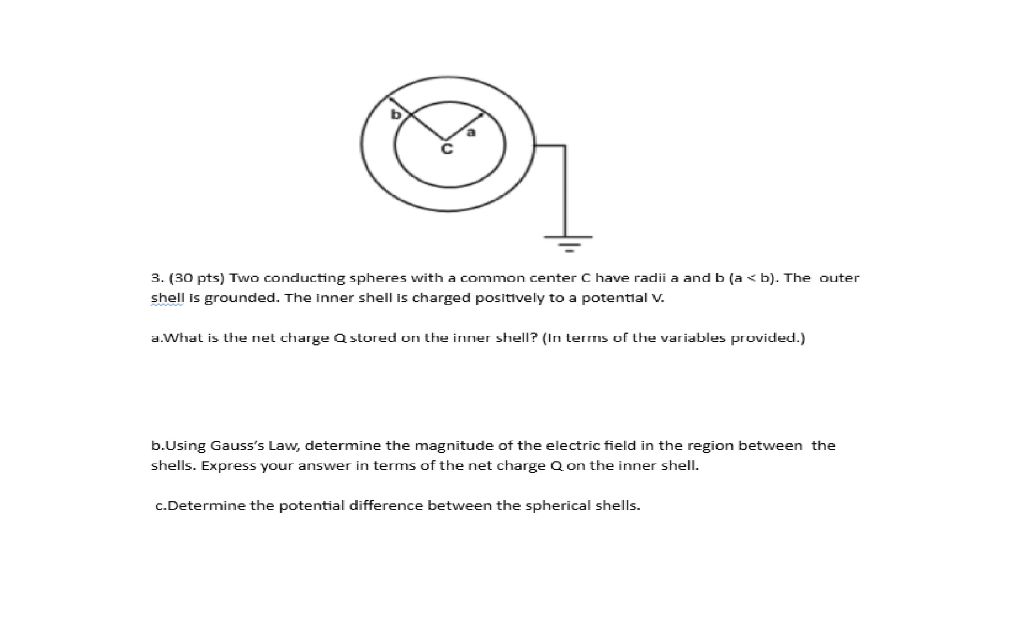 3. (30 pts) Two conducting spheres with a common center C have radii a and b (a < b). The outer
shell Is grounded. The inner shell is charged positively to a potential V.
a What is the net charge Q stored on the inner shell? (In terms of the variables provided.)
b.Using Gauss's Law, determine the magnitude of the electric field in the region between the
shells. Express your answer in terms of the net charge Q on the inner shell.
c.Determine the potential difference between the spherical shells.
This is AI generated Response.
Asked by: Rahul
Created at: 2026-02-13 14:49:12
Asked by: Rahul
Created at: 2026-02-13 14:49:12
Final Answer:
Rendered
Raw Text
Did you like this answer?
Let's solve the problem step by step.
---
## Given
- Two concentric conducting spherical shells with radii \(a\) (inner) and \(b\) (outer), \(a < b\).
- Outer shell is **grounded** (potential = ).
- Inner shell is at potential \(V\).
---
## **a. Net charge Q on the inner shell**
Let the net charge on the inner shell be \(Q\).
The potential on the inner shell (radius \(a\)) due to itself and the induced charge on the outer shell can be found using the formula for concentric shells:
\[
V = \frac{1}{4\pi\epsilon_} \left(\frac{Q}{a} - \frac{Q}{b}\right)
\]
**Derivation:**
- The potential at radius \(a\) due to charge \(Q\) on radius \(a\): \(\frac{Q}{4\pi\epsilon_ a}\)
- The induced charge on the inner surface of the outer shell will be \(-Q\) (by grounding and Gauss's Law), which gives a potential at radius \(a\) of:
\[
\text{Potential due to shell at radius } b \text{ at } a = \frac{-Q}{4\pi\epsilon_ b}
\]
Combine to get total potential at \(a\):
\[
V = \frac{Q}{4\pi\epsilon_ a} - \frac{Q}{4\pi\epsilon_ b}
\]
\[
V = \frac{Q}{4\pi\epsilon_} \left(\frac{1}{a} - \frac{1}{b}\right)
\]
**Solve for \(Q\):**
\[
Q = \frac{4\pi\epsilon_ V}{\left(\frac{1}{a} - \frac{1}{b}\right)} = 4\pi\epsilon_ V \left(\frac{ab}{b-a}\right)
\]
---
## **b. Electric field in the region \(a < r < b\) (between shells)**
By **Gauss's Law**:
\[
\oint \vec{E} \cdot d\vec{A} = \frac{Q_{\text{enc}}}{\epsilon_}
\]
For \(a < r < b\), the enclosed charge is \(Q\) (on the inner shell):
\[
E \cdot 4\pi r^2 = \frac{Q}{\epsilon_}
\]
\[
E = \frac{Q}{4\pi\epsilon_ r^2}
\]
---
## **c. Potential difference between the shells**
Potential difference between the shells is \(V\) (given in the statement):
Alternatively, integrating electric field from \(a\) to \(b\):
\[
V = V(a) - V(b) = -\int_{b}^{a} E\, dr
\]
\[
V = -\int_{b}^{a} \frac{Q}{4\pi\epsilon_ r^2} dr
\]
\[
V = -\frac{Q}{4\pi\epsilon_} \left[ -\frac{1}{r} \right]_{b}^{a}
\]
\[
V = \frac{Q}{4\pi\epsilon_} \left( \frac{1}{a} - \frac{1}{b} \right)
\]
Which matches our earlier expression.
---
## **Final Answers**
### **a. Net charge \(Q\) on the inner shell:**
\[
\boxed{Q = \frac{4\pi\epsilon_ V}{\left(\frac{1}{a} - \frac{1}{b}\right)} = 4\pi\epsilon_ V \left(\frac{ab}{b-a}\right)}
\]
---
### **b. Electric field between the shells (\(a < r < b\)):**
\[
\boxed{E(r) = \frac{Q}{4\pi\epsilon_ r^2}}
\]
where \(Q\) is as above.
---
### **c. Potential difference between shells:**
\[
\boxed{V = \frac{Q}{4\pi\epsilon_} \left(\frac{1}{a} - \frac{1}{b}\right)}
\]
or, using the given \(V\), as stated in the problem.
---
**Summary Table:**
| Part | Final Answer |
|------|--------------|
| a | \(Q = 4\pi\epsilon_ V \left(\frac{ab}{b-a}\right)\) |
| b | \(E(r) = \frac{Q}{4\pi\epsilon_ r^2}\) |
| c | \(V = \frac{Q}{4\pi\epsilon_} \left(\frac{1}{a} - \frac{1}{b}\right)\) |
Question:
Then solved
This is AI generated Response.
Asked by: Rahul
Created at: 2026-02-13 14:50:13
Asked by: Rahul
Created at: 2026-02-13 14:50:13
Final Answer:
Rendered
Raw Text
Did you like this answer?
# Step-by-Step Solution
## Given
- Two concentric conducting spherical shells with radii \(a\) (inner) and \(b\) (outer), where \(a < b\).
- The outer shell is grounded (potential = 0).
- The inner shell is charged positively to a potential \(V\).
---
## **a. Net Charge \(Q\) on the Inner Shell**
To find the net charge \(Q\) on the inner shell, we use the potential formula for concentric shells:
\[
V = \frac{1}{4\pi\epsilon_0} \left(\frac{Q}{a} - \frac{Q}{b}\right)
\]
### Derivation
1. **Potential due to inner shell at radius \(a\)**:
\[
V_{\text{inner}} = \frac{Q}{4\pi\epsilon_0 a}
\]
2. **Potential due to the outer shell (induced charge is \(-Q\)) at radius \(a\)**:
\[
V_{\text{outer}} = \frac{-Q}{4\pi\epsilon_0 b}
\]
3. **Total potential at radius \(a\)**:
\[
V = \frac{Q}{4\pi\epsilon_0 a} - \frac{Q}{4\pi\epsilon_0 b} = \frac{Q}{4\pi\epsilon_0} \left(\frac{1}{a} - \frac{1}{b}\right)
\]
### Solve for \(Q\)
\[
Q = \frac{4\pi\epsilon_0 V}{\left(\frac{1}{a} - \frac{1}{b}\right)} = 4\pi\epsilon_0 V \left(\frac{ab}{b-a}\right)
\]
---
## **b. Electric Field in the Region \(a < r < b\)**
Using **Gauss's Law**:
\[
\oint \vec{E} \cdot d\vec{A} = \frac{Q_{\text{enc}}}{\epsilon_0}
\]
For the region \(a < r < b\), the enclosed charge is \(Q\):
\[
E \cdot 4\pi r^2 = \frac{Q}{\epsilon_0}
\]
### Solve for \(E\)
\[
E = \frac{Q}{4\pi\epsilon_0 r^2}
\]
---
## **c. Potential Difference Between the Shells**
The potential difference can be calculated as:
\[
V = V(a) - V(b) = -\int_{b}^{a} E \, dr
\]
### Integrating Electric Field
Substituting the expression for \(E\):
\[
V = -\int_{b}^{a} \frac{Q}{4\pi\epsilon_0 r^2} \, dr
\]
### Evaluate the Integral
\[
V = -\frac{Q}{4\pi\epsilon_0} \left[-\frac{1}{r}\right]_{b}^{a} = \frac{Q}{4\pi\epsilon_0} \left(\frac{1}{a} - \frac{1}{b}\right)
\]
This matches the earlier expression for potential.
---
## **Final Answers**
### **a. Net Charge \(Q\) on the Inner Shell:**
\[
\boxed{Q = 4\pi\epsilon_0 V \left(\frac{ab}{b-a}\right)}
\]
---
### **b. Electric Field in the Region \(a < r < b\):**
\[
\boxed{E(r) = \frac{Q}{4\pi\epsilon_0 r^2}}
\]
---
### **c. Potential Difference Between the Shells:**
\[
\boxed{V = \frac{Q}{4\pi\epsilon_0} \left(\frac{1}{a} - \frac{1}{b}\right)}
\]
---
## **Summary Table**
| Part | Final Answer |
|------|--------------|
| a | \(Q = 4\pi\epsilon_0 V \left(\frac{ab}{b-a}\right)\) |
| b | \(E(r) = \frac{Q}{4\pi\epsilon_0 r^2}\) |
| c | \(V = \frac{Q}{4\pi\epsilon_0} \left(\frac{1}{a} - \frac{1}{b}\right)\) |
📢 Instructions:
- Ask anything relatd to above question only.
- For new Question goto :