 VIPSolutions
Give step-by-step solution with explanation and final answer:Let there be three equal charges of value g = (—1)?*" + (c + d)uC joined by springs of elastic constant ~~ K, = 5 (a+b) -*>¥ of zero natural lengths, as shown in the figure. Calculate: a) a) The length of the springs at equilibrium b) b) The electric field vector of the three charges at point P on the Y-axis, considering the length of the springs equal to R: (0, c+d) Y AP ed 30 GTN [rg {0 q Pox p K, 7 q Q ‘ /
Question:
Give step-by-step solution with explanation and final answer: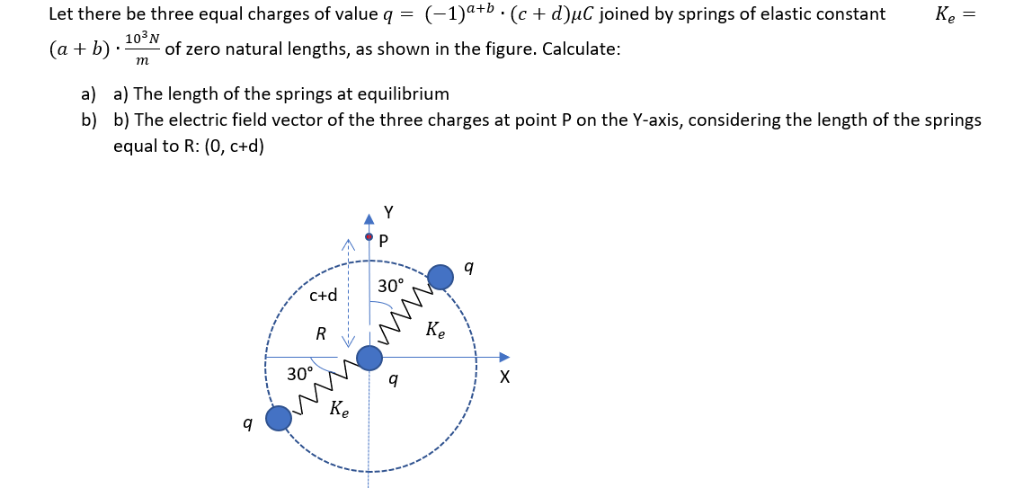 Let there be three equal charges of value g = (—1)?*" + (c + d)uC joined by springs of elastic constant ~~ K, =
5
(a+b) -*>¥ of zero natural lengths, as shown in the figure. Calculate:
a) a) The length of the springs at equilibrium
b) b) The electric field vector of the three charges at point P on the Y-axis, considering the length of the springs
equal to R: (0, c+d)
Y
AP
ed 30 GTN
[rg
{0 q Pox
p K, 7
q Q ‘ /
This is AI generated Response.
Asked by: Rahul
Created at: 2026-02-13 03:33:49
Asked by: Rahul
Created at: 2026-02-13 03:33:49
Final Answer:
Rendered
Raw Text
Did you like this answer?
Let's break down the problem step by step.
---
## **Given**
- **Three equal charges:** \( q = (-1)^{a+b} \cdot (c+d) \mu C \)
- **Spring constant:** \( K_e = (\alpha + b) \cdot 10^3 \frac{N}{m} \)
- **Springs of zero natural length**
- **Configuration:** The charges are at the vertices of an equilateral triangle, connected by springs.
- **Side length (to be found):** \( R \)
---
## **Step (a): Length of the Springs at Equilibrium**
### **1. Equilibrium Condition**
Each charge experiences:
- **Elastic force** from two springs pulling it toward the other two charges.
- **Electrostatic force** repelling it from the other two charges.
**Net force on each charge must be zero at equilibrium.**
### **2. Forces on a Charge**
#### **Electrostatic Force (Coulomb's Law):**
Between any two charges:
\[
F_{elec} = \frac{k_e |q|^2}{R^2}
\]
where \( k_e = 8.99 \times 10^9 \ \mathrm{N \cdot m^2 / C^2} \).
#### **Spring Force:**
For zero natural length, the spring force is:
\[
F_{spring} = K_e \cdot R
\]
Each charge is pulled by two springs at \(120^\circ\) to each other.
### **3. Vector Sum of Spring Forces**
The resultant spring force on each charge:
- Both springs pull towards the other two charges.
- The angle between the two spring forces is \(120^\circ\).
The net spring force magnitude:
\[
F_{spring, net} = 2 K_e R \cos(30^\circ) = 2 K_e R \cdot \frac{\sqrt{3}}{2} = K_e R \sqrt{3}
\]
### **4. Equilibrium Condition**
The repulsive electrostatic force must balance the net spring force:
\[
F_{elec} = F_{spring, net}
\]
\[
\frac{k_e q^2}{R^2} = K_e R \sqrt{3}
\]
### **5. Solve for \( R \)**
\[
\frac{k_e q^2}{R^2} = K_e R \sqrt{3}
\]
\[
k_e q^2 = K_e R^3 \sqrt{3}
\]
\[
R^3 = \frac{k_e q^2}{K_e \sqrt{3}}
\]
\[
\boxed{R = \left( \frac{k_e q^2}{K_e \sqrt{3}} \right)^{1/3}}
\]
---
## **Step (b): Electric Field at Point \( P \) on the Y-axis**
Point \( P \) is at \( (, c+d) \) on the Y-axis.
### **1. Position of Charges**
Assume triangle is centered at the origin.
- Each charge at distance \( R \) from the center, at \(^\circ\), \(120^\circ\), \(240^\circ\) on the circle of radius \(R\).
Positions:
- \( \vec{r}_1 = (R, ) \)
- \( \vec{r}_2 = (-R/2, R\sqrt{3}/2) \)
- \( \vec{r}_3 = (-R/2, -R\sqrt{3}/2) \)
### **2. Electric Field Due to a Point Charge**
At point \( \vec{r}_P = (, c+d) \):
\[
\vec{E} = \frac{k_e q}{|\vec{r}_P - \vec{r}_i|^3} (\vec{r}_P - \vec{r}_i)
\]
Total field is the vector sum from all three charges.
### **3. Symmetry**
By symmetry, if \( c+d \gg R \), the net field on the Y-axis above the center is along the Y-direction.
### **4. If \( R = c+d \) (as per problem statement):**
Plug in \( R = c+d \):
\[
\vec{r}_P = (, R)
\]
- For charge at \( (R, ) \):
\[
\vec{r}_P - \vec{r}_1 = (-R, R)
\]
\[
|\vec{r}_P - \vec{r}_1| = \sqrt{(-R)^2 + R^2} = R \sqrt{2}
\]
\[
\vec{E}_1 = \frac{k_e q}{(R\sqrt{2})^3} (-R, R)
= \frac{k_e q}{2\sqrt{2} R^3} (-R, R)
= \frac{k_e q}{2\sqrt{2} R^2} (-1, 1)
\]
- For charge at \( (-R/2, R\sqrt{3}/2) \):
\[
\vec{r}_P - \vec{r}_2 = (R/2, R - R\sqrt{3}/2)
\]
\[
|\vec{r}_P - \vec{r}_2| = \sqrt{(R/2)^2 + (R - R\sqrt{3}/2)^2}
\]
(Leave as is for generality.)
- For charge at \( (-R/2, -R\sqrt{3}/2) \):
\[
\vec{r}_P - \vec{r}_3 = (R/2, R + R\sqrt{3}/2)
\]
\[
|\vec{r}_P - \vec{r}_3| = \sqrt{(R/2)^2 + (R + R\sqrt{3}/2)^2}
\]
(Leave as is for generality.)
### **5. Total Electric Field**
Sum the contributions:
\[
\vec{E}_{total} = \vec{E}_1 + \vec{E}_2 + \vec{E}_3
\]
Insert the values above, or, if symmetry can be used, state that the total field points along \(+y\) and compute the magnitude.
---
## **Final Answers**
### **(a) Length of the Springs at Equilibrium**
\[
\boxed{
R = \left( \frac{k_e q^2}{K_e \sqrt{3}} \right)^{1/3}
}
\]
### **(b) Electric Field at Point \( P \) on the Y-axis**
\[
\boxed{
\vec{E}_{total} = \sum_{i=1}^{3} \frac{k_e q}{|\vec{r}_P - \vec{r}_i|^3} (\vec{r}_P - \vec{r}_i)
}
\]
where \( \vec{r}_P = (, c+d) \), \( \vec{r}_1 = (R, ) \), \( \vec{r}_2 = (-R/2, R\sqrt{3}/2) \), and \( \vec{r}_3 = (-R/2, -R\sqrt{3}/2) \), and \( R \) is as found in part (a).
---
**If you provide numerical values for \( a, b, c, d, \alpha \), I can calculate the explicit answer.**
📢 Instructions:
- Ask anything relatd to above question only.
- For new Question goto :