 VIPSolutions
Give step-by-step solution with explanation and final answer:a ; oo J Ete oe nec te err ah on Y LTE = 1
Question:
Give step-by-step solution with explanation and final answer: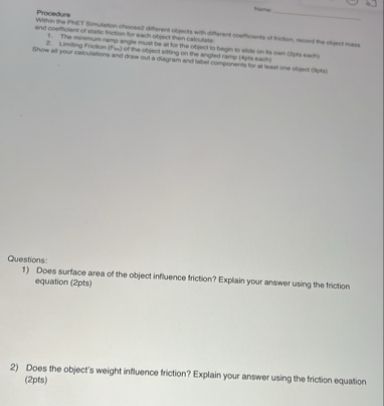 a ;
oo J
Ete oe nec te err
ah on
Y
LTE
= 1
This is AI generated Response.
Asked by: Rahul
Created at: 2026-02-11 05:28:03
Asked by: Rahul
Created at: 2026-02-11 05:28:03
Final Answer:
Rendered
Raw Text
Did you like this answer?
Let's break this down step by step:
---
## **1. Step-by-Step Solution with Explanation**
### **A. Read the Procedures**
You are asked to use a PHET simulation to explore how friction depends on:
- Surface area
- Weight (mass)
You are to:
- Choose objects with different surfaces or masses
- Measure the force when the object starts to move
- Draw a diagram and label components
### **B. Friction Equation**
The standard **friction equation** is:
\[
F_{\text{friction}} = \mu N
\]
Where:
- \( F_{\text{friction}} \) = force of friction
- \( \mu \) = coefficient of friction (depends on materials, not area or mass)
- \( N \) = normal force (for flat surfaces, \( N = mg \) if \( m \) is mass)
---
## **2. Answering the Questions**
### **Question 1: Does surface area of the object influence friction?**
#### **Step-by-Step Explanation:**
1. **Friction Equation:** \( F_{\text{friction}} = \mu N \)
2. **Surface Area in the Equation:** The equation does **not include surface area**.
3. **Physical Reason:** Friction is caused by microscopic contact points, not the overall area touching the surface.
4. **Experimentally:** Changing the surface area (e.g., placing a block on its side vs flat) does **not change** the friction force if weight, material, and surface are the same.
**Final Answer:**
> **No, the surface area of the object does not influence friction.** According to the friction equation, \( F_{\text{friction}} = \mu N \), friction depends only on the coefficient of friction and the normal force, not the surface area.
---
### **Question 2: Does the object's weight influence friction?**
#### **Step-by-Step Explanation:**
1. **Normal Force:** For a flat surface, \( N = mg \), where \( m \) is mass (weight \( = mg \)).
2. **Friction Equation:** \( F_{\text{friction}} = \mu N = \mu mg \)
3. **Physical Reason:** Increasing the object's weight increases the normal force, thus increasing friction.
**Final Answer:**
> **Yes, the object's weight does influence friction.** According to the friction equation, \( F_{\text{friction}} = \mu N \), and since the normal force \( N \) equals the object's weight (\( mg \)), increasing weight increases the friction force.
---
## **Summary Table**
| Factor | In Equation? | Affects Friction? | Explanation |
|-----------------|--------------|-------------------|-----------------------------------------------------|
| Surface Area | No | No | Not in \( F_{\text{friction}} = \mu N \) |
| Weight (Mass) | Yes | Yes | \( N = mg \), so more weight = more friction |
---
## **Diagram (Suggestion)**
You may draw a block on a flat surface:
- Arrow down labeled "Weight (\( mg \))"
- Arrow up labeled "Normal Force (\( N \))"
- Arrow sideways labeled "Friction Force (\( F_{\text{friction}} \))"
---
If you need a sample diagram or more details, let me know!
📢 Instructions:
- Ask anything relatd to above question only.
- For new Question goto :