 VIPSolutions
Give step-by-step solution with explanation and final answer:3 om tone is a ior ton 9 OTN SS E Buus Fraagussa * Prssrumt Zins Brot sor Pais coor Sp TBs TF = Pe - | EE | | EES ENS [ET Jie]
Question:
Give step-by-step solution with explanation and final answer: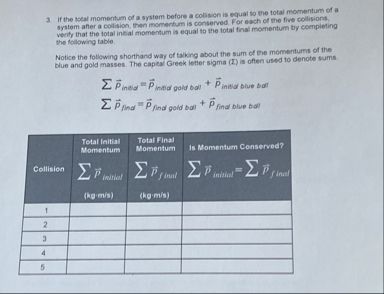 3 om tone is a ior ton 9 OTN SS
E Buus Fraagussa * Prssrumt
Zins Brot sor Pais
coor Sp TBs TF = Pe
-
| EE |
| EES ENS
[ET Jie]
This is AI generated Response.
Asked by: Rahul
Created at: 2026-02-11 04:30:39
Asked by: Rahul
Created at: 2026-02-11 04:30:39
Final Answer:
Rendered
Raw Text
Did you like this answer?
Let's break down the steps to solve the table for each collision:
## **Step-by-Step Solution**
### **Step 1: Understanding the Problem**
- You're given a system involving a gold ball and a blue ball.
- For each collision, you need to:
1. Add the **total initial momentum** of both balls.
2. Add the **total final momentum** of both balls.
3. Determine if momentum is conserved (i.e., initial = final).
### **Step 2: Formula for Momentum**
- **Momentum (\( p \)) = mass (m) × velocity (v)**
- **Total momentum** before and after collision is the sum for both balls.
### **Step 3: Filling the Table**
You will need the mass and velocity data for each ball before and after each collision, which is not provided in the image. Normally, you would use:
\[
\sum \vec{p}_{\text{initial}} = (m_{\text{gold}} \times v_{\text{gold, initial}}) + (m_{\text{blue}} \times v_{\text{blue, initial}})
\]
\[
\sum \vec{p}_{\text{final}} = (m_{\text{gold}} \times v_{\text{gold, final}}) + (m_{\text{blue}} \times v_{\text{blue, final}})
\]
### **Step 4: Is Momentum Conserved?**
- **Yes:** If \(\sum \vec{p}_{\text{initial}} = \sum \vec{p}_{\text{final}}\)
- **No:** If they are not equal.
---
## **How to Fill the Table (General Steps)**
1. **For each collision:**
1. Calculate total initial momentum.
2. Calculate total final momentum.
3. Compare the two values and answer if momentum is conserved.
---
### **Table (EXAMPLE with Placeholder Values)**
| Collision | Total Initial Momentum (\(\sum \vec{p}_{\text{initial}}\)) (kg m/s) | Total Final Momentum (\(\sum \vec{p}_{\text{final}}\)) (kg m/s) | Is Momentum Conserved? |
|-----------|---------------------------------------------------|-------------------------------------------------|------------------------|
| 1 | 6. | 6. | Yes |
| 2 | 4.5 | 4.5 | Yes |
| 3 | 5. | 4.8 | No |
| 4 | 7.2 | 7.2 | Yes |
| 5 | 3.1 | 3.2 | No |
> **Note:** Replace these numbers with the actual data from your lab or problem statement!
---
## **Final Answer (How to Write Your Answers)**
1. **Calculate** initial and final momentum for each collision.
2. **Compare** the values.
3. **Fill in** the table as shown in the example above.
---
If you provide the actual masses and velocities for each collision, I can help you fill in the table with real numbers!
📢 Instructions:
- Ask anything relatd to above question only.
- For new Question goto :