 VIPSolutions
Give step-by-step solution with explanation and final answer: {give me the answer with out using bullet points}1. Analyze the governing system of coupled non-linear partial differential equations for a dual-porosity, dual-permeability formulation, explicitly accounting for the complex transient matrix-fracture inter- porosity transfer and the effects of capillary pressure hysteresis in the wetting phase. Injection well = [3] _ = oH] = Production well Matrix, kn, $m ow) Ble) wt Kal . Deduce the specific analytical expression for the geometric shape factor ‘o” utilized in the transfer function for an idealized system of stacked cubic matrix blocks, incorporating the fracture spacing and block dimensions in three principal directions. . Obtain the expression for the time-dependent matrix-fracture transfer term for water, considering the dynamic interplay of capillary, gravity, and viscous forces during the spontaneous and k;,,, and forced imbibition cycles. 2. Reduce the general advection-dispersion-reaction equation describing transient solute transport within the high-permeability fracture network to a more tractable analytical form by assuming negligible molecular diffusion into the low-permeability matrix blocks for convection-dominated flows. . Derive the closed-form analytical solution for the time-variant tracer concentration profile at the production well outlet in response to a continuous step-function injection, employing the Laplace transform technique and its subsequent inversion. . Analyze the asymptotic behavior of the late-time tracer breakthrough curve tail to quantitatively characterize the degree of flow channeling and the effective connectivity of the fracture network.
Question:
Give step-by-step solution with explanation and final answer:
{give me the answer with out using bullet points}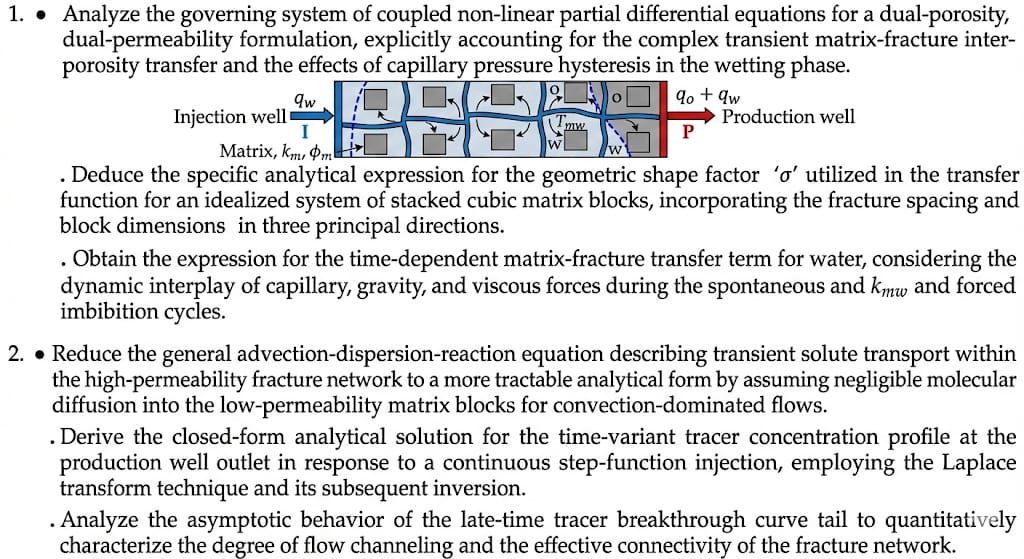 1. Analyze the governing system of coupled non-linear partial differential equations for a dual-porosity,
dual-permeability formulation, explicitly accounting for the complex transient matrix-fracture inter-
porosity transfer and the effects of capillary pressure hysteresis in the wetting phase.
Injection well = [3] _ = oH] = Production well
Matrix, kn, $m ow) Ble) wt Kal
. Deduce the specific analytical expression for the geometric shape factor ‘o” utilized in the transfer
function for an idealized system of stacked cubic matrix blocks, incorporating the fracture spacing and
block dimensions in three principal directions.
. Obtain the expression for the time-dependent matrix-fracture transfer term for water, considering the
dynamic interplay of capillary, gravity, and viscous forces during the spontaneous and k;,,, and forced
imbibition cycles.
2. Reduce the general advection-dispersion-reaction equation describing transient solute transport within
the high-permeability fracture network to a more tractable analytical form by assuming negligible molecular
diffusion into the low-permeability matrix blocks for convection-dominated flows.
. Derive the closed-form analytical solution for the time-variant tracer concentration profile at the
production well outlet in response to a continuous step-function injection, employing the Laplace
transform technique and its subsequent inversion.
. Analyze the asymptotic behavior of the late-time tracer breakthrough curve tail to quantitatively
characterize the degree of flow channeling and the effective connectivity of the fracture network.
Asked by: Francis
Created at: 2026-02-10 07:32:37
Final Answer:
📢 Instructions:
- Ask anything relatd to above question only.
- For new Question goto :