This is AI generated Response.
Asked by: Rahul
Created at: 2026-02-10 03:49:56
Final Answer:
RenderedRaw Text
Did you like this answer?
Let's solve each part **step by step**:
---
## (a) At which of the labeled points is the electric potential lowest?
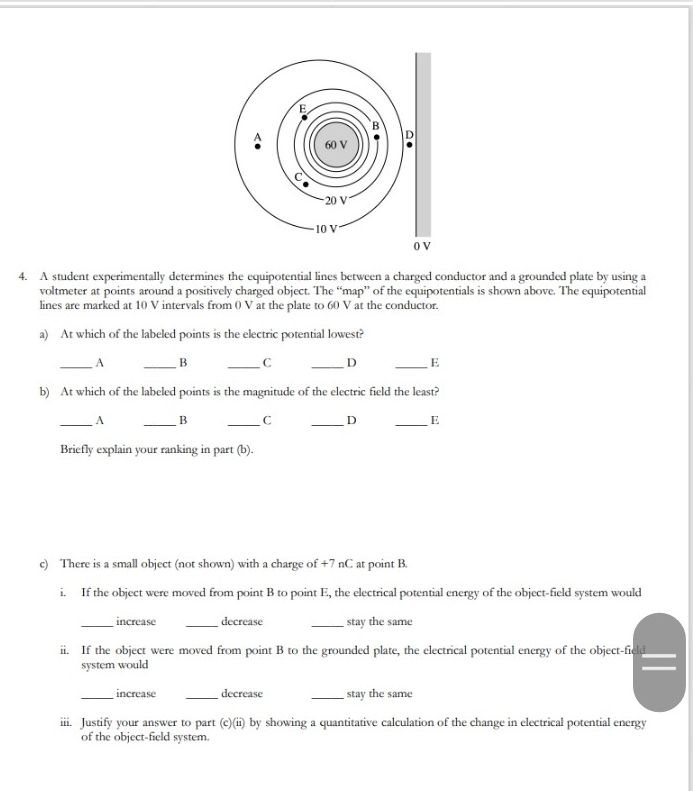
- The **electric potential** is marked on the equipotential lines. The outermost line (next to the grounded plate) is ** V**.
- **Point D** is located on the V line.
**Final Answer (a):**
> The electric potential is lowest at **D**.
---
## (b) At which of the labeled points is the magnitude of the electric field the least?
- The **electric field** is strongest where equipotential lines are **closest together** (largest change in potential per distance), and weakest where they are **furthest apart**.
- **Point A** is where the lines are farthest apart (around the 60 V region).
**Final Answer (b):**
> The magnitude of the electric field is least at **A**.
**Explanation:**
The electric field is proportional to the rate of change of potential (E = -dV/dr). Where the equipotential lines are spaced far apart (as at A), the potential changes slowly with distance, so the electric field is small.
---
## (c) Small object with charge \(+7\) nC at point B
### (i) If moved from B to E, the electrical potential energy would...
- Potential at B = 40 V, E = 60 V.
- \( U = qV \)
- Moving from lower to higher potential with a positive charge **increases** potential energy.
**Answer:**
> **increase**
---
### (ii) If moved from B to the grounded plate ( V), the electrical potential energy would...
- Potential at B = 40 V, grounded plate = V.
- \( U = qV \)
- Moving from higher to lower potential with a positive charge **decreases** potential energy.
**Answer:**
> **decrease**
---
### (iii) Quantitative calculation of the change in electrical potential energy
- \( q = +7\,\text{nC} = 7 \times 10^{-9}\,\text{C} \)
- \( V_B = 40\,\text{V} \)
- \( V_{\text{plate}} = \,\text{V} \)
- Change in potential energy:
\( \Delta U = q (V_{\text{final}} - V_{\text{initial}}) \)
- Here, final = V, initial = 40 V
\[
\Delta U = 7 \times 10^{-9} \times ( - 40) = -2.8 \times 10^{-7}\,\text{J}
\]
**Answer:**
> The electrical potential energy decreases by \(2.8 \times 10^{-7}\) J.
---
## **Summary Table**
| Part | Answer | Explanation |
|------|--------|-------------|
| (a) | D | D is on the V equipotential, the lowest. |
| (b) | A | Equipotentials are farthest apart at A; weakest E field. |
| (c-i) | Increase | Moving to higher V with positive charge increases U. |
| (c-ii) | Decrease | Moving to lower V with positive charge decreases U. |
| (c-iii)| \(-2.8 \times 10^{-7}\) J | \( \Delta U = 7 \times 10^{-9} \times ( - 40) \) |
---
Let me know if you need a diagram or further explanation!
VIPSolutions focuses on clear, step‑by‑step explanations so you can learn quickly. Whether you need an AI‑generated walkthrough or a short hint to get unstuck, each solution is organized for fast reading and easy review later.
Search similar questions, compare approaches, and bookmark the best answers for revision. Our goal is simple: quick, reliable study help that feels natural—not noisy.
 VIPSolutions
 (?
A ® 3) ol
. Hq
$e
20V
Tov:
ov
4. A student experimentally detcemines the equipotentia ines between charged conductor and grounded plate by using a
voltmeter at points around a positively charged object. The “map” of the equiporentials i shown above. The cquipotential
lines are marked at 10 V intervals from 0 V at the plate 10.60 V at the conductor
3) At which of the labeled points is the electric potential lowest?
SE CRE JERE A
1b) At which of the labeled points is the magnitude of the electric field the least?
EE SN SE I SR
Briefly explain your ranking in part ©).
©) There is a small object (not shown) with a charge of +7 nC at point B.
i 16the object were moved from point to point F, the dlectscal potential encegy of the object-feld system would
increase decrease stay the same
i. If the object were moved from point B to the grounded plate, the electrical potential energy of the object
system would
increase decrease stay the same
il Justify your answer to part (ei) by showing a quantitative caleulaion of the change in electrical potential energy
‘ofthe object-fckd system.