VIPSolutions logo ✨ VIPSolutions

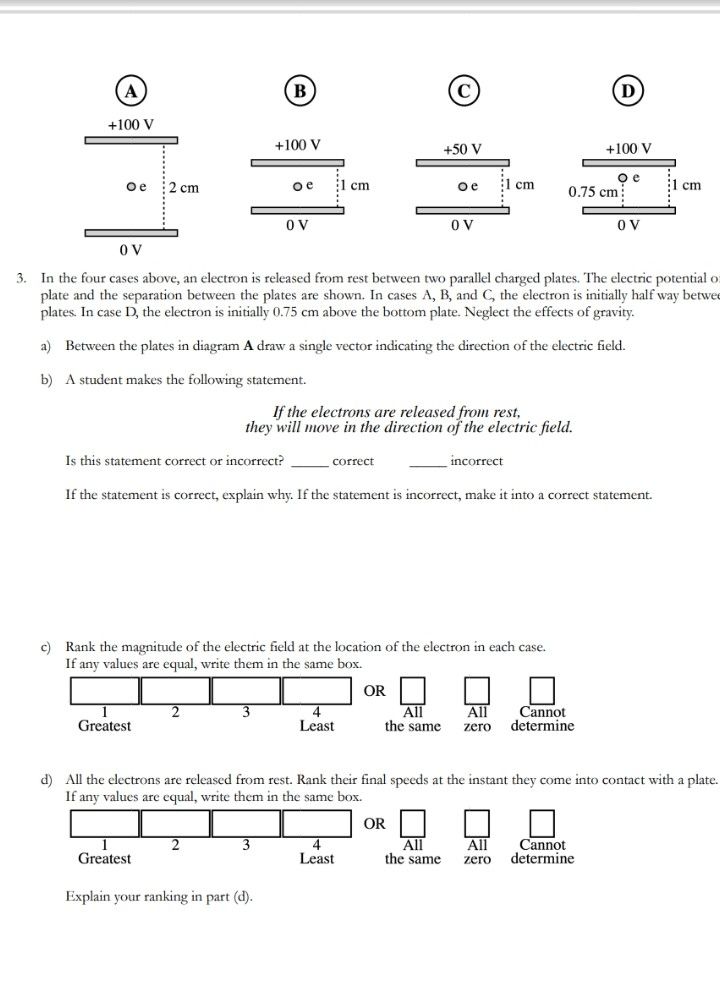
Give step-by-step solution with explanation and final answer:+100V — 7 +100V +50 V. +100V i —_— —_— =— oe i2em oc {lem oe lem oc @C fem m— ov ov ov ov 3. Tn the four cases above, an electron is released from est between two parallel charged plates. The electric potential o plate and the separation between the plates are shown. In cases A, B, and C, the electron is initially half way betwe plates. Tn case I, the electron is initially 0.75 cm above the bottom plate. Neglect the effects of gravity. 2) Between the plates in diagram A draw a single vector indicating the direction of the electric field. b) A student makes the following statement. If the electrons are released from rest, they will move in the direction of the electric field. Is this statement correct or incorrect? correct incorrect If the statement is correct, explain why. If the statement is incorrect, make it into a correct statement. ©) Rank the magnitude of the electric field at the location of the electron in each case. If any values are equal, write them in the same box. CTT T Je[] [J] [0 T 7 3 7 Al AI Cannot Greatest Least the same zero determine d&) All the electrons ace released from rest. Rank theie final speeds at the instant they come into contact with a plate If any values are cqual, write them in the same box. CT TT Je[] [J 0 T 7 3 7 Al AI Camot Greatest Least the same zero determine Explain your ranking in part (d).

Question:

Give step-by-step solution with explanation and final answer:Uploaded Image+100V — 7 +100V +50 V. +100V i —_— —_— =— oe i2em oc {lem oe lem oc @C fem m— ov ov ov ov 3. Tn the four cases above, an electron is released from est between two parallel charged plates. The electric potential o plate and the separation between the plates are shown. In cases A, B, and C, the electron is initially half way betwe plates. Tn case I, the electron is initially 0.75 cm above the bottom plate. Neglect the effects of gravity. 2) Between the plates in diagram A draw a single vector indicating the direction of the electric field. b) A student makes the following statement. If the electrons are released from rest, they will move in the direction of the electric field. Is this statement correct or incorrect? correct incorrect If the statement is correct, explain why. If the statement is incorrect, make it into a correct statement. ©) Rank the magnitude of the electric field at the location of the electron in each case. If any values are equal, write them in the same box. CTT T Je[] [J] [0 T 7 3 7 Al AI Cannot Greatest Least the same zero determine d&) All the electrons ace released from rest. Rank theie final speeds at the instant they come into contact with a plate If any values are cqual, write them in the same box. CT TT Je[] [J 0 T 7 3 7 Al AI Camot Greatest Least the same zero determine Explain your ranking in part (d).
This is AI generated Response.
Asked by: Rahul
Created at: 2026-02-10 03:44:13

Final Answer:

Rendered Raw Text
Did you like this answer?
Let's solve each part step by step: --- ## (a) Direction of Electric Field in Diagram A **Between the plates in diagram A, draw a single vector indicating the direction of the electric field.** - The electric field **direction** is from higher potential (+100 V) to lower potential ( V). - Therefore, the electric field points **downward** (from the top plate to the bottom plate). --- ## (b) Student's Statement > "If the electrons are released from rest, they will move in the direction of the electric field." **Is this statement correct?** **Incorrect.** **Explanation:** - The electric field direction is the direction a **positive** charge would move. - Electrons are **negative** charges, so they move **opposite** to the direction of the electric field. **Corrected Statement:** *If electrons are released from rest, they will move in the direction **opposite** to the electric field.* --- ## (c) Rank the Magnitude of the Electric Field The electric field between parallel plates: \[ E = \frac{V}{d} \] where \( V \) is the voltage difference and \( d \) is the separation. Let's calculate for each case: 1. **A:** \( V = 100\,V, \quad d = 2\,cm = .02\,m \) \( E_A = \frac{100}{.02} = 500\,\text{V/m} \) 2. **B:** \( V = 100\,V, \quad d = 1\,cm = .01\,m \) \( E_B = \frac{100}{.01} = 10{,}000\,\text{V/m} \) 3. **C:** \( V = 50\,V, \quad d = 1\,cm = .01\,m \) \( E_C = \frac{50}{.01} = 500\,\text{V/m} \) 4. **D:** \( V = 100\,V, \quad d = 1\,cm = .01\,m \) \( E_D = \frac{100}{.01} = 10{,}000\,\text{V/m} \) **Ranking (from greatest to least):** - B and D (10,000 V/m) > A and C (5,000 V/m) - [B D] > [A C] --- ## (d) Rank Final Speeds of Electrons Electrons are released from rest. The final speed depends on the **potential difference the electron travels through**: \[ \frac{1}{2}mv^2 = q \Delta V \] - \( m \) = mass of electron - \( q = -e \) = charge of electron (magnitude is \( e \)) - \( \Delta V \) = potential difference traversed (from start to plate it ends up at) Let's check each case: ### **A:** - Electron starts halfway between (1 cm from each plate), so \(\Delta V = 50\,V\) (from 50 V to V or 50 V to 100 V). - When it reaches the bottom plate, it has traversed 50 V. ### **B:** - Electron starts halfway between (.5 cm from each plate), so \(\Delta V = 50\,V\). ### **C:** - Electron starts halfway between (.5 cm from each plate), so \(\Delta V = 25\,V\). ### **D:** - Electron starts .75 cm above the bottom plate (closer to the bottom plate). Plate separation is 1 cm, so it's .25 cm from the top plate. - Let's find \(\Delta V\) from starting point to bottom plate ( V): - The potential drops linearly from 100 V (top) to V (bottom) over 1 cm. - At .75 cm above the bottom plate, potential = \( \frac{.25}{1} \times 100\,V = 25\,V \) above V. - So, electron moves through \( 25\,V \) from starting point to bottom plate. **Ranking (from greatest to least):** - A and B (50 V) > C and D (25 V) - [A B] > [C D] --- ### **Final Answers:** --- ### (a) **Electric field direction:** Downward (from +100 V to V). --- ### (b) **Statement:** Incorrect. **Correction:** Electrons move opposite to the direction of the electric field. --- ### (c) **Electric field magnitude ranking:** [B D] > [A C] --- ### (d) **Final electron speed ranking:** [A B] > [C D] **Explanation:** The final speed depends on the potential difference the electron moves through, not the electric field strength alone. A and B have the largest potential difference (50 V), so their electrons will achieve the greatest speed; C and D have 25 V, so their electrons will have lower final speeds.

📢 Instructions:

  • Ask anything relatd to above question only.
  • For new Question goto :

Study Help, Fast Answers

VIPSolutions focuses on clear, step‑by‑step explanations so you can learn quickly. Whether you need an AI‑generated walkthrough or a short hint to get unstuck, each solution is organized for fast reading and easy review later.

Search similar questions, compare approaches, and bookmark the best answers for revision. Our goal is simple: quick, reliable study help that feels natural—not noisy.