 VIPSolutions
Give step-by-step solution with explanation and final answer:pee 2 2 E a Part2 (1point) @) Feedback 3 Provide the missing curved arrows to complete the mechanism for the alkylation of the a carbon. & i : i: iF a ox > Be i J | IGP - 3 Ec) 3 oN ~~ & Ee a I 2 48 JE | a : i © Somdimges eiET EE Ne fe = TT ; ccc SC I i A —- i 1 i Ee tt Relist: sada 4 ligiiie pilin HIE |
Question:
Give step-by-step solution with explanation and final answer: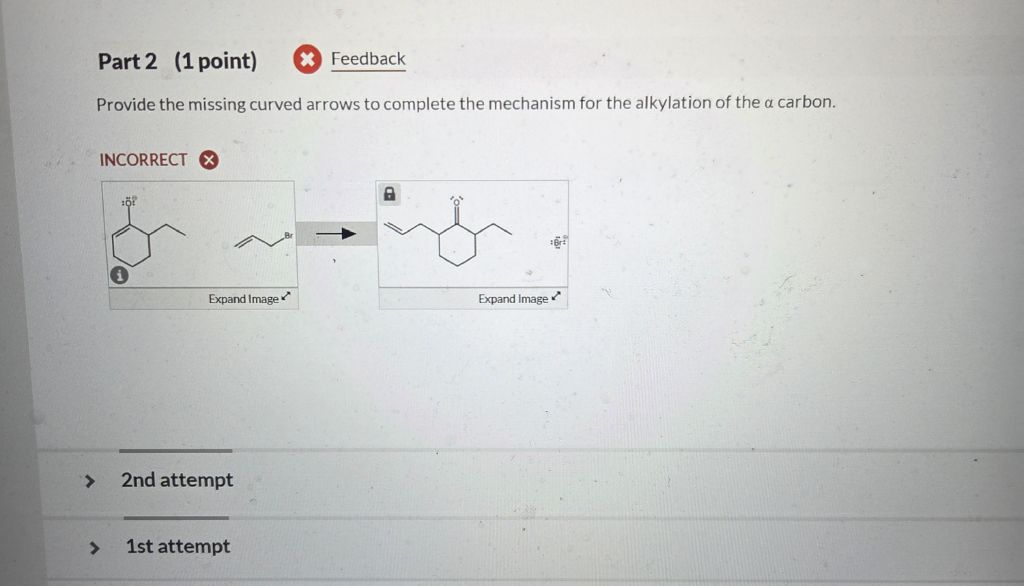 pee 2 2
E a
Part2 (1point) @) Feedback 3
Provide the missing curved arrows to complete the mechanism for the alkylation of the a carbon. &
i :
i: iF a ox > Be
i J
| IGP - 3
Ec) 3 oN ~~ & Ee
a I 2 48
JE | a : i
© Somdimges eiET EE
Ne fe
=
TT ; ccc
SC I i A
—- i 1 i
Ee tt
Relist: sada
4 ligiiie pilin HIE |
This is AI generated Response.
Asked by: Rahul
Created at: 2026-02-08 05:17:12
Asked by: Rahul
Created at: 2026-02-08 05:17:12
Final Answer:
Rendered
Raw Text
Did you like this answer?
Let's break down the mechanism shown in the image, which is the **alkylation of the α-carbon** of a carbonyl compound. The specific reaction shown is an **enolate alkylation** using an alkyl halide (bromide).
---
## **Step-by-Step Mechanism**
### **1. Identify the Reactants**
- **Cyclohexanone** (with an enolate already formed, as shown by the negative charge on the α-carbon and the oxygen anion)
- **1-Bromopropene** (prop-1-enyl bromide)
### **2. The Enolate as a Nucleophile**
The enolate ion (formed from cyclohexanone) is a strong nucleophile.
- The **lone pair on the α-carbon** (the carbon with the negative charge) will attack the **electrophilic carbon** of the alkyl halide (the carbon attached to Br).
### **3. Alkyl Halide as Electrophile**
- The **carbon attached to Br** in the alkyl halide is partially positive and susceptible to nucleophilic attack.
### **4. Curved Arrow Mechanism**
**Draw the following curved arrows:**
1. **From the lone pair (negative charge) on the α-carbon** of the enolate **to the electrophilic carbon** of the alkyl halide (the carbon bonded to Br).
2. **From the C–Br bond to the Br atom**, indicating that the Br leaves as Br⁻ (bromide ion).
This is an **SN2 reaction** at the alkyl halide.
---
## **Summary of Curved Arrows**
1. **Enolate α-carbon (nucleophile) attacks the alkyl halide carbon (electrophile).**
2. **Alkyl halide C–Br bond breaks, and Br leaves with a pair of electrons as Br⁻.**
---
## **Final Answer (Mechanism Explanation)**
**Curved arrows to draw:**
- From the lone pair (negative charge) on the α-carbon of the enolate to the terminal carbon of the alkyl bromide.
- From the C–Br bond to the Br atom.
**Result:**
You get the alkylated product (with the new C–C bond at the α-position) and Br⁻ as the leaving group.
---
### **Visual Representation**
```
Step 1:
O⁻
|
/ \
| |
/-----\ + CH₂=CH-CH₂-Br
| |
Step 2 (Curved arrows):
- Arrow from negative α-carbon to C of CH₂=CH-CH₂-Br
- Arrow from C–Br bond to Br
Step 3:
O⁻
|
/ \
| |
/-----\
| |----CH₂-CH=CH₂
(new bond)
+ Br⁻
```
**That's the correct curved-arrow mechanism for this alkylation!**
📢 Instructions:
- Ask anything relatd to above question only.
- For new Question goto :