 VIPSolutions
Give step-by-step solution with explanation and final answer: {give me the answer with out using bullet points}(b) Determine the Miller indices for the planes (A and B) shown in the following unit cell. (show all your steps) (5 marks). ” Wo’ i } A = wt
Question:
Give step-by-step solution with explanation and final answer:
{give me the answer with out using bullet points}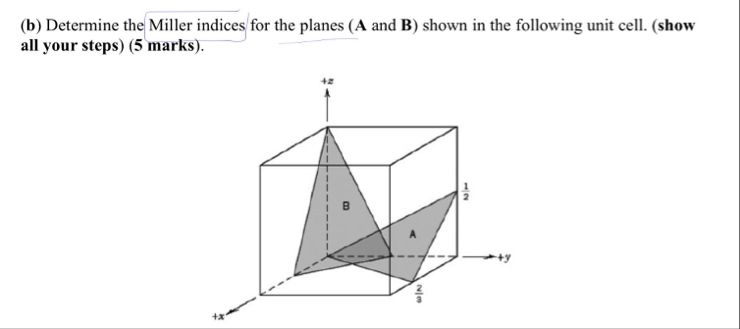 (b) Determine the Miller indices for the planes (A and B) shown in the following unit cell. (show
all your steps) (5 marks).
”
Wo’ i
}
A
=
wt
This is AI generated Response.
Asked by: Francis
Created at: 2026-02-07 08:08:49
Asked by: Francis
Created at: 2026-02-07 08:08:49
Final Answer:
Rendered
Raw Text
Did you like this answer?
Let's determine the Miller indices for planes A and B step by step.
### **Step 1: Identify the intercepts of each plane with the axes (in terms of the lattice constant a)**
**For Plane A:**
From the diagram, Plane A cuts the x-axis at 1, y-axis at 1/2, and z-axis at 1/3.
**For Plane B:**
Plane B cuts the x-axis at 1, y-axis at 1, and z-axis at 1/2.
### **Step 2: Write the intercepts as (x, y, z)**
For Plane A, the intercepts are (1, 1/2, 1/3).
For Plane B, the intercepts are (1, 1, 1/2).
### **Step 3: Take reciprocals of the intercepts**
For Plane A:
Reciprocals are (1/1, 1/(1/2), 1/(1/3)) = (1, 2, 3).
For Plane B:
Reciprocals are (1/1, 1/1, 1/(1/2)) = (1, 1, 2).
### **Step 4: Clear fractions (if any) by multiplying with the lowest common multiple (LCM) to get whole numbers**
For both planes, the reciprocals are already whole numbers.
### **Step 5: Write Miller indices as (hkl)**
For Plane A, the Miller indices are (1 2 3).
For Plane B, the Miller indices are (1 1 2).
### **Final Answers**
Plane A has Miller indices (1 2 3).
Plane B has Miller indices (1 1 2).
📢 Instructions:
- Ask anything relatd to above question only.
- For new Question goto :