 VIPSolutions
Give step-by-step solution with explanation and final answer:MEF Tb PS ES Beer, damit aera | IY J Nn
Question:
Give step-by-step solution with explanation and final answer: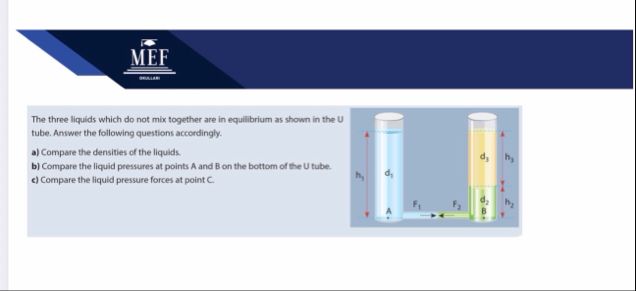 MEF
Tb PS ES
Beer, damit aera | IY J Nn
This is AI generated Response.
Asked by: Rahul
Created at: 2026-02-07 04:07:10
Asked by: Rahul
Created at: 2026-02-07 04:07:10
Final Answer:
Rendered
Raw Text
Did you like this answer?
Let's break down each part of the problem step by step.
---
## a) **Compare the densities of the liquids**
Given:
- The three liquids are **not mixing** and are in **equilibrium** in a U-tube.
- Heights and density notations:
- Left arm: \( h_1, d_1 \) (blue liquid)
- Right arm, top: \( h_3, d_3 \) (yellow liquid)
- Right arm, bottom: \( h_2, d_2 \) (green liquid)
**At equilibrium in a U-tube, the pressures at the same horizontal level (at the bottom of the tube) are equal.**
Let's denote the bottom points:
- Left side bottom: Point **A**
- Right side bottom: Point **B**
- Middle bottom: Point **C**
For equilibrium:
\[
\text{Pressure at A} = \text{Pressure at B}
\]
Pressure due to the column of liquid:
\[
P = h \cdot d \cdot g
\]
where \( h \) is height, \( d \) is density, and \( g \) is gravitational acceleration.
- At **A**: Only the blue liquid column is above.
\[
P_A = h_1 \cdot d_1 \cdot g
\]
- At **B**: Both yellow (on top) and green (below) are above.
\[
P_B = h_3 \cdot d_3 \cdot g + h_2 \cdot d_2 \cdot g
\]
Set these equal:
\[
h_1 d_1 g = h_3 d_3 g + h_2 d_2 g
\]
\[
h_1 d_1 = h_3 d_3 + h_2 d_2
\]
**Without numerical values, we cannot make a precise ranking, but:**
- If the heights of the green and yellow are less than the blue, then their densities must be larger, or vice versa.
---
## b) **Compare the liquid pressures at points A and B on the bottom of the U-tube**
As derived above, **at equilibrium**:
\[
P_A = P_B
\]
So, **the pressures at A and B are equal**.
---
## c) **Compare the liquid pressure forces at point C**
The force due to liquid pressure at point C:
\[
F_C = P_C \cdot S
\]
where \( S \) is the area at point C.
Since A and B are at the same level as C and pressures at A and B are the same, **the pressure at C is also the same:**
\[
P_C = P_A = P_B
\]
Therefore,
\[
F_C = P_C \cdot S = P_A \cdot S = P_B \cdot S
\]
So, **the liquid pressure forces at points A, B, and C are equal (assuming equal area at all points)**.
---
# **Summary Table**
| | Densities (comparison) | Pressures (A vs. B) | Forces (at C) |
|------|------------------------|---------------------|-----------------------|
| **a** | \(h_1 d_1 = h_3 d_3 + h_2 d_2\) | \(P_A = P_B\) | Same as at A and B |
| **b** | | **Equal** | |
| **c** | | | **Equal** |
---
### **Final Answers**
**a)** Densities are related by: \( h_1 d_1 = h_3 d_3 + h_2 d_2 \).
**b)** The liquid pressures at points A and B are **equal**.
**c)** The liquid pressure force at point C is **equal** to the forces at A and B (assuming same area).
📢 Instructions:
- Ask anything relatd to above question only.
- For new Question goto :