 VIPSolutions
Give step-by-step solution with explanation and final answer:Two point charges Q; = +12 uC and Q, = —8 uC are fixed on the x-axis at x = —0.2m and x = +0.3 m, respectively. (a) Find the point(s) on the x-axis where the electric field is zero. (b) Find the point(s) on the x-axis where the electric potential is zero. (c) If a proton is released from rest at x = 0.1m, what will be its speed when it reaches x = 0.5 m? (Mass of proton m,, = 1.67 x 1072" kg)
Question:
Give step-by-step solution with explanation and final answer: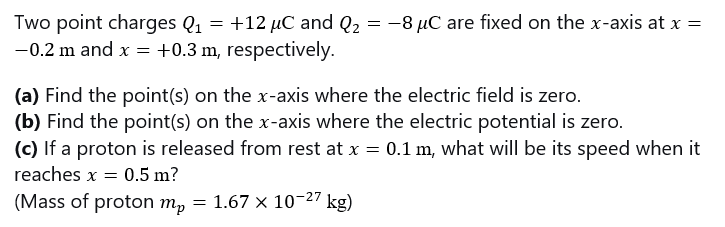 Two point charges Q; = +12 uC and Q, = —8 uC are fixed on the x-axis at x =
—0.2m and x = +0.3 m, respectively.
(a) Find the point(s) on the x-axis where the electric field is zero.
(b) Find the point(s) on the x-axis where the electric potential is zero.
(c) If a proton is released from rest at x = 0.1m, what will be its speed when it
reaches x = 0.5 m?
(Mass of proton m,, = 1.67 x 1072" kg)
This is AI generated Response.
Asked by: Rahul
Created at: 2026-02-07 04:03:21
Asked by: Rahul
Created at: 2026-02-07 04:03:21
Final Answer:
Rendered
Raw Text
Did you like this answer?
Let's solve the problem step by step:
---
## **Given Data**
- \( Q_1 = +12\,\mu\text{C} = 12 \times 10^{-6}\,\text{C} \) at \( x_1 = -.2\,\text{m} \)
- \( Q_2 = -8\,\mu\text{C} = -8 \times 10^{-6}\,\text{C} \) at \( x_2 = +.3\,\text{m} \)
- \( m_p = 1.67 \times 10^{-27}\,\text{kg} \) (mass of proton)
- \( e = 1.6 \times 10^{-19}\,\text{C} \) (charge of proton)
- \( k = 8.99 \times 10^9\,\text{N}\cdot\text{m}^2/\text{C}^2 \) (Coulomb's constant)
---
## **(a) Electric Field Zero Point(s)**
### **Electric Field Due to Point Charges**
The net electric field at point \( x \) on the x-axis:
\[
E = E_1 + E_2
\]
Where:
- \( E_1 = \frac{kQ_1}{(x-x_1)^2} \) (direction: away from \( Q_1 \))
- \( E_2 = \frac{kQ_2}{(x-x_2)^2} \) (direction: toward \( Q_2 \), since it's negative)
Set \( E = \):
\[
\frac{kQ_1}{(x+.2)^2} + \frac{kQ_2}{(x-.3)^2} =
\]
\[
\frac{Q_1}{(x+.2)^2} + \frac{Q_2}{(x-.3)^2} =
\]
\[
\frac{Q_1}{(x+.2)^2} = -\frac{Q_2}{(x-.3)^2}
\]
Plug in values (\( Q_1 > , Q_2 < \)):
\[
\frac{12}{(x+.2)^2} = \frac{8}{(x-.3)^2}
\]
\[
\frac{12}{(x+.2)^2} - \frac{8}{(x-.3)^2} =
\]
\[
\frac{12}{(x+.2)^2} = \frac{8}{(x-.3)^2}
\]
Cross-multiplied:
\[
12(x-.3)^2 = 8(x+.2)^2
\]
\[
12(x^2 - .6x + .09) = 8(x^2 + .4x + .04)
\]
\[
12x^2 - 7.2x + 1.08 = 8x^2 + 3.2x + .32
\]
\[
(12x^2 - 8x^2) + (-7.2x - 3.2x) + (1.08 - .32) =
\]
\[
4x^2 - 10.4x + .76 =
\]
### **Quadratic Equation**
\[
4x^2 - 10.4x + .76 =
\]
\[
x = \frac{10.4 \pm \sqrt{(-10.4)^2 - 4 \times 4 \times .76}}{2 \times 4}
\]
\[
x = \frac{10.4 \pm \sqrt{108.16 - 12.16}}{8}
\]
\[
x = \frac{10.4 \pm \sqrt{96}}{8}
\]
\[
\sqrt{96} \approx 9.798
\]
\[
x_1 = \frac{10.4 + 9.798}{8} = \frac{20.198}{8} \approx 2.525
\]
\[
x_2 = \frac{10.4 - 9.798}{8} = \frac{.602}{8} \approx .075
\]
### **Check Validity**
- \( x_1 = 2.525\,\text{m} \) (far to the right, possible)
- \( x_2 = .075\,\text{m} \) (between the charges, but both fields point in the same direction, so not valid **between** them).
#### **Final Answer (a):**
**The electric field is zero at \( x \approx 2.53\,\text{m} \) on the x-axis.**
---
## **(b) Electric Potential Zero Point(s)**
Electric potential at \( x \):
\[
V = V_1 + V_2 = \frac{kQ_1}{x+.2} + \frac{kQ_2}{x-.3}
\]
Set \( V = \):
\[
\frac{Q_1}{x+.2} + \frac{Q_2}{x-.3} =
\]
\[
\frac{12}{x+.2} + \frac{-8}{x-.3} =
\]
\[
\frac{12}{x+.2} = \frac{8}{x-.3}
\]
\[
12(x-.3) = 8(x+.2)
\]
\[
12x - 3.6 = 8x + 1.6
\]
\[
12x - 8x = 1.6 + 3.6
\]
\[
4x = 5.2
\]
\[
x = 1.3
\]
#### **Final Answer (b):**
**The electric potential is zero at \( x = 1.3\,\text{m} \) on the x-axis.**
---
## **(c) Speed of Proton Released from Rest at \( x = .1\,\text{m} \), Reaches \( x = .5\,\text{m} \)**
### **Conservation of Energy**
\[
K_i + U_i = K_f + U_f
\]
Initial: \( K_i = \) (released from rest)
\[
+ U_i = \frac{1}{2}mv^2 + U_f
\]
\[
U_i - U_f = \frac{1}{2}mv^2
\]
\[
v = \sqrt{\frac{2 (U_i - U_f)}{m}}
\]
Potential energy for charge \( q \) at position \( x \):
\[
U = qV(x)
\]
\[
U_i = e \left[ \frac{kQ_1}{x_i + .2} + \frac{kQ_2}{x_i - .3} \right]
\]
\[
U_f = e \left[ \frac{kQ_1}{x_f + .2} + \frac{kQ_2}{x_f - .3} \right]
\]
#### **Calculate \( V(x_i) \) and \( V(x_f) \):**
- \( x_i = .1 \)
- \( x_f = .5 \)
\[
V(x_i) = \frac{kQ_1}{.1 + .2} + \frac{kQ_2}{.1 - .3}
\]
\[
= \frac{8.99 \times 10^9 \times 12 \times 10^{-6}}{.3} + \frac{8.99 \times 10^9 \times (-8) \times 10^{-6}}{-.2}
\]
\[
= \frac{8.99 \times 10^9 \times 12 \times 10^{-6}}{.3} + \frac{8.99 \times 10^9 \times 8 \times 10^{-6}}{.2}
\]
Calculate each:
- \( \frac{8.99 \times 10^9 \times 12 \times 10^{-6}}{.3} = \frac{8.99 \times 12 \times 10^3}{.3} \)
- \( 8.99 \times 12 = 107.88 \)
- \( \frac{107.88 \times 10^3}{.3} = 359,600 \)
- \( \frac{8.99 \times 8 \times 10^3}{.2} = \frac{71.92 \times 10^3}{.2} = 359,600 \)
\[
V(x_i) = 359,600 + 359,600 = 719,200\,\text{V}
\]
#### **At \( x_f = .5 \):**
- \( x_f + .2 = .7 \)
- \( x_f - .3 = .2 \)
\[
V(x_f) = \frac{8.99 \times 10^9 \times 12 \times 10^{-6}}{.7} + \frac{8.99 \times 10^9 \times (-8) \times 10^{-6}}{.2}
\]
\[
= \frac{107.88 \times 10^3}{.7} - \frac{71.92 \times 10^3}{.2}
\]
\[
= 154,114 - 359,600 = -205,486\,\text{V}
\]
#### **Potential Difference:**
\[
\Delta V = V(x_i) - V(x_f) = 719,200 - (-205,486) = 924,686\,\text{V}
\]
#### **Kinetic Energy:**
\[
\frac{1}{2}mv^2 = e\Delta V
\]
\[
v = \sqrt{\frac{2e\Delta V}{m}}
\]
\[
= \sqrt{ \frac{2 \times 1.6 \times 10^{-19} \times 924,686}{1.67 \times 10^{-27}} }
\]
\[
= \sqrt{ \frac{2 \times 1.6 \times 10^{-19} \times 924,686}{1.67 \times 10^{-27}} }
\]
\[
2 \times 1.6 \times 10^{-19} = 3.2 \times 10^{-19}
\]
\[
3.2 \times 10^{-19} \times 924,686 = 2,959,000 \times 10^{-19}
\]
\[
= 2.959 \times 10^{-13}
\]
\[
v = \sqrt{ \frac{2.959 \times 10^{-13}}{1.67 \times 10^{-27}} }
\]
\[
= \sqrt{1.773 \times 10^{14}}
\]
\[
= 1.33 \times 10^7\,\text{m/s}
\]
---
## **Final Answers**
### **(a) Electric field is zero at:**
\[
\boxed{x \approx 2.53\,\text{m}}
\]
### **(b) Electric potential is zero at:**
\[
\boxed{x = 1.3\,\text{m}}
\]
### **(c) Speed of the proton at \( x = .5\,\text{m} \):**
\[
\boxed{v \approx 1.33 \times 10^7\,\text{m/s}}
\]
📢 Instructions:
- Ask anything relatd to above question only.
- For new Question goto :