 VIPSolutions
Give step-by-step solution with explanation and final answer: {give me the answer with out using bullet points}Although real estate contracts are important and should always be in writing, our major emphasis on this chapter will be closings. Case 2 (dealing with real estate closings) is to answer study question 8 at the end of Chapter 13. This assignment is not due until Sunday, but | will be begin checking on Wednesday to see if you have any problems and need revisions. Chapter 13 provides an excellent update to the closing process and shows the information required to be provided to the lender to the buyer and seller. Perhaps one of the more confusing aspects involves prorating property taxes and mortgage interest, both of which are paid in arrears. This is important, especially for the buyer, since the new owner may end up owing taxes or interest for a time period in which he/she did not even own the property. Just for your refefence, I've added an old closing case for a house | purchased in Virginia Beach which you may find interesting, especially the interest rate which was 10.5% for a VA mortgage. (we had double digit inflation during the early 80's). Bought this “home for $99K and sold for $145K five years later. With respect to mortgages, Chapter 9 provides a good introduction to the descriptive aspects of mortgages, which includes both the mortgage agreement and mortgage note. The agreement always specifies the descriptive or written aspects of the mortgage, while the note primarily specifies the financial terms - especially the interest rate and length of the note, as well as the $ amount of the loan. ‘Next week wil be busy, 50 you may want to go ahead and read Chapters 11 and 16 to allow you plenty of time to work on mortgage problems and prepare for exam 2.
Question:
Give step-by-step solution with explanation and final answer:
{give me the answer with out using bullet points}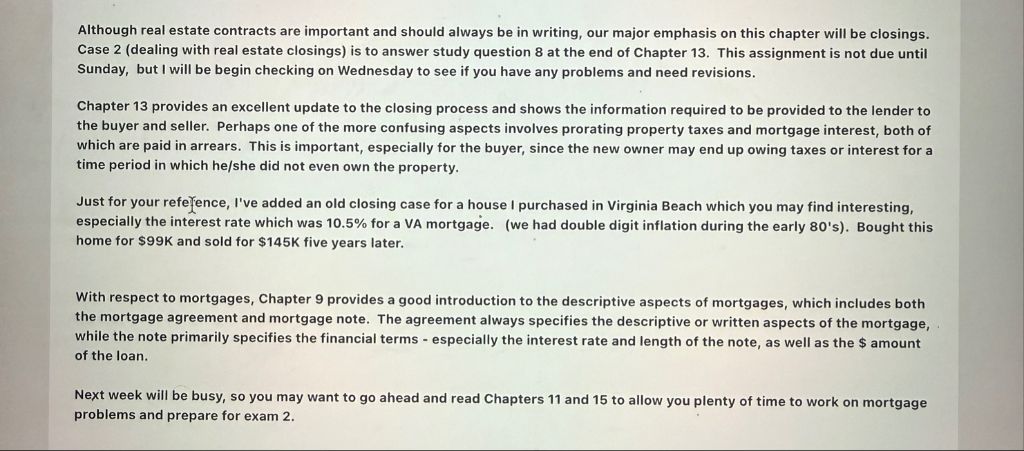 Although real estate contracts are important and should always be in writing, our major emphasis on this chapter will be closings.
Case 2 (dealing with real estate closings) is to answer study question 8 at the end of Chapter 13. This assignment is not due until
Sunday, but | will be begin checking on Wednesday to see if you have any problems and need revisions.
Chapter 13 provides an excellent update to the closing process and shows the information required to be provided to the lender to
the buyer and seller. Perhaps one of the more confusing aspects involves prorating property taxes and mortgage interest, both of
which are paid in arrears. This is important, especially for the buyer, since the new owner may end up owing taxes or interest for a
time period in which he/she did not even own the property.
Just for your refefence, I've added an old closing case for a house | purchased in Virginia Beach which you may find interesting,
especially the interest rate which was 10.5% for a VA mortgage. (we had double digit inflation during the early 80's). Bought this
“home for $99K and sold for $145K five years later.
With respect to mortgages, Chapter 9 provides a good introduction to the descriptive aspects of mortgages, which includes both
the mortgage agreement and mortgage note. The agreement always specifies the descriptive or written aspects of the mortgage,
while the note primarily specifies the financial terms - especially the interest rate and length of the note, as well as the $ amount
of the loan.
‘Next week wil be busy, 50 you may want to go ahead and read Chapters 11 and 16 to allow you plenty of time to work on mortgage
problems and prepare for exam 2.
Asked by: Francis
Created at: 2026-02-06 12:40:11
Final Answer:
📢 Instructions:
- Ask anything relatd to above question only.
- For new Question goto :