 VIPSolutions
Give step-by-step solution with explanation and final answer: {give me the answer with out using bullet points}} LS A | Reaction: & B FORWARD RATE: 1; = kCp, k=1.0 min”! | EQUILIBRIUM CONSTANT: K — Se =3 A FEED: | ® Cao = 30 kmol/m? | ® Volumetric flow rate v,=05 m/min | ® Feed temperature T, = 310 K THERMAL DATA: e Heat of reaction AH e Density = 1000 kg/m* | | ® Heat capacity = 4 kJ/kg-K | TASKS: 1. Derive equilibrium conversion expression. 2. Write PFR mole balance including reversible reaction. | 3. Derive temperature-conversion relation (adiabatic). 4. Calculate equilibrium conversion. 5. Reactor volume required to reach 90 % of equilibrium conversio | 6. Comment on effect of increasing feed temperature.
Question:
Give step-by-step solution with explanation and final answer:
{give me the answer with out using bullet points}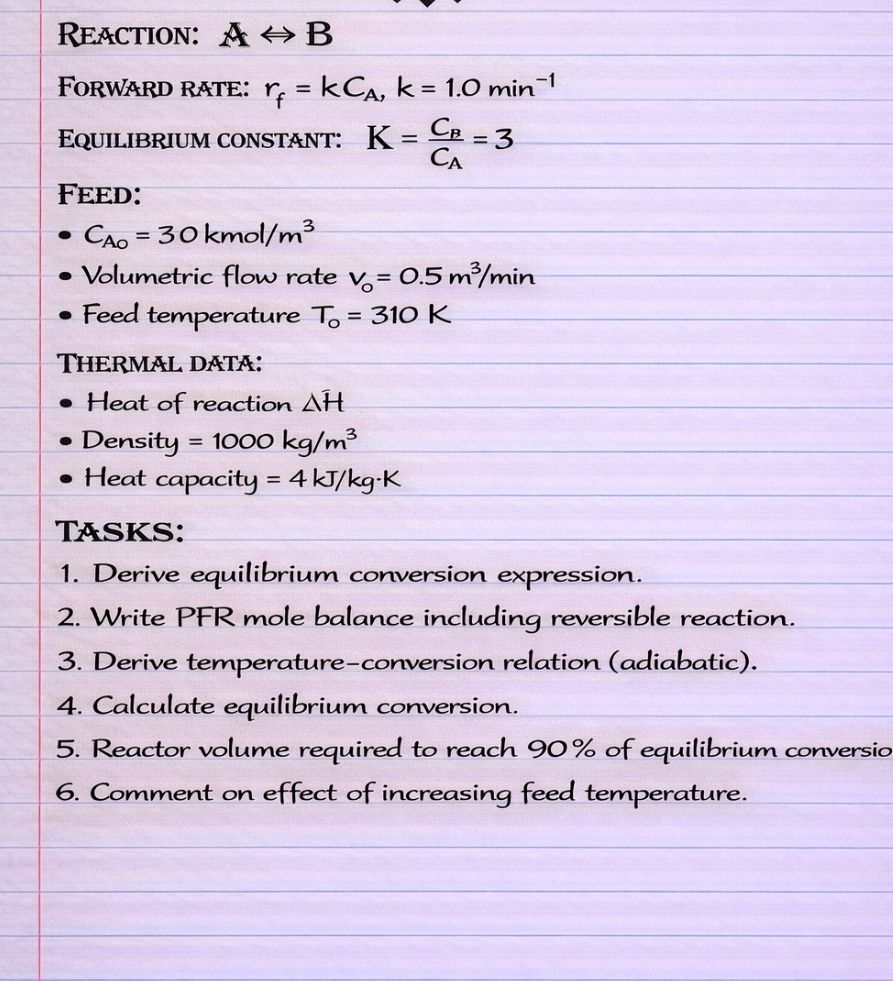 } LS A
| Reaction: & B
FORWARD RATE: 1; = kCp, k=1.0 min”!
| EQUILIBRIUM CONSTANT: K — Se =3
A
FEED:
| ® Cao = 30 kmol/m?
| ® Volumetric flow rate v,=05 m/min
| ® Feed temperature T, = 310 K
THERMAL DATA:
e Heat of reaction AH
e Density = 1000 kg/m*
|
| ® Heat capacity = 4 kJ/kg-K
| TASKS:
1. Derive equilibrium conversion expression.
2. Write PFR mole balance including reversible reaction.
| 3. Derive temperature-conversion relation (adiabatic).
4. Calculate equilibrium conversion.
5. Reactor volume required to reach 90 % of equilibrium conversio
| 6. Comment on effect of increasing feed temperature.
This is AI generated Response.
Asked by: Francis
Created at: 2026-02-06 10:59:52
Asked by: Francis
Created at: 2026-02-06 10:59:52
Final Answer:
Rendered
Raw Text
Did you like this answer?
Let's solve each task step by step as requested:
---
# 1. **Derive Equilibrium Conversion Expression**
For the reaction A ⇌ B, the equilibrium constant is \( K = \frac{C_B}{C_A} \).
If \( X_{eq} \) is the equilibrium conversion, then:
- \( C_A = C_{A} (1 - X_{eq}) \)
- \( C_B = C_{A} X_{eq} \)
So,
\[
K = \frac{C_B}{C_A} = \frac{C_{A} X_{eq}}{C_{A}(1 - X_{eq})} = \frac{X_{eq}}{1 - X_{eq}}
\]
Thus,
\[
X_{eq} = \frac{K}{1+K}
\]
---
# 2. **Write PFR Mole Balance (Reversible Reaction)**
For a PFR (Plug Flow Reactor), the mole balance is:
\[
\frac{dF_A}{dV} = -r_A
\]
For a reversible reaction,
\[
r_A = k C_A - k_{-1} C_B
\]
But since \( k_{-1} = \frac{k}{K} \),
\[
r_A = k C_A - \frac{k}{K} C_B
\]
Substitute \( C_A = C_{A}(1-X) \) and \( C_B = C_{A} X \):
\[
r_A = k C_{A} (1-X) - \frac{k}{K} C_{A} X = k C_{A} \left( 1-X - \frac{X}{K} \right )
\]
\[
r_A = k C_{A} \left( 1-X \left(1 + \frac{1}{K}\right) \right )
\]
---
# 3. **Temperature-Conversion Relation (Adiabatic)**
For an adiabatic reactor,
The energy balance gives:
\[
T = T_ + \frac{ -\Delta H }{ \rho C_p } C_{A} X
\]
where \( \Delta H \) is the heat of reaction (per mole A), \( \rho \) is density, \( C_p \) is heat capacity.
---
# 4. **Calculate Equilibrium Conversion**
Given \( K = 3 \):
From step 1,
\[
X_{eq} = \frac{K}{1+K} = \frac{3}{1+3} = \frac{3}{4} = .75
\]
---
# 5. **Reactor Volume for 90% of Equilibrium Conversion**
90% of equilibrium conversion is:
\[
X_{90\%} = .9 \times .75 = .675
\]
For a PFR,
\[
V = \int_^{X_{90\%}} \frac{F_{A}}{-r_A} dX
\]
Given:
\( F_{A} = C_{A} v_ = 30 \times .5 = 15 \) mol/min
\( k = 1. \) min\(^{-1} \)
From step 2,
\[
-r_A = k C_{A} \left(1 - X \left(1 + \frac{1}{K}\right)\right)
\]
\[
-r_A = 1 \times 30 \left(1 - X \left(1 + \frac{1}{3}\right)\right) = 30 \left(1 - X \cdot 1.333\right)
\]
\[
V = \int_^{.675} \frac{15}{30(1 - 1.333X)} dX = \int_^{.675} \frac{.5}{1 - 1.333X} dX
\]
\[
V = .5 \int_^{.675} \frac{dX}{1 - 1.333X}
\]
Let \( a = 1.333 \):
\[
V = .5 \left[ -\frac{1}{a} \ln|1 - aX| \right]_^{.675}
\]
\[
= .5 \left[ -\frac{1}{1.333} \left( \ln|1 - 1.333 \times .675| - \ln|1| \right) \right]
\]
\[
1 - 1.333 \times .675 = 1 - .9 = .1
\]
\[
V = .5 \left( -\frac{1}{1.333} (\ln .1 - ) \right )
\]
\[
= .5 \times \frac{1}{1.333} \times 2.3026
\]
\[
= .5 \times .750 \times 2.3026 \approx .863\, \text{m}^3
\]
---
# 6. **Effect of Increasing Feed Temperature**
Increasing feed temperature increases the initial reaction rate due to increased \( k \), but for an exothermic reaction (since most reactions are exothermic unless specified), the equilibrium constant \( K \) decreases with increasing temperature, resulting in a lower equilibrium conversion. Thus, while rate improves, the maximum achievable conversion decreases at higher temperature.
---
# **Summary of Answers**
1. \( X_{eq} = \frac{K}{1+K} \)
2. PFR mole balance: \( \frac{dF_A}{dV} = -r_A = kC_{A}[1 - X(1+\frac{1}{K})] \)
3. Adiabatic relation: \( T = T_ + \frac{ -\Delta H }{ \rho C_p } C_{A} X \)
4. \( X_{eq} = .75 \)
5. Required reactor volume for 90% of equilibrium conversion is approximately \( .863\, \text{m}^3 \)
6. Increasing feed temperature decreases equilibrium conversion for exothermic reactions due to a decrease in \( K \).
📢 Instructions:
- Ask anything relatd to above question only.
- For new Question goto :