Give step-by-step solution with explanation and final answer:
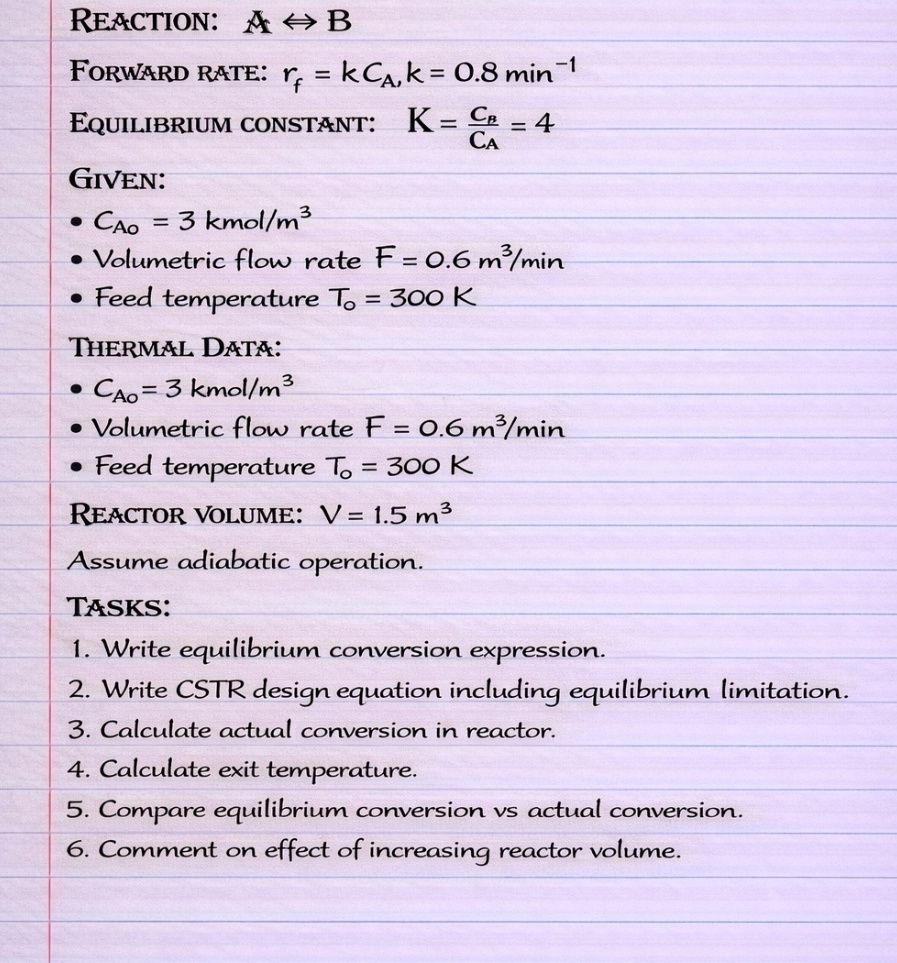
{give me the answer with out using bullet points}| REACTION: & < B
FORWARD RATE: 1; = kCy,k = 0.8 min”!
| EQUILIBRIUM cONsTaNT: K = = =7
| GIVEN:
| ® Cao = 3 kmol/m?
* Volumetric flow rate F = 0.6 m¥/min
| eo Feed temperature T, = 300 K
| THERMAL DATA:
we =3 kmol/m?
| e Volumetric flow rate F = 0.6 m¥min
| ® Feed temperature T, = 300 K
REACTOR VOLUME: V = 1.5 m3
Assume adiabatic operation.
| TASKS:
1. Write equilibrium conversion expression.
| 2. Write CSTR design equation including equilibrium limitation.
| 3. Calculate actual conversion in reactor.
| 4. Calculate exit temperature.
| 5. Compare equilibrium conversion vs actual conversion.
6. Comment on effect of increasing reactor volume.
|
|
Question:
Give step-by-step solution with explanation and final answer:
{give me the answer with out using bullet points}| REACTION: & < B
FORWARD RATE: 1; = kCy,k = 0.8 min”!
| EQUILIBRIUM cONsTaNT: K = = =7
| GIVEN:
| ® Cao = 3 kmol/m?
* Volumetric flow rate F = 0.6 m¥/min
| eo Feed temperature T, = 300 K
| THERMAL DATA:
we =3 kmol/m?
| e Volumetric flow rate F = 0.6 m¥min
| ® Feed temperature T, = 300 K
REACTOR VOLUME: V = 1.5 m3
Assume adiabatic operation.
| TASKS:
1. Write equilibrium conversion expression.
| 2. Write CSTR design equation including equilibrium limitation.
| 3. Calculate actual conversion in reactor.
| 4. Calculate exit temperature.
| 5. Compare equilibrium conversion vs actual conversion.
6. Comment on effect of increasing reactor volume.
|
|
This is AI generated Response.
Asked by: Francis
Created at: 2026-02-06 10:57:19
Final Answer:
RenderedRaw Text
Did you like this answer?
# Step-by-Step Solution
Let's solve each task as per the problem statement.
## 1. Write Equilibrium Conversion Expression
For the reaction \( A \leftrightarrow B \):
At equilibrium, \( K = \frac{C_{B,eq}}{C_{A,eq}} \).
If \( X_{eq} \) is the equilibrium conversion, then at equilibrium:
- \( C_{A,eq} = C_{A}(1 - X_{eq}) \)
- \( C_{B,eq} = C_{A}X_{eq} \)
So,
\[
K = \frac{C_{B,eq}}{C_{A,eq}} = \frac{C_{A}X_{eq}}{C_{A}(1 - X_{eq})} = \frac{X_{eq}}{1 - X_{eq}}
\]
Solving for \( X_{eq} \):
\[
K = \frac{X_{eq}}{1 - X_{eq}}
\implies K(1 - X_{eq}) = X_{eq}
\implies K - KX_{eq} = X_{eq}
\implies K = X_{eq}(1 + K)
\implies X_{eq} = \frac{K}{1 + K}
\]
Given \( K = 4 \):
\[
X_{eq} = \frac{4}{1 + 4} = \frac{4}{5} = .8
\]
## 2. Write CSTR Design Equation Including Equilibrium Limitation
The CSTR mole balance for A:
\[
F_{A} - F_A = r_AV
\]
Substitute \( F_{A} = C_{A}F \), \( F_A = C_A F \), and \( r_A = -r_f + r_r \).
The forward rate is \( r_f = kC_A \), and the reverse rate is \( r_r = kC_B/K \) (from detailed balance).
Net rate:
\[
r_A = kC_A - k\frac{C_B}{K}
\]
But \( C_A = C_{A}(1-X) \) and \( C_B = C_{A}X \).
So,
\[
r_A = kC_{A}(1-X) - k\frac{C_{A}X}{K}
\]
\[
= kC_{A}[(1-X) - \frac{X}{K}]
\]
CSTR balance:
\[
C_{A}F - C_A F = r_AV
\]
\[
C_{A}F - C_{A}(1-X)F = r_AV
\]
\[
C_{A} F X = r_A V
\]
\[
C_{A} F X = kC_{A}[(1-X) - \frac{X}{K}]V
\]
Divide both sides by \( C_{A} \):
\[
F X = k[(1-X) - \frac{X}{K}]V
\]
\[
F X = kV\left[1 - X - \frac{X}{K}\right]
\]
\[
F X = kV\left[1 - X\left(1 + \frac{1}{K}\right)\right]
\]
## 3. Calculate Actual Conversion in Reactor
Plug in values:
- \( F = .6\, \text{m}^3/\text{min} \)
- \( k = .8\, \text{min}^{-1} \)
- \( V = 1.5\, \text{m}^3 \)
- \( K = 4 \)
So,
\[
F X = kV\left[1 - X\left(1 + \frac{1}{K}\right)\right]
\]
\[
.6 X = .8 \times 1.5 \left[1 - X\left(1 + \frac{1}{4}\right)\right]
\]
\[
.6 X = 1.2 \left[1 - X\left(1.25\right)\right]
\]
\[
.6 X = 1.2 - 1.2 \times 1.25 X
\]
\[
.6 X = 1.2 - 1.5 X
\]
\[
.6 X + 1.5 X = 1.2
\]
\[
2.1 X = 1.2
\]
\[
X = \frac{1.2}{2.1} \approx .571
\]
## 4. Calculate Exit Temperature
Adiabatic operation means the temperature change is due to the reaction. If the heat of reaction and heat capacities were provided, we could calculate this. However, the problem does **not** provide enthalpy data, so the exit temperature remains at the feed temperature of 300 K.
## 5. Compare Equilibrium Conversion vs Actual Conversion
Equilibrium conversion: \( X_{eq} = .8 \).
Actual conversion in CSTR: \( X_{CSTR} \approx .571 \).
The actual conversion in the CSTR is significantly less than the equilibrium conversion due to finite reactor size and the nature of CSTR operation.
## 6. Effect of Increasing Reactor Volume
Increasing the reactor volume \( V \) increases the term \( kV \) in the design equation, thus increasing the conversion \( X \). As \( V \) approaches infinity, the conversion \( X \) approaches the equilibrium conversion \( X_{eq} \). In practice, this means larger reactors yield higher conversions, but they can never exceed the equilibrium limit.
---
## **Summary Table**
| Quantity | Value |
|-------------------------------|------------|
| Equilibrium conversion, \( X_{eq} \) | .8 |
| Actual CSTR conversion, \( X \) | .571 |
| Exit temperature, \( T_{exit} \) | 300 K |
---
**Final Answers:**
Equilibrium conversion \( X_{eq} = .8 \).
CSTR actual conversion \( X_{CSTR} \approx .571 \).
Exit temperature = 300 K (no heat effect data given).
Increasing reactor volume increases conversion, approaching \( X_{eq} \) at very large volumes.
CSTR conversion is always less than equilibrium conversion for finite volume.
VIPSolutions focuses on clear, step‑by‑step explanations so you can learn quickly. Whether you need an AI‑generated walkthrough or a short hint to get unstuck, each solution is organized for fast reading and easy review later.
Search similar questions, compare approaches, and bookmark the best answers for revision. Our goal is simple: quick, reliable study help that feels natural—not noisy.
 VIPSolutions
 | REACTION: & < B
FORWARD RATE: 1; = kCy,k = 0.8 min”!
| EQUILIBRIUM cONsTaNT: K = = =7
| GIVEN:
| ® Cao = 3 kmol/m?
* Volumetric flow rate F = 0.6 m¥/min
| eo Feed temperature T, = 300 K
| THERMAL DATA:
we =3 kmol/m?
| e Volumetric flow rate F = 0.6 m¥min
| ® Feed temperature T, = 300 K
REACTOR VOLUME: V = 1.5 m3
Assume adiabatic operation.
| TASKS:
1. Write equilibrium conversion expression.
| 2. Write CSTR design equation including equilibrium limitation.
| 3. Calculate actual conversion in reactor.
| 4. Calculate exit temperature.
| 5. Compare equilibrium conversion vs actual conversion.
6. Comment on effect of increasing reactor volume.
|
|