 VIPSolutions
Give step-by-step solution with explanation and final answer: {give me the answer without using bullet-points}The fundamental assessment of hydrocarbon reservoir potential rests upon the intricate interplay between the rock’s storage capacity, governed by porosity, and its fluid transmissivity, characterized by permeability. While Darcy’s law provides the macroscopic description of fluid flow, the underlying microscopic pore geometry, including pore throat size distribution and tortuosity, significantly dictates the flow behavior. The development of predictive models relating these two distinct properties necessitates a theoretical framework that bridges the gap between the pore-scale attributes and the continuum- scale flow properties. A The fundamental relationship governing flow through porous media can be = modelled by considering the porous medium as a bundle of capillary tubes. Grains Pores (¢) i Derive the Kozeny-Carman equation, which expresses permeability (£) as a function of porosity (¢), specific surface area (S,), and tortuosity (7), Tortuous starting from the Hagen-Poiscuille equation for flow in a single capillary Flow Path tube. (1) ii Deduce the expression for the Kozeny constant (K.,) in terms of the flow path tortuosity and a pore shape factor, demonstrating its dependence on the Flow geometric complexity of the pore space. Direction B The influence of grain size distribution and sorting on the porosity-permeability relationship is a critical factor in reservoir characterization. i Establish a mathematical relation or correlation, based on empirical or theoretical models, that describes how grain sorting (e.g., represented by the Trask sorting coefficient) influences the permeability for a given porosity. ii Obtain an expression for the specific surface area (S,) as a function of the dominant grain size (d) and sorting parameters, considering a pack of spherical grains.
Question:
Give step-by-step solution with explanation and final answer:
{give me the answer without using bullet-points}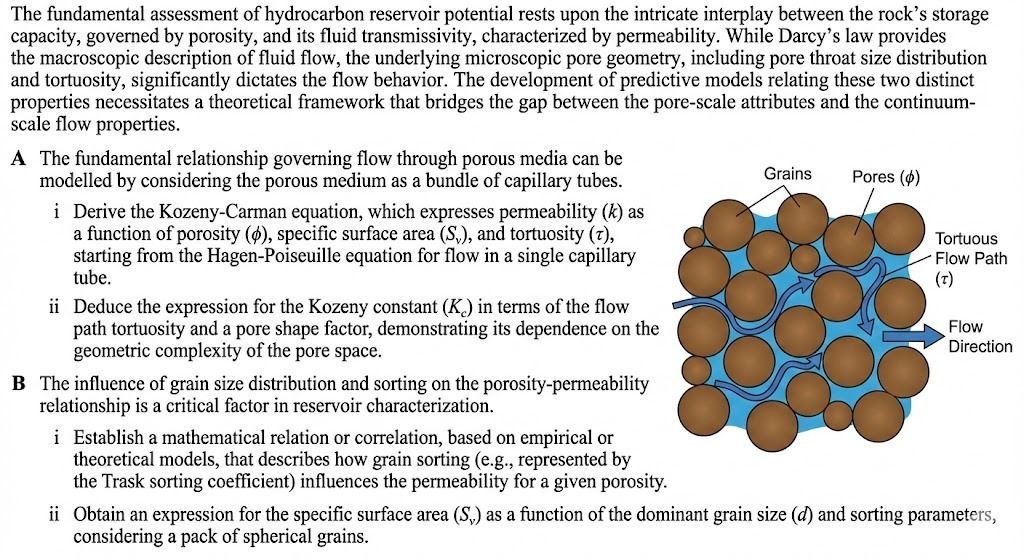 The fundamental assessment of hydrocarbon reservoir potential rests upon the intricate interplay between the rock’s storage
capacity, governed by porosity, and its fluid transmissivity, characterized by permeability. While Darcy’s law provides
the macroscopic description of fluid flow, the underlying microscopic pore geometry, including pore throat size distribution
and tortuosity, significantly dictates the flow behavior. The development of predictive models relating these two distinct
properties necessitates a theoretical framework that bridges the gap between the pore-scale attributes and the continuum-
scale flow properties.
A The fundamental relationship governing flow through porous media can be =
modelled by considering the porous medium as a bundle of capillary tubes. Grains Pores (¢)
i Derive the Kozeny-Carman equation, which expresses permeability (£) as
a function of porosity (¢), specific surface area (S,), and tortuosity (7), Tortuous
starting from the Hagen-Poiscuille equation for flow in a single capillary Flow Path
tube. (1)
ii Deduce the expression for the Kozeny constant (K.,) in terms of the flow
path tortuosity and a pore shape factor, demonstrating its dependence on the Flow
geometric complexity of the pore space. Direction
B The influence of grain size distribution and sorting on the porosity-permeability
relationship is a critical factor in reservoir characterization.
i Establish a mathematical relation or correlation, based on empirical or
theoretical models, that describes how grain sorting (e.g., represented by
the Trask sorting coefficient) influences the permeability for a given porosity.
ii Obtain an expression for the specific surface area (S,) as a function of the dominant grain size (d) and sorting parameters,
considering a pack of spherical grains.
Asked by: francis
Created at: 2026-02-06 09:46:17
Final Answer:
📢 Instructions:
- Ask anything relatd to above question only.
- For new Question goto :