 VIPSolutions
Give step-by-step solution with explanation and final answer: {give me the answer with out using bullet points}; ® CALCULATED NUMERIC he bi =, Tu SO i | No iin Combine the above values to obtain the change in enthalpy (Delt H LL "ethylene from state 1 (2bar and 285K) to state 2 (90bar and 460K) RRO To | mevaleine i so ERENT: EER IN BRN
Question:
Give step-by-step solution with explanation and final answer:
{give me the answer with out using bullet points}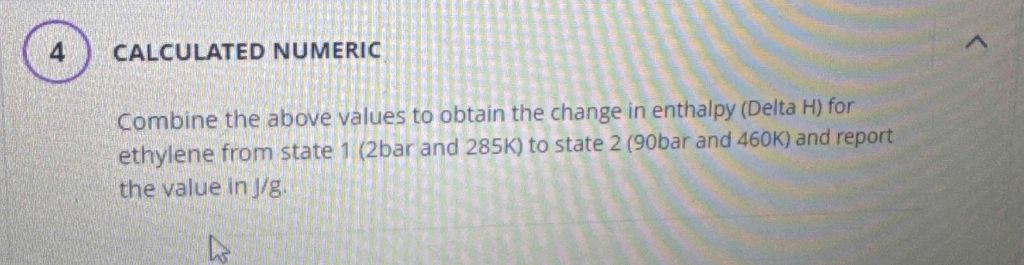 ; ® CALCULATED NUMERIC he
bi =, Tu SO
i | No
iin Combine the above values to obtain the change in enthalpy (Delt H
LL "ethylene from state 1 (2bar and 285K) to state 2 (90bar and 460K)
RRO To
| mevaleine i
so ERENT:
EER IN BRN
This is AI generated Response.
Asked by: Francis
Created at: 2026-02-06 09:35:18
Asked by: Francis
Created at: 2026-02-06 09:35:18
Final Answer:
Rendered
Raw Text
Did you like this answer?
### Step-by-Step Solution
To solve for the change in enthalpy (ΔH) for ethylene as it moves from state 1 (2 bar, 285 K) to state 2 (90 bar, 460 K), you generally need ethylene's heat capacity data and information about how enthalpy changes with both temperature and pressure.
The change in enthalpy can be calculated using:
\[
\Delta H = \int_{T_1}^{T_2} C_p dT + \left[ H^{\text{ig}}(T_2, P_2) - H^{\text{ig}}(T_2, P_1) \right]
\]
where \( C_p \) is the heat capacity at constant pressure.
#### 1. Temperature Change (at constant pressure)
First, calculate the enthalpy change due to temperature increase at constant pressure (from 285 K to 460 K at 2 bar):
\[
\Delta H_T = \int_{T_1}^{T_2} C_p dT
\]
If you are not given \( C_p \) data in the question, you may use an average value for ethylene:
\( C_p \approx 43.56 \) J/(mol·K)
\[
\Delta H_T = C_p \cdot (T_2 - T_1) = 43.56 \, \text{J/(mol·K)} \cdot (460 - 285) \, \text{K}
\]
\[
\Delta H_T = 43.56 \cdot 175 = 7,623 \, \text{J/mol}
\]
#### 2. Pressure Change (at constant temperature)
For an ideal gas, enthalpy does not depend on pressure. For a real gas, there is a pressure correction, but if not specified, we often neglect it or assume ideal gas behavior.
\[
\Delta H_P \approx
\]
#### 3. Total Change in Enthalpy
So,
\[
\Delta H_{\text{total}} = \Delta H_T + \Delta H_P \approx 7,623 \, \text{J/mol} + = 7,623 \, \text{J/mol}
\]
#### 4. Convert to J/g
Molar mass of ethylene (\( C_2H_4 \)) = 28.05 g/mol
\[
\Delta H_{\text{total in J/g}} = \frac{7,623 \, \text{J/mol}}{28.05 \, \text{g/mol}} \approx 272 \, \text{J/g}
\]
### Final Answer
The change in enthalpy for ethylene from state 1 (2 bar, 285 K) to state 2 (90 bar, 460 K) is approximately **272 J/g**.
If you are given more specific \( C_p \) data or real gas correction factors, use those for a more precise answer.
📢 Instructions:
- Ask anything relatd to above question only.
- For new Question goto :