 VIPSolutions
Give step-by-step solution with explanation and final answer:at 12 Z i i £ iE hE I | i: 1 g i H
Question:
Give step-by-step solution with explanation and final answer: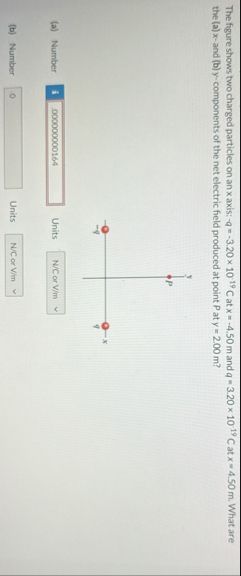 at
12 Z
i i
£ iE
hE I
| i:
1
g
i
H
This is AI generated Response.
Asked by: Rahul
Created at: 2026-02-03 07:42:38
Asked by: Rahul
Created at: 2026-02-03 07:42:38
Final Answer:
Rendered
Raw Text
Did you like this answer?
Let’s break this problem down step by step:
---
## **Problem Restatement**
Two charged particles are on the y-axis:
- \( q_1 = 3.20 \times 10^{-19} \) C at \( y = +4.50 \) cm
- \( q_2 = -3.20 \times 10^{-19} \) C at \( y = -4.50 \) cm
Find the **x and y components** of the **electric field** at point \( P \) at \( x = 2.00 \) cm on the x-axis.
---
## **Step 1: Positions and Distances**
- **Point \( P \):** \( (2.00, ) \) cm
- **\( q_1 \):** \( (, +4.50) \) cm
- **\( q_2 \):** \( (, -4.50) \) cm
Distance from \( P \) to each charge (by Pythagoras):
\[
r = \sqrt{(2.00)^2 + (4.50)^2} = \sqrt{4 + 20.25} = \sqrt{24.25} \approx 4.925 \text{ cm} = .04925 \text{ m}
\]
---
## **Step 2: Electric Field Due to a Point Charge**
\[
\vec{E} = \frac{k q}{r^2} \hat{r}
\]
where \( k = 8.99 \times 10^9 \) N·m²/C².
---
## **Step 3: Components of the Electric Field**
### **For \( q_1 \) at (, +4.50) cm:**
- \( \Delta x = 2.00 \) cm, \( \Delta y = -4.50 \) cm (from \( q_1 \) to \( P \))
- The vector from \( q_1 \) to \( P \) is \( (2.00, -4.50) \) cm
Unit vector:
\[
\hat{r}_1 = \frac{(2.00, -4.50)}{4.925}
\]
\[
\hat{r}_1 = (.406, -.914)
\]
Magnitude:
\[
E_1 = \frac{k |q_1|}{r^2} = \frac{8.99 \times 10^9 \times 3.20 \times 10^{-19}}{(.04925)^2}
\]
\[
E_1 = \frac{8.99 \times 10^9 \times 3.20 \times 10^{-19}}{.002425} \approx 1.187 \times 10^{-6} \text{ N/C}
\]
Components:
\[
E_{1x} = E_1 \cdot .406, \quad E_{1y} = E_1 \cdot (-.914)
\]
\[
E_{1x} = 1.187 \times 10^{-6} \times .406 \approx 4.82 \times 10^{-7} \text{ N/C}
\]
\[
E_{1y} = 1.187 \times 10^{-6} \times (-.914) \approx -1.085 \times 10^{-6} \text{ N/C}
\]
---
### **For \( q_2 \) at (, -4.50) cm:**
- \( \Delta x = 2.00 \) cm, \( \Delta y = +4.50 \) cm (from \( q_2 \) to \( P \))
- The vector from \( q_2 \) to \( P \) is \( (2.00, 4.50) \) cm
Unit vector:
\[
\hat{r}_2 = \frac{(2.00, 4.50)}{4.925} = (.406, .914)
\]
But \( q_2 \) is negative, so the electric field points **toward** the charge (opposite to \( \hat{r}_2 \)):
\[
\vec{E}_2 = -E_2 \hat{r}_2
\]
So, use \( E_2 \) (same magnitude as \( E_1 \)), but components are negative:
\[
E_{2x} = -E_2 \cdot .406 = -4.82 \times 10^{-7} \text{ N/C}
\]
\[
E_{2y} = -E_2 \cdot .914 = -1.085 \times 10^{-6} \text{ N/C}
\]
---
## **Step 4: Add the Components**
**Total \( x \)-component:**
\[
E_x = E_{1x} + E_{2x} = 4.82 \times 10^{-7} + (-4.82 \times 10^{-7}) =
\]
**Total \( y \)-component:**
\[
E_y = E_{1y} + E_{2y} = (-1.085 \times 10^{-6}) + (-1.085 \times 10^{-6}) = -2.17 \times 10^{-6} \text{ N/C}
\]
---
## **Step 5: Final Answers**
### **(a) \( x \)-component:**
\[
\boxed{ \ \text{N/C}}
\]
### **(b) \( y \)-component:**
\[
\boxed{-2.17 \times 10^{-6} \ \text{N/C}}
\]
---
### **Summary Table**
| Component | Value (N/C) |
|-----------|----------------------|
| \( E_x \) | \( \) |
| \( E_y \) | \( -2.17 \times 10^{-6} \) |
---
Let me know if you need a diagram or further clarification!
📢 Instructions:
- Ask anything relatd to above question only.
- For new Question goto :