 VIPSolutions
Give step-by-step solution with explanation and final answer:A R, hs [A ; ea
Question:
Give step-by-step solution with explanation and final answer: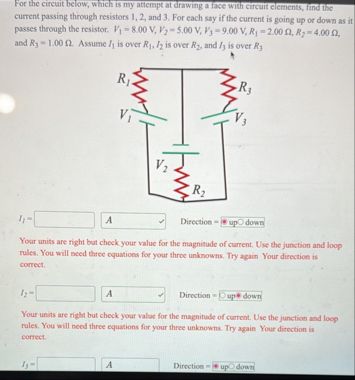 A R,
hs [A
;
ea
This is AI generated Response.
Asked by: Rahul
Created at: 2026-02-03 06:33:38
Asked by: Rahul
Created at: 2026-02-03 06:33:38
Final Answer:
Rendered
Raw Text
Did you like this answer?
Let's solve the circuit step by step using **Kirchhoff’s Laws**.
We are given:
- \( V_1 = 8.00~\text{V} \)
- \( V_2 = 5.00~\text{V} \)
- \( V_3 = 9.00~\text{V} \)
- \( R_1 = 2.00~\Omega \)
- \( R_2 = 4.00~\Omega \)
- \( R_3 = 1.00~\Omega \)
Let:
- \( I_1 \) = current through \( R_1 \) (downward)
- \( I_2 \) = current through \( R_2 \) (rightward)
- \( I_3 \) = current through \( R_3 \) (downward)
The direction is as shown in your assumption.
---
## **Step 1: Write Junction Rule (at top node)**
**Incoming currents = Outgoing currents:**
\[
I_1 = I_2 + I_3
\]
---
## **Step 2: Loop 1 (left loop: \( V_1 \to R_1 \to R_2 \to V_2 \))**
Start at the top, go down through \( R_1 \), to the left through \( R_2 \), up through \( V_2 \), and back to the top.
\[
-V_1 + I_1 R_1 + I_2 R_2 + V_2 =
\]
---
## **Step 3: Loop 2 (right loop: \( V_3 \to R_3 \to R_2 \to V_2 \))**
Start at the top, go down through \( R_3 \), left through \( R_2 \), up through \( V_2 \), and back to the top.
\[
-V_3 + I_3 R_3 + I_2 R_2 + V_2 =
\]
---
## **Step 4: Substitute Values**
### Equation 1 (Junction):
\[
I_1 = I_2 + I_3 \tag{1}
\]
### Equation 2 (Left loop):
\[
-8.00 + 2.00I_1 + 4.00I_2 + 5.00 = \\
2.00I_1 + 4.00I_2 = 3.00 \tag{2}
\]
### Equation 3 (Right loop):
\[
-9.00 + 1.00I_3 + 4.00I_2 + 5.00 = \\
1.00I_3 + 4.00I_2 = 4.00 \tag{3}
\]
---
## **Step 5: Solve the System**
### From (1): \( I_1 = I_2 + I_3 \)
### Plug into (2):
\[
2(I_2 + I_3) + 4I_2 = 3 \\
2I_2 + 2I_3 + 4I_2 = 3 \\
6I_2 + 2I_3 = 3 \tag{4}
\]
### From (3):
\[
I_3 + 4I_2 = 4 \implies I_3 = 4 - 4I_2 \tag{5}
\]
### Substitute (5) into (4):
\[
6I_2 + 2(4 - 4I_2) = 3 \\
6I_2 + 8 - 8I_2 = 3 \\
(6I_2 - 8I_2) + 8 = 3 \\
-2I_2 = 3 - 8 \\
-2I_2 = -5 \implies I_2 = \boxed{2.5~\text{A}}
\]
### Find \( I_3 \):
\[
I_3 = 4 - 4(25) = 4 - 10 = -6~\text{A}
\]
### Find \( I_1 \):
\[
I_1 = I_2 + I_3 = 2.5 + (-6) = -3.5~\text{A}
\]
---
## **Step 6: Directions**
- **Positive**: direction as assumed is correct.
- **Negative**: actual current is in the **opposite** direction.
#### So:
- \( I_1 = 3.5~\text{A} \) **upward** (opposite of assumed down)
- \( I_2 = 2.5~\text{A} \) **right** (as assumed)
- \( I_3 = 6~\text{A} \) **upward** (opposite of assumed down)
---
## **Final Answers**
| Current | Magnitude (A) | Direction |
|---------|---------------|---------------------|
| \( I_1 \) | 3.5 | **Up** (not down) |
| \( I_2 \) | 2.5 | **Right** |
| \( I_3 \) | 6. | **Up** (not down) |
---
### **Boxed Final Answers**
\[
\boxed{I_1 = 3.5~\text{A}~\text{up}}
\]
\[
\boxed{I_2 = 2.5~\text{A}~\text{right}}
\]
\[
\boxed{I_3 = 6.~\text{A}~\text{up}}
\]
📢 Instructions:
- Ask anything relatd to above question only.
- For new Question goto :