 VIPSolutions
Give step-by-step solution with explanation and final answer:25 points) In the figure below the particles have charges are gq; = 100nC, g2 = —200nC, and g5 = +300nC, ind distances b — 5.0 cm and ¢ = 7.0 cm, Determine the net electri force on charge gz oq v 92 a3 ee c
Question:
Give step-by-step solution with explanation and final answer: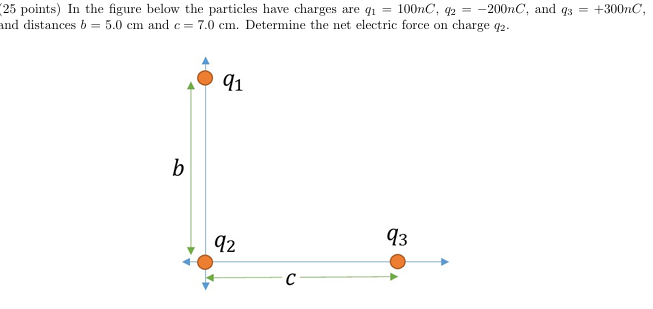 25 points) In the figure below the particles have charges are gq; = 100nC, g2 = —200nC, and g5 = +300nC,
ind distances b — 5.0 cm and ¢ = 7.0 cm, Determine the net electri force on charge gz
oq
v 92 a3
ee
c
This is AI generated Response.
Asked by: Om
Created at: 2026-02-02 06:00:04
Asked by: Om
Created at: 2026-02-02 06:00:04
Final Answer:
Rendered
Raw Text
Did you like this answer?
Let's solve the problem **step by step**.
---
## **Given Data**
- \( q_1 = 100\,\text{nC} = 100 \times 10^{-9}\,\text{C} \)
- \( q_2 = -200\,\text{nC} = -200 \times 10^{-9}\,\text{C} \)
- \( q_3 = +300\,\text{nC} = 300 \times 10^{-9}\,\text{C} \)
- \( b = 5.\,\text{cm} = .050\,\text{m} \)
- \( c = 7.\,\text{cm} = .070\,\text{m} \)
- **Coulomb's Constant:** \( k = \frac{1}{4\pi\epsilon_} = 8.99 \times 10^9\,\text{N}\cdot\text{m}^2/\text{C}^2 \)
We need to find the **net electric force on \( q_2 \)**.
---
## **Step 1: Find Forces Acting on \( q_2 \)**
### **A. Force on \( q_2 \) due to \( q_1 \) (\( \vec{F}_{21} \))**
- Distance between \( q_2 \) and \( q_1 \) is \( b \).
- Direction: \( q_1 \) is above \( q_2 \) (along \( +y \)).
\[
F_{21} = k \frac{|q_2 q_1|}{b^2}
\]
Plug in the values:
\[
F_{21} = 8.99 \times 10^9 \frac{|(-200 \times 10^{-9})(100 \times 10^{-9})|}{(.050)^2}
\]
\[
= 8.99 \times 10^9 \cdot \frac{200 \times 100 \times 10^{-18}}{.0025}
\]
\[
= 8.99 \times 10^9 \cdot \frac{20000 \times 10^{-18}}{.0025}
\]
\[
= 8.99 \times 10^9 \cdot \frac{2 \times 10^{-14}}{.0025}
\]
\[
= 8.99 \times 10^9 \cdot 8 \times 10^{-12}
\]
\[
= 71.92 \times 10^{-3} = .0719\,\text{N}
\]
- Since \( q_2 \) is negative and \( q_1 \) is positive, the force is **attractive** (points **upwards**, \( +y \)).
---
### **B. Force on \( q_2 \) due to \( q_3 \) (\( \vec{F}_{23} \))**
- Distance between \( q_2 \) and \( q_3 \) is \( c \).
- Direction: \( q_3 \) is to the right of \( q_2 \) (along \( +x \)).
\[
F_{23} = k \frac{|q_2 q_3|}{c^2}
\]
\[
= 8.99 \times 10^9 \frac{|(-200 \times 10^{-9})(300 \times 10^{-9})|}{(.070)^2}
\]
\[
= 8.99 \times 10^9 \cdot \frac{200 \times 300 \times 10^{-18}}{.0049}
\]
\[
= 8.99 \times 10^9 \cdot \frac{60000 \times 10^{-18}}{.0049}
\]
\[
= 8.99 \times 10^9 \cdot \frac{6 \times 10^{-14}}{.0049}
\]
\[
= 8.99 \times 10^9 \cdot 1.2245 \times 10^{-11}
\]
\[
\approx .110\,\text{N}
\]
- The force is **attractive** (since \( q_2 \) is negative and \( q_3 \) is positive), so it points **right** (\( +x \)).
---
## **Step 2: Net Force (Vector Addition)**
Both forces are **perpendicular** (\( F_{21} \) along \( +y \), \( F_{23} \) along \( +x \)).
\[
F_{\text{net}} = \sqrt{F_{21}^2 + F_{23}^2}
\]
\[
= \sqrt{(.0719)^2 + (.110)^2}
\]
\[
= \sqrt{.00517 + .0121}
\]
\[
= \sqrt{.01727}
\]
\[
= .131\,\text{N}
\]
---
### **Direction (Angle with Respect to +x Axis)**
\[
\tan\theta = \frac{F_{21}}{F_{23}} = \frac{.0719}{.110} = .654
\]
\[
\theta = \arctan(.654) \approx 33^\circ
\]
---
## **Final Answer**
\[
\boxed{
\text{The net electric force on } q_2 \text{ is } .13\,\text{N} \text{ at } 33^\circ \text{ above the } +x \text{ axis.}
}
\]
---
### **Summary Table**
| Force | Magnitude (N) | Direction |
|------------|---------------|-------------------|
| \( F_{21} \) | .0719 | \( +y \) |
| \( F_{23} \) | .110 | \( +x \) |
| \( F_{\text{net}} \) | .13 | \( 33^\circ \) above \( +x \) |
---
**Let me know if you need a diagram or further clarifications!**
📢 Instructions:
- Ask anything relatd to above question only.
- For new Question goto :