 VIPSolutions
Give step-by-step solution with explanation and final answer:(18 points) In the figure below, what is the net electric field point P due to the four particles? g = 7.14 fC, and {= 6.00 cm? (1 fe = 107% C) -q ay wd a wd rt 2? d »
Question:
Give step-by-step solution with explanation and final answer: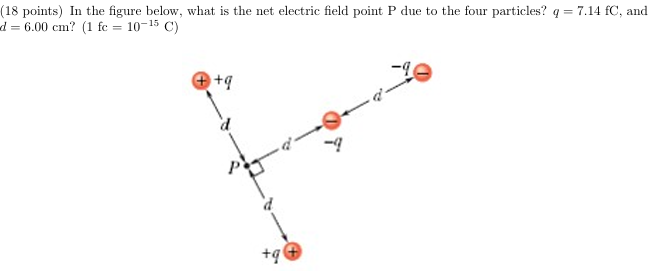 (18 points) In the figure below, what is the net electric field point P due to the four particles? g = 7.14 fC, and
{= 6.00 cm? (1 fe = 107% C)
-q
ay wd
a wd
rt
2?
d
»
This is AI generated Response.
Asked by: Om
Created at: 2026-02-02 05:56:48
Asked by: Om
Created at: 2026-02-02 05:56:48
Final Answer:
Rendered
Raw Text
Did you like this answer?
Let's solve the problem step by step.
---
## **Step 1: Given Data**
- \( q = 7.14 \) fC \( = 7.14 \times 10^{-15} \) C
- \( d = 6.00 \) cm \( = .060 \) m
- 1 fC (femtocoulomb) \( = 10^{-15} \) C
---
## **Step 2: Analyzing the Configuration**
- There are four charges:
- \( +q \) above P (at distance \( d \))
- \( +q \) below P (at distance \( d \))
- \( -q \) to the right of P (distance \( d \)), then another \( -q \) a further distance \( d \) to the right (total \( 2d \) from P)
- The two positive charges are vertically aligned.
- The two negative charges are horizontally aligned (one at \( d \) and one at \( 2d \) to the right of P).
---
## **Step 3: Electric Field Due to Each Charge**
The electric field due to a point charge:
\[
E = \frac{k|q|}{r^2}
\]
where \( k = 8.99 \times 10^9 \) N·m²/C².
### **Directions:**
- Fields from \( +q \) point away from the charge.
- Fields from \( -q \) point toward the charge.
Let's assign axes:
- \( +y \) is up, \( +x \) is right.
---
### **A. Top \( +q \) at (, +d):**
\[
E_{\text{top}} = \frac{kq}{d^2} \quad (\text{downward at P, i.e., in } -\hat{y})
\]
### **B. Bottom \( +q \) at (, -d):**
\[
E_{\text{bottom}} = \frac{kq}{d^2} \quad (\text{upward at P, i.e., in } +\hat{y})
\]
---
### **C. Right \( -q \) at (d, ):**
\[
E_{\text{right}} = \frac{kq}{d^2} \quad (\text{toward the charge, i.e., +\hat{x}})
\]
### **D. Far Right \( -q \) at (2d, ):**
\[
E_{\text{far-right}} = \frac{kq}{(2d)^2} = \frac{kq}{4d^2} \quad (\text{toward the charge, i.e., +\hat{x}})
\]
---
## **Step 4: Net Electric Field Components at P**
### **Y-components:**
- \( +q \) at top: \( E_{\text{top}} \) down (\(-y\))
- \( +q \) at bottom: \( E_{\text{bottom}} \) up (\(+y\))
They are equal in magnitude and opposite in direction:
\[
E_{y, \text{net}} = \frac{kq}{d^2} - \frac{kq}{d^2} =
\]
### **X-components:**
- \( -q \) at right: \( E_{\text{right}} \) right (\(+x\))
- \( -q \) at far right: \( E_{\text{far-right}} \) right (\(+x\))
Sum:
\[
E_{x, \text{net}} = \frac{kq}{d^2} + \frac{kq}{4d^2} = \frac{5kq}{4d^2}
\]
---
## **Step 5: Plug in the Values**
\[
E = \frac{5kq}{4d^2}
\]
Where:
- \( k = 8.99 \times 10^9 \) N·m²/C²
- \( q = 7.14 \times 10^{-15} \) C
- \( d = .060 \) m
Calculate \( d^2 \):
\[
d^2 = (.060)^2 = .0036 \text{ m}^2
\]
Plug in:
\[
E = \frac{5 \times 8.99 \times 10^9 \times 7.14 \times 10^{-15}}{4 \times .0036}
\]
Calculate numerator:
\[
5 \times 8.99 \times 10^9 \times 7.14 \times 10^{-15} =
5 \times 8.99 \times 7.14 \times 10^{-6}
= 5 \times 64.1886 \times 10^{-6}
= 320.943 \times 10^{-6}
= 3.20943 \times 10^{-4}
\]
Calculate denominator:
\[
4 \times .0036 = .0144
\]
Final calculation:
\[
E = \frac{3.20943 \times 10^{-4}}{.0144} = .0223 \text{ N/C}
\]
---
## **Step 6: Final Answer**
### **Net Electric Field at Point P:**
\[
\boxed{.0223 \; \text{N/C} \;\;\text{to the right} \; (+\hat{x})}
\]
---
**Summary Table:**
| Component | Value (N/C) | Direction |
|-----------|-------------|-----------|
| \(E_x\) | .0223 | right |
| \(E_y\) | | — |
| **Total** | **.0223** | **right** |
📢 Instructions:
- Ask anything relatd to above question only.
- For new Question goto :