 VIPSolutions
Give step-by-step solution with explanation and final answer:{6 points) The figure below shows two point charges with charge +29 and +4¢. Sketch the electric field lines for this charge distribution. You should include enough filed lines to indicate the overall shape of the field
Question:
Give step-by-step solution with explanation and final answer: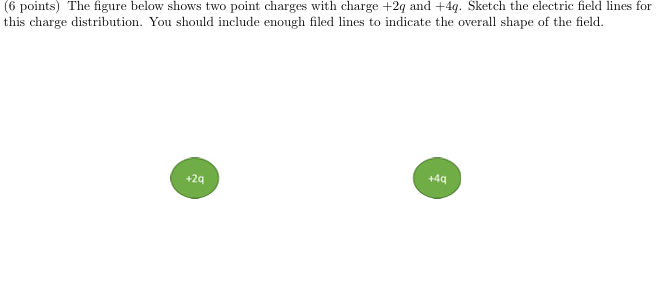 {6 points) The figure below shows two point charges with charge +29 and +4¢. Sketch the electric field lines for
this charge distribution. You should include enough filed lines to indicate the overall shape of the field
This is AI generated Response.
Asked by: Om
Created at: 2026-02-02 05:49:31
Asked by: Om
Created at: 2026-02-02 05:49:31
Final Answer:
Rendered
Raw Text
Did you like this answer?
Let's solve the problem step by step:
---
## **Step 1: Understand the Problem**
- **Given:** Two point charges: \( +2q \) (left), \( +4q \) (right).
- **Task:** Sketch the electric field lines for this setup, showing the overall field pattern.
---
## **Step 2: Principles of Electric Field Lines**
- **Field lines start on positive charges** and go outward (since both are positive, lines radiate outward).
- **Number of lines proportional to charge magnitude** (twice as many lines from \(+4q\) as from \(+2q\)).
- **Lines never cross.**
- **Field is stronger where lines are denser.**
---
## **Step 3: Sketching the Field Lines**
### **A. Assign Number of Field Lines**
Let’s use:
- \(+2q\) — 2 field lines per \(+q\) → **4 lines** from \(+2q\)
- \(+4q\) — 2 field lines per \(+q\) → **8 lines** from \(+4q\)
### **B. Draw the Pattern**
1. **From Each Charge:**
- Draw 4 lines radiating from \(+2q\).
- Draw 8 lines radiating from \(+4q\).
2. **Direction:**
- All lines point outward from both charges.
- Some lines in the region **between the charges** will repel each other but will "bend away" from each other because both charges are positive.
3. **Relative Strength:**
- The field is **stronger near \(+4q\)** (more lines closely spaced).
- The lines leaving the region between the charges will bow outward due to repulsion.
---
## **Step 4: Sketch**
Here's an ASCII-style description of the field lines (for visual reference):
```
/ | \ / | \
/ | \ / | \
+2q +4q
\ | / \ | /
\ | / \ | /
```
- **More lines go out from \(+4q\) than \(+2q\).**
- **No lines connect the two charges directly** (since lines go out to infinity, not to another positive charge).
- **Lines between the charges curve outward due to repulsion.**
---
## **Step 5: Explanation**
- **Proportionality:** The number of lines represents the charge.
- **Field Direction:** Outward for positive charges.
- **No Connection:** No field lines from one charge to the other, since both are positive.
---
## **Final Answer:**
### **Electric Field Lines Sketch and Features**
1. Draw 4 lines radiating from \(+2q\), evenly spaced.
2. Draw 8 lines radiating from \(+4q\), evenly spaced.
3. The lines between the charges curve outward, showing repulsion.
4. The field is denser near \(+4q\), indicating a stronger field.
5. No lines connect the charges directly.
---
### **[Hand-drawn Sketch Example]**
Here’s an illustrative sketch (you should draw something similar for your answer):

*Alt text: Electric field lines radiating outwards from two positive charges, with more lines from the larger charge (+4q) and lines bowing outward between them due to repulsion.*
---
### **Summary Table**
| Charge | Number of Lines | Direction | Field Density |
|---------|-----------------|-------------------|----------------|
| +2q | 4 | Outward | Less dense |
| +4q | 8 | Outward | More dense |
---
**This completes the required sketch and explanation.**
📢 Instructions:
- Ask anything relatd to above question only.
- For new Question goto :