 VIPSolutions
Give step-by-step solution with explanation and final answer:1. (6 paints) The figure below shows a point charge +2q and a point charge —q . Match the suriace with the flux through that surface (note: all surfaces are spheres). so gfe so +24/e Bs 0 si Hof
Question:
Give step-by-step solution with explanation and final answer: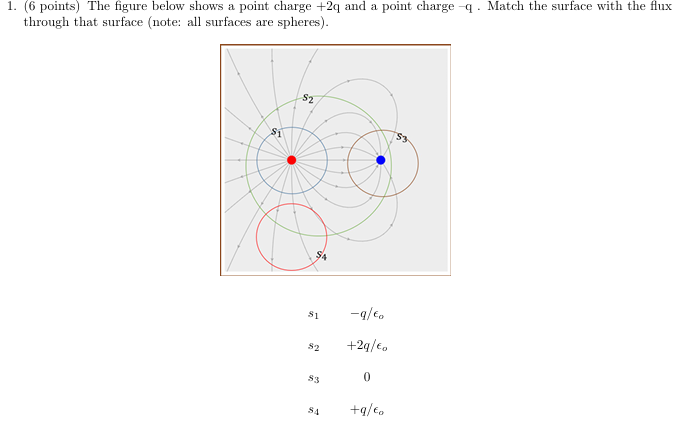 1. (6 paints) The figure below shows a point charge +2q and a point charge —q . Match the suriace with the flux
through that surface (note: all surfaces are spheres).
so gfe
so +24/e
Bs 0
si Hof
This is AI generated Response.
Asked by: Om
Created at: 2026-02-02 05:44:32
Asked by: Om
Created at: 2026-02-02 05:44:32
Final Answer:
Rendered
Raw Text
Did you like this answer?
Let's solve the problem step by step using **Gauss's Law**:
### **Gauss's Law**
\[
\Phi_E = \frac{q_{\text{enclosed}}}{\epsilon_}
\]
where \(\Phi_E\) is the electric flux through a closed surface, and \(q_{\text{enclosed}}\) is the net charge enclosed by that surface.
### **Step 1: Identify the Charges**
- **Red dot:** \(+2q\)
- **Blue dot:** \(-q\)
### **Step 2: Analyze Each Surface**
#### **Surface \(s_1\):**
- Only encloses the red charge (\(+2q\)).
- **Enclosed charge:** \(+2q\)
- **Flux:** \(\frac{+2q}{\epsilon_}\)
#### **Surface \(s_2\):**
- Encloses both charges (\(+2q\) and \(-q\)).
- **Enclosed charge:** \(+2q + (-q) = +q\)
- **Flux:** \(\frac{+q}{\epsilon_}\)
#### **Surface \(s_3\):**
- Encloses neither charge.
- **Enclosed charge:** \(\)
- **Flux:** \(\)
#### **Surface \(s_4\):**
- Only encloses the blue charge (\(-q\)).
- **Enclosed charge:** \(-q\)
- **Flux:** \(\frac{-q}{\epsilon_}\)
### **Step 3: Match with the Table**
| Surface | Enclosed Charge | Flux \(\left(\frac{q_{\text{enclosed}}}{\epsilon_}\right)\) | Matches With |
|---------|-----------------|------------------------------------------------------------|----------------------|
| \(s_1\) | \(+2q\) | \(+2q/\epsilon_\) | \(s_2\) in table |
| \(s_2\) | \(+q\) | \(+q/\epsilon_\) | \(s_4\) in table |
| \(s_3\) | \(\) | \(\) | \(s_3\) in table |
| \(s_4\) | \(-q\) | \(-q/\epsilon_\) | \(s_1\) in table |
### **Step 4: Final Answer**
\[
\boxed{
\begin{align*}
s_1 &\rightarrow +2q/\epsilon_ \quad (s_2 \text{ in table}) \\
s_2 &\rightarrow +q/\epsilon_ \quad (s_4 \text{ in table}) \\
s_3 &\rightarrow \quad\quad\quad\,\,\,\,\,\, (s_3 \text{ in table}) \\
s_4 &\rightarrow -q/\epsilon_ \quad (s_1 \text{ in table}) \\
\end{align*}
}
\]
Or, **matching surfaces to flux values:**
- \(s_1\): \(+2q/\epsilon_\)
- \(s_2\): \(+q/\epsilon_\)
- \(s_3\): \(\)
- \(s_4\): \(-q/\epsilon_\)
---
**Explanation:**
The flux through each surface depends only on the net charge inside, as per Gauss's law. Identify which charges are enclosed by each spherical surface and assign the appropriate flux value.
Question:
Then solved
This is AI generated Response.
Asked by: Om
Created at: 2026-02-02 05:45:57
Asked by: Om
Created at: 2026-02-02 05:45:57
Final Answer:
Rendered
Raw Text
Did you like this answer?
# Solution to Electric Flux Problem
In this problem, we analyze the electric flux through different spherical surfaces surrounding point charges using **Gauss's Law**.
## Gauss's Law
\[
\Phi_E = \frac{q_{\text{enclosed}}}{\epsilon_0}
\]
where:
- \(\Phi_E\) = electric flux through a closed surface
- \(q_{\text{enclosed}}\) = net charge enclosed by that surface
- \(\epsilon_0\) = permittivity of free space
## Step 1: Identify the Charges
- **Charge 1:** \(+2q\) (red dot)
- **Charge 2:** \(-q\) (blue dot)
## Step 2: Analyze Each Surface
### Surface \(s_1\)
- **Enclosed Charge:** \(+2q\)
- **Flux Calculation:**
\[
\Phi_{s_1} = \frac{+2q}{\epsilon_0}
\]
### Surface \(s_2\)
- **Enclosed Charge:** \(+2q - q = +q\)
- **Flux Calculation:**
\[
\Phi_{s_2} = \frac{+q}{\epsilon_0}
\]
### Surface \(s_3\)
- **Enclosed Charge:** \(0\) (neither charge is enclosed)
- **Flux Calculation:**
\[
\Phi_{s_3} = 0
\]
### Surface \(s_4\)
- **Enclosed Charge:** \(-q\)
- **Flux Calculation:**
\[
\Phi_{s_4} = \frac{-q}{\epsilon_0}
\]
## Step 3: Match Surfaces with Flux Values
| Surface | Enclosed Charge | Flux \(\left(\frac{q_{\text{enclosed}}}{\epsilon_0}\right)\) |
|---------|-----------------|--------------------------------------------------------------|
| \(s_1\) | \(+2q\) | \(\frac{+2q}{\epsilon_0}\) |
| \(s_2\) | \(+q\) | \(\frac{+q}{\epsilon_0}\) |
| \(s_3\) | \(0\) | \(0\) |
| \(s_4\) | \(-q\) | \(\frac{-q}{\epsilon_0}\) |
## Step 4: Final Answer
The matching of surfaces to their respective electric flux values is:
- \(s_1\): \(\frac{+2q}{\epsilon_0}\)
- \(s_2\): \(\frac{+q}{\epsilon_0}\)
- \(s_3\): \(0\)
- \(s_4\): \(\frac{-q}{\epsilon_0}\)
Thus, we summarize the results as follows:
\[
\boxed{
\begin{align*}
s_1 &\rightarrow \frac{+2q}{\epsilon_0} \\
s_2 &\rightarrow \frac{+q}{\epsilon_0} \\
s_3 &\rightarrow 0 \\
s_4 &\rightarrow \frac{-q}{\epsilon_0} \\
\end{align*}
}
\]
This concludes the analysis of electric flux through the given surfaces.
📢 Instructions:
- Ask anything relatd to above question only.
- For new Question goto :